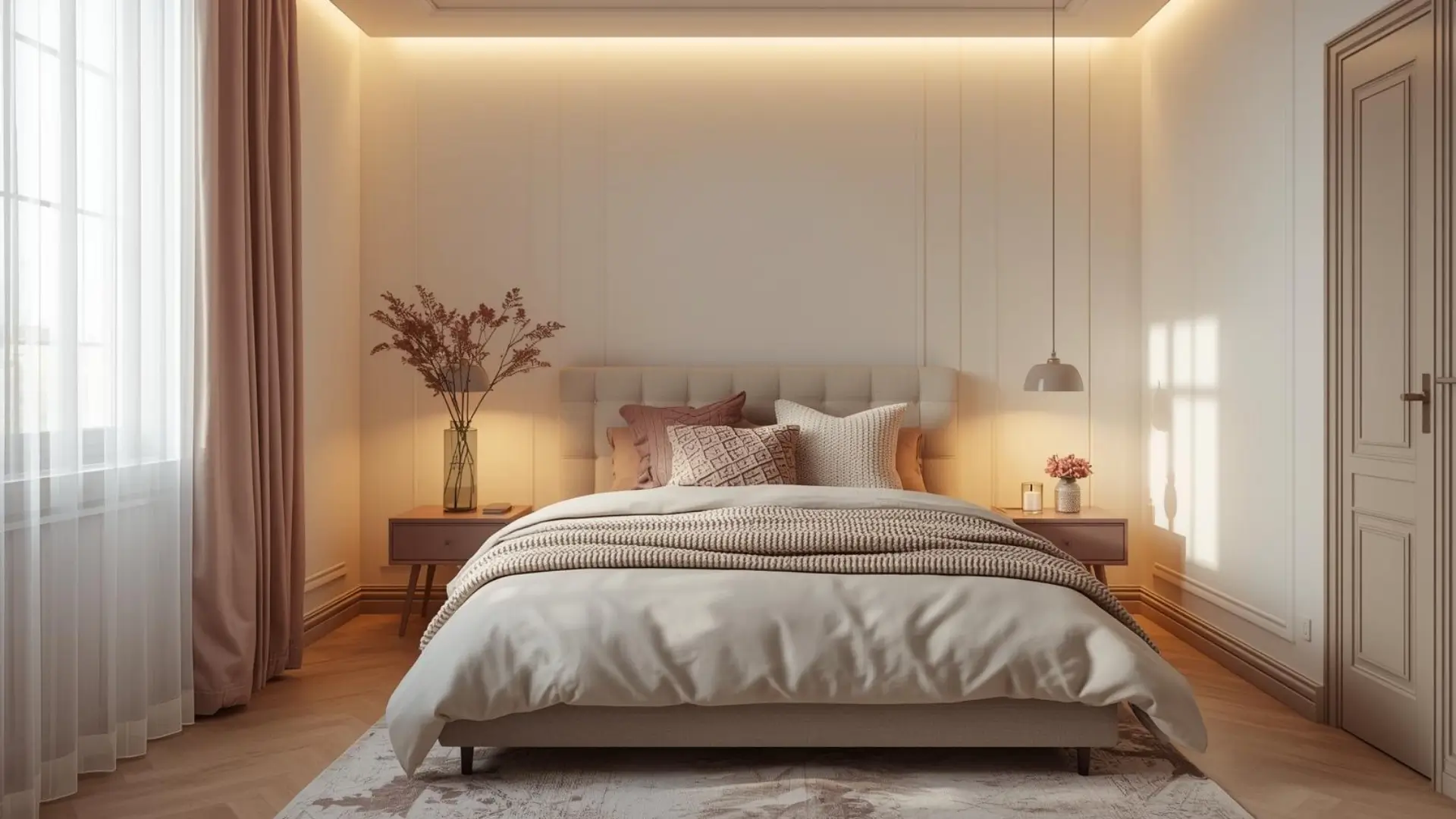


Cozy aesthetic bedrooms for small apartments
There's something quietly transformative about stepping into a bedroom that feels like a soft exhale. Not the sprawling, Pinterest-perfect suites with endless square footage and custom millwork, but the real thing: a small, rented space that somehow manages to feel warm, intentional, and deeply yours.
If you're reading this from a compact flat where the bedroom doubles as your sanctuary, your workspace, and possibly your yoga studio, you already know the challenge. The lighting is harsh. The walls are magnolia (again). The carpet is... fine. And yet, you want something more than fine. You want a room that wraps itself around you at the end of the day, that feels feminine and calm without trying too hard, that looks considered even when it costs less than your monthly coffee budget.
When we talk about a cozy aesthetic bedroom, we're not talking about clutter or chaos dressed up as "lived-in charm". We mean a space that feels soft and inviting, where textures layer thoughtfully, where light pools rather than glares, where every element serves a purpose even if that purpose is simply to make you feel more like yourself. It's the opposite of stark minimalism, but it's also not maximalism in disguise. It sits somewhere in between: warm, considered, quietly abundant.
In this section, you'll learn how to create that feeling in a small apartment bedroom, even when you can't touch the walls, even when your budget is modest, even when your bedroom is technically just a corner of your studio with good intentions. We'll walk through the emotional foundation, then into the practical details: lighting that transforms simple furniture, textiles that add richness without visual noise, layout strategies for awkward spaces, soft colour palettes that work when magnolia isn't going anywhere, and styling touches that make a room feel finished rather than staged.
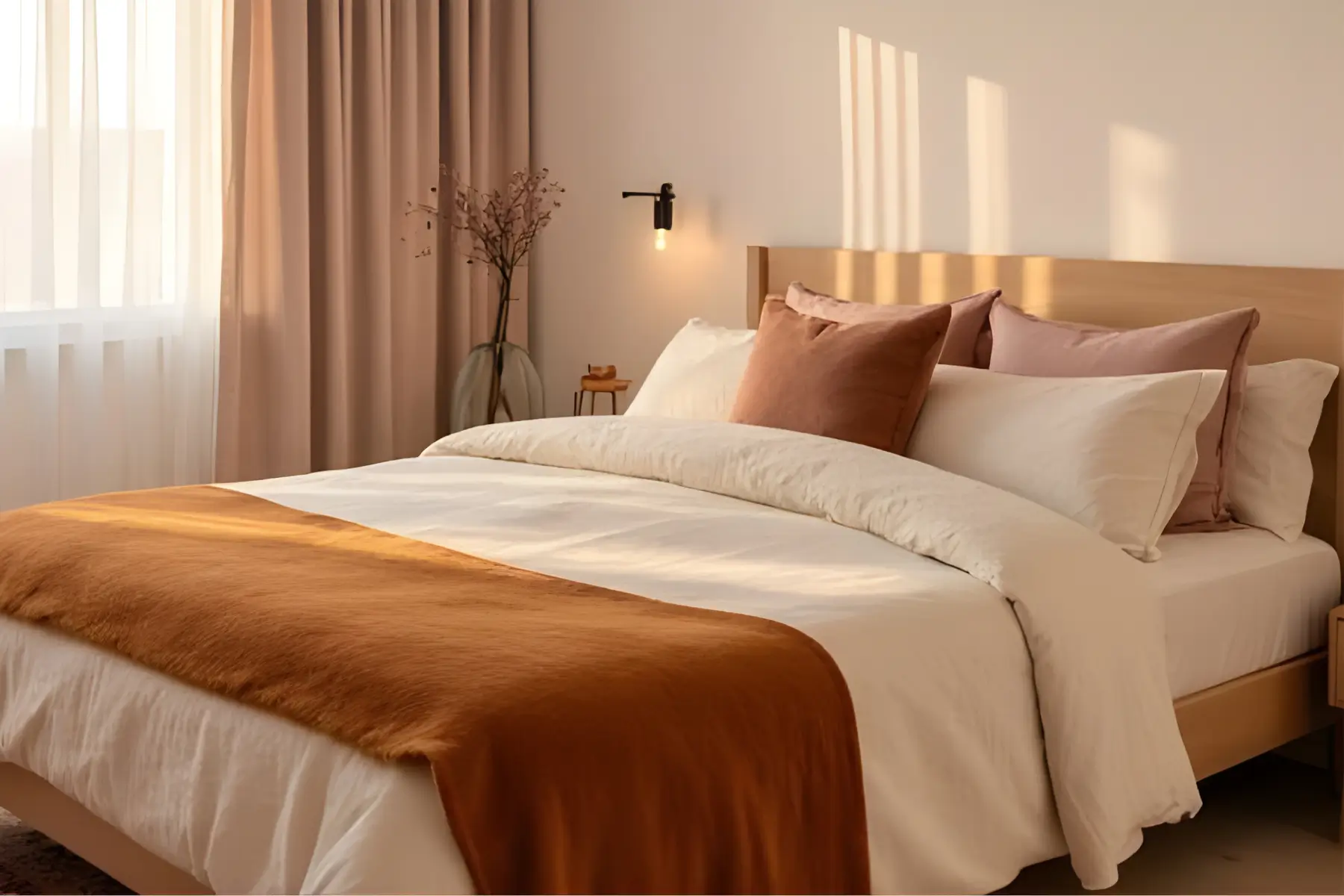
COZY OVERVIEW
Small, cozy bedroom in a real apartment with warm lighting, layered bedding and soft neutral tones, aspirational but achievable rather than a luxury suite.
Start with the feeling, not the furniture
Before you think about what to buy or where to position the bed, spend a few minutes defining how you want this space to feel. This isn't an aesthetic exercise for its own sake, it's the most practical thing you can do. When you know the emotional brief, every subsequent decision becomes simpler because you have something to measure it against.
Ask yourself: when you walk into this room at the end of a long day, what do you want to feel? Calm and grounded? Romantic and soft? Quietly energised? Safe and cocooned? There's no wrong answer, but there is your answer, and it will guide everything else.
Here are three cozy bedroom archetypes to help you narrow in.
The Soft Neutral Cocoon
Think warm whites, oatmeal linens, ivory walls or ivory-toned textiles if the walls aren't cooperating, natural wood tones and plenty of texture. The light is always soft, never sharp. The mood is serene, uncluttered, quietly luxurious.
The Warm Rosy Glow
This room leans into blush tones, soft terracottas, dusty pinks, warm taupes and creamy whites. The lighting has a golden cast. It feels feminine without being saccharine, warm without being heavy, like the last hour of daylight in late summer.
The Darker, Candlelit Snug Corner
A darker, moodier refuge that leans into the intimacy of a small room: deep charcoal bedding, navy accents, warm brass hardware, low ambient lighting and plenty of texture. It feels like a private members club at midnight.
Once you have a mood, create a simple visual reference, a Pinterest board, a folder of saved images or a few paint swatches and fabric samples. The goal is to have something tangible you can return to when you are deciding between options.
Cozy lighting that makes even simple furniture look expensive
If there is one single change that will transform your bedroom from functional to cozy, it is this: replace overhead lighting with layered, warm, ambient light. Nothing kills a cozy bedroom faster than a single ceiling fixture with a blue-white bulb.
The framework is simple: layer your light. You want at least three sources working together: ambient, task and accent.
Ambient light
This is your primary light source, the one that fills the room with a soft, general glow. Avoid bare overhead bulbs. Think instead of a large floor lamp with a fabric shade or a ceiling pendant with a pleated linen shade on a dimmer.
Task light
Task light is for reading, getting dressed or working if your bedroom doubles as an office. Bedside lamps with fabric shades are worth investing in. Position them so the bottom of the shade sits roughly at eye level when you are lying in bed to avoid glare.
Accent light
Accent light adds warmth and atmosphere without needing to be strictly functional. A small LED candle on a shelf, a string of warm fairy lights or a single wall sconce above art all create a layered, lived-in glow.
When you choose bulbs, opt for a warm colour temperature. Look for 2700K or 3000K, the range that mimics candlelight. Anything cooler will start to feel clinical, especially in a small bedroom.
For renters, plug-in solutions make this easy: dimmer modules that sit between the lamp and the socket, floor lamps instead of fixed ceiling lights and plug-in wall sconces that give a built-in look without any electrical work.
What to avoid: cold, blue-white bulbs, single bare ceiling lights, downlighters and spotlights that flatten the room. They make even beautiful bedding look harsh and clinical rather than soft and inviting.
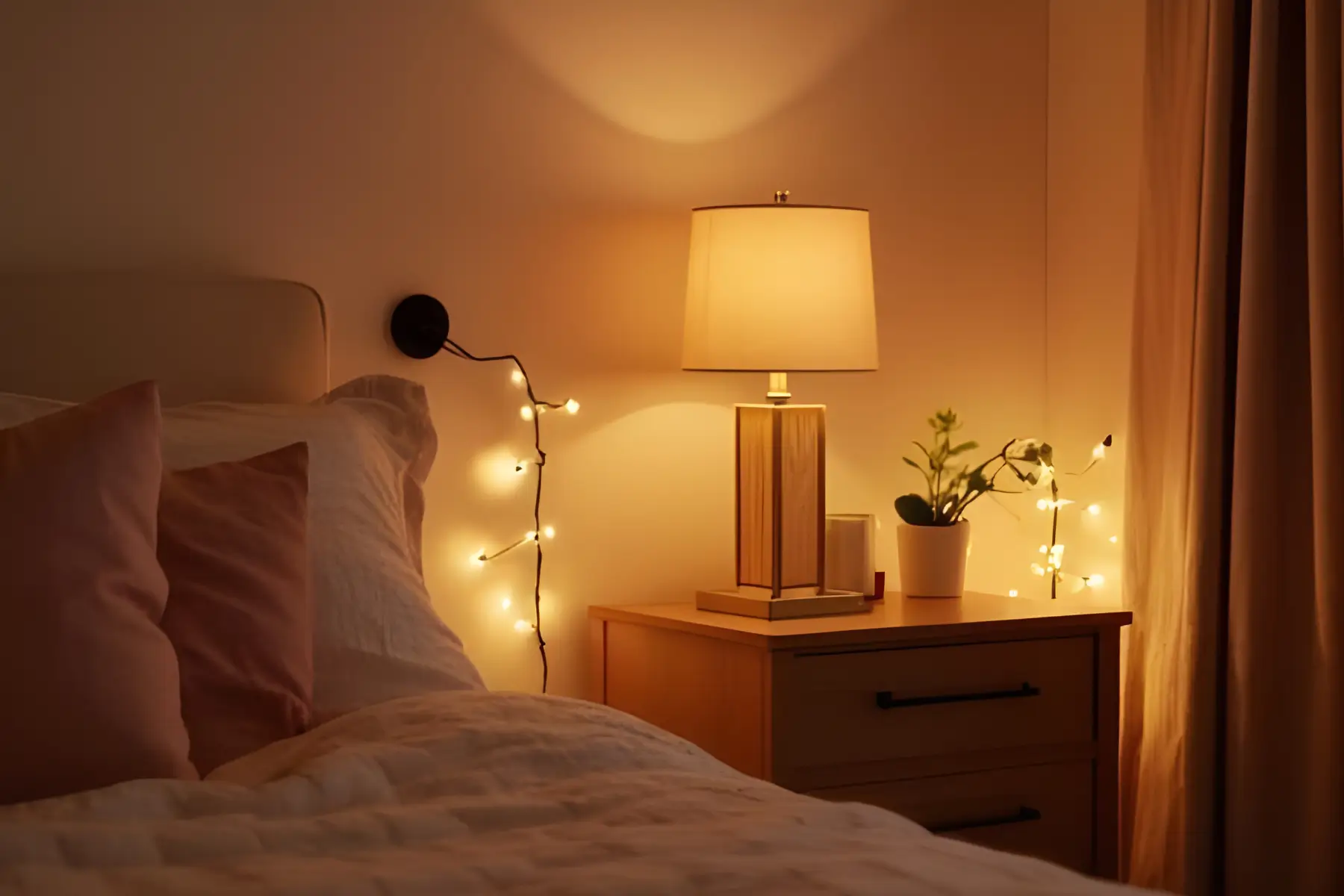
LAYERED LIGHTING
Layered lighting in a small bedroom, linen bedside lamp, warm string lights and textured bedding showing depth and warmth.
Textiles and layers, the fastest way to make a room feel cozy
If lighting is the most transformative change, textiles are the fastest. A room with beautiful light but no softness will still feel austere. Layers of fabric, bedding, throws, cushions, rugs and curtains immediately make a space feel more welcoming.
The secret is texture and intentional layering, not just piling on more stuff.
Start with the bed
Your bed is the visual anchor of the room, so this is where you should concentrate your textile budget. A cozy bed usually includes a natural fibre duvet, at least two layers of pillows and a throw at the foot of the bed in a contrasting texture.
If your budget is tight, prioritise the duvet cover and one really good throw. A beautiful linen duvet in oatmeal or soft white with a chunky knit throw in camel or rust will elevate the whole room.
Mixing textures
The reason a well styled bed looks expensive has less to do with thread count and more with contrast. Mix smooth and nubby, matte and slightly lustrous, tight weave and loose weave, for example crisp linen, cotton velvet, chunky knit and a boucle accent cushion.
Rugs and windows
If your flooring is letting the room down, a medium-sized rug beside the bed or a runner along one side adds warmth and visually anchors the space. Look for natural fibres and simple tonal patterns that will not fight with your bedding.
Curtains in a light, natural fabric soften harsh windows and help control light. Hang them as high as possible to create the illusion of height and choose warm whites or soft neutrals that blend rather than contrast sharply with the walls.

TEXTILE LAYERS
Close up of a bed corner with layered textiles, linen duvet in a warm neutral, textured throw and mixed cushion textures beside a natural wood bedside table.
Small apartment bedroom layout ideas that actually work in real rentals
There's a big difference between bedroom layouts that look good in moodboards and layouts that work in an 11 m² rental with one window, one radiator and doors in the worst possible place.
Most advice for small bedrooms leans on decluttering or buying better storage. Helpful, but incomplete. If the layout itself is working against you, no amount of tidying will make the room feel calm. A bed shoved into a corner, a wardrobe blocking the light, a room that feels cramped no matter how much you organise – these are layout problems first, storage problems second.
Good layout is not about having more space. It is about using the space you have in a way that feels intentional, calm and functional. In small rentals, changing nothing but furniture placement – no renovation, no new pieces – can turn a bedroom from a chaotic storage zone into an actual sanctuary.
This section walks you through the whole process: how to assess your room, which layout principles matter most in small spaces and four concrete layout recipes you can adapt to your own bedroom. These are real layouts for real constraints: narrow rooms, awkward windows, radiators you cannot move and bedrooms that double as offices.
Why layout matters more than square footage
A small bedroom can feel spacious if the layout is right. A large bedroom can feel suffocating if it is wrong. The difference comes down to three things: visual flow, physical pathways and proportion.
In a well laid out small bedroom, your eye moves smoothly around the space. There is a clear path from the door to the bed. The furniture feels balanced rather than crammed into every corner and you can see enough floor for the room to breathe.
When the layout is wrong, you feel it immediately. You enter and it is like navigating an obstacle course. The bed blocks the window, the wardrobe looms as soon as you open the door, there is no visual breathing room. Even if the room is tidy, it feels cluttered because the furniture itself is creating noise.
In a small apartment bedroom, layout is the foundation. Everything else – colour palette, textiles, lighting – works better once the layout is right. No amount of beautiful bedding will fix a room where the bed is in the wrong place.
Step 1, understand your room before you move anything
Before you touch a single piece of furniture, you need to understand the room you are working with. Most people skip this and go straight to "where should the bed go?", which means guessing instead of working with the real constraints and opportunities of the space.
Map the fixed elements
Start by mapping everything in the room that cannot be moved:
- Doors: Where do they open, inward or outward, and how much clearance do they need?
- Windows: Where are they, how large are they and do they open inward?
- Radiators: Note their position and keep at least 15–20 cm clearance in front.
- Built in storage: Wardrobes or fixed shelving you must work around.
- Electrical outlets: These dictate where lamps and other electrical pieces can realistically live.
- Awkward features: Sloped ceilings, alcoves, chimney breasts, odd corners.
A quick sketch on paper is enough. Draw the room roughly to scale, mark the fixed elements and measure the length and width of both the room and the main pieces, especially the bed and wardrobe. Ten minutes here saves hours of dragging furniture only to discover it does not fit.
Identify the natural focal point
Most bedrooms have a natural focal point: usually the largest wall or the wall opposite the door. In a good layout, the bed sits against or near this wall, because it is the main function and the largest piece in the room.
In many small rentals, the focal point becomes clear once you map the fixed elements – it is the wall that is not interrupted by a door, window or radiator. If the room truly has no obvious focal point (for example a perfect square with multiple windows), you will create one through bed placement.
Note the traffic flow
Think about how you move through the room in a normal day: from the door to the bed, bed to wardrobe, bed to window. These are your main pathways and they must stay clear.
A common small bedroom mistake is blocking these routes with furniture so you have to squeeze past the bed or slide around a wardrobe. Good layout preserves clear pathways, ideally at least 60–70 cm wide, between the door and key areas.
Step 2, small bedroom layout principles that keep rooms calm
Once you understand your room, you need a framework for making decisions. These principles apply to almost every small bedroom, regardless of configuration.
Principle 1, anchor the room with the bed
The bed is the largest and most important piece. It should anchor the space, not float awkwardly or squeeze into a leftover corner. In most small bedrooms the bed works best against a wall – often the longest wall, the wall opposite the door or centred under a suitable window.
Floating the bed in the middle of a small room almost never works. It eats up floor space and makes the room feel fragmented.
Principle 2, create clear sightlines
When you open the bedroom door, you want to see the bed (or at least part of it) and an uncluttered view, not the side of a wardrobe or a stack of boxes. Clear sightlines make small rooms feel larger because your eye can travel.
Avoid placing tall, bulky pieces directly opposite the door or dominating the first view as you step in. If you have no choice because of built ins, keep those fronts visually calm and tidy.
Principle 3, balance the furniture placement
Small bedrooms feel best when furniture is distributed rather than piled on one side. If all your storage is on the left wall and the right side is empty, the room feels lopsided. Aim for balanced visual weight instead of perfect symmetry.
Principle 4, preserve floor space wherever possible
Visible floor space is your friend. Low profile beds and leggy furniture keep the room feeling open, whereas chunky pieces that sit heavy on the floor make it feel crowded. Rugs work beautifully when they define the bed zone without covering the entire floor.
Principle 5, limit the number of pieces
PULLQUOTE
In a small bedroom, every extra piece of furniture is a decision: is this worth the space it takes from my calm?
Be ruthless about what actually needs to be in the bedroom. Most small bedrooms work best with a bed, one or two bedside tables, one main storage piece and possibly a small desk. Every extra item reduces openness and calm.
Layout recipes for real small bedrooms
Here are four specific layouts that work in real small apartment bedrooms. Use them as starting points – your room will not match exactly, but one will be close enough to adapt.
Layout 1, long narrow bedroom with one window
The challenge: narrow bedrooms feel like corridors. Placing furniture along both long walls exaggerates that feeling.
The solution: embrace the length. Position the bed against one long wall, closer to the window end than the door end, and keep a clear pathway along the opposite side.
Specific layout:
- Bed: against the long wall in the upper two thirds of the room, ideally centred if space allows.
- Bedside tables: one on each side if the bed is centred or a single table on the door side if space is tight.
- Storage: a narrow dresser near the door on the opposite wall, 40–50 cm deep at most.
- Rug: rectangular, under the front half of the bed and extending slightly beyond the sides.
Why it works: you get a clear pathway, the window remains a source of light rather than being blocked and the bed anchors the room instead of turning it into a corridor.
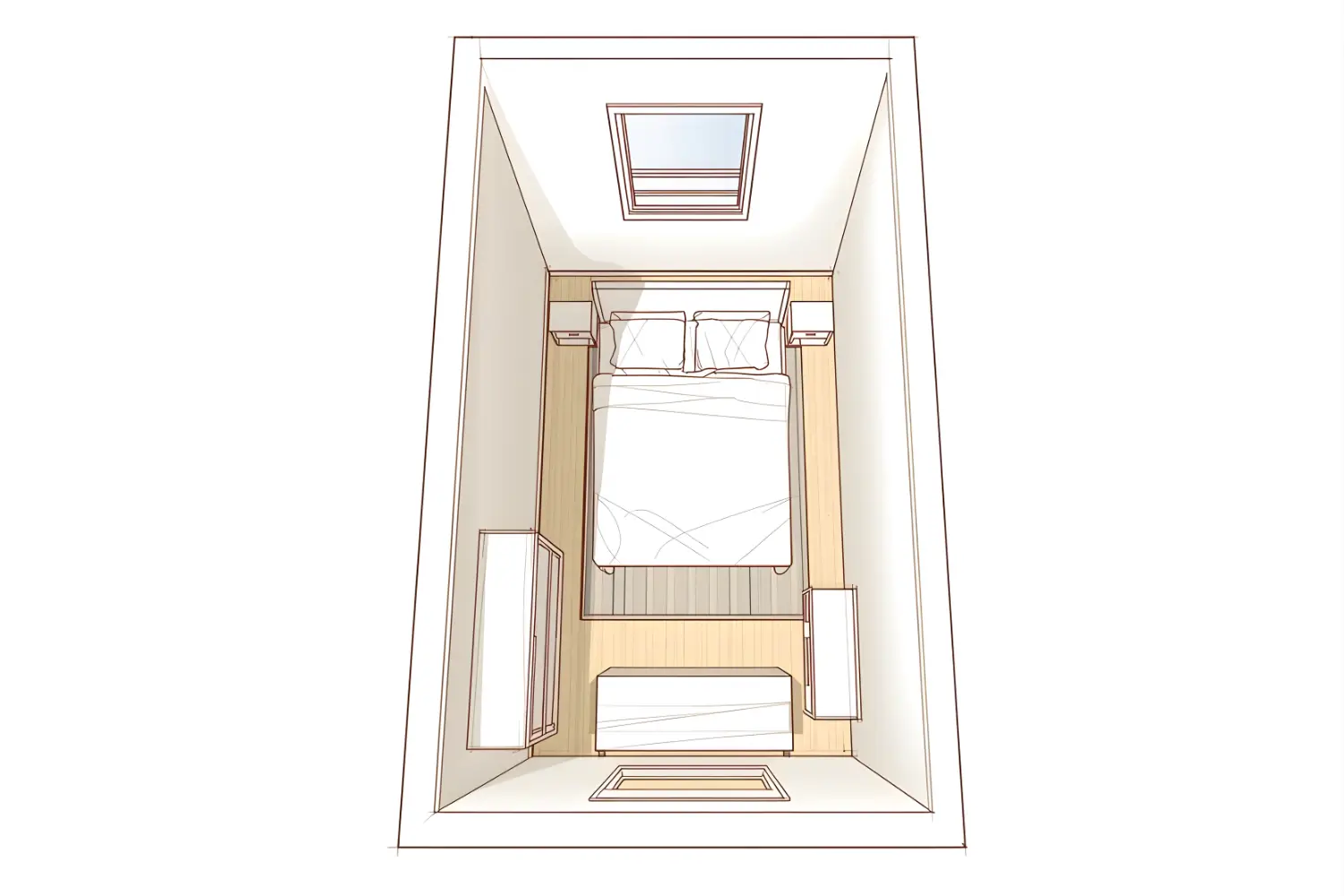
LAYOUT 1 OVERHEAD
Overhead plan of a long, narrow bedroom where the bed placement creates a clear walkway and defines the space without crowding.
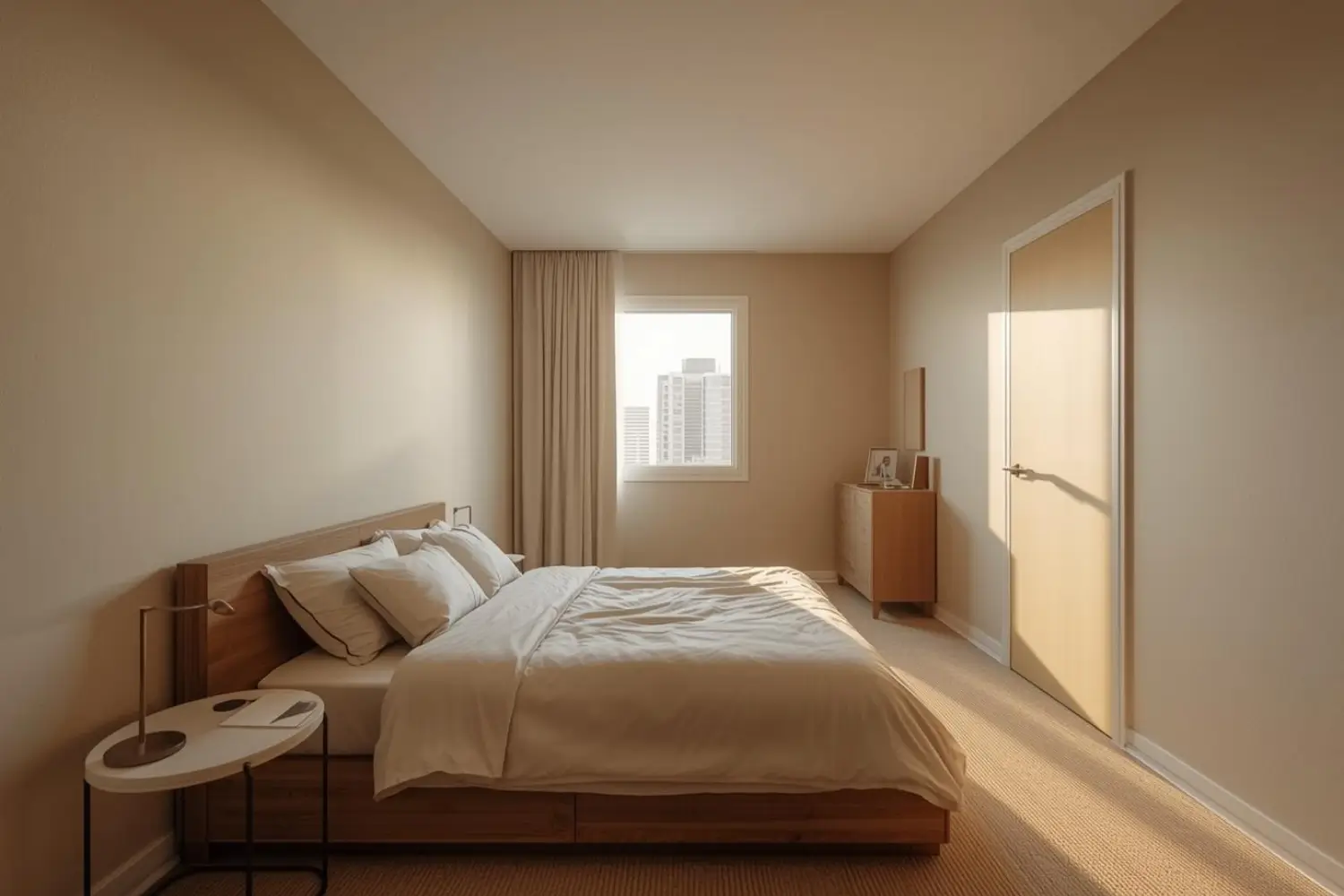
LAYOUT 1 IN REAL LIFE
Real narrow bedroom following Layout 1, with a low bed on the long wall, slim bedside tables, a narrow dresser and warm, softly feminine styling.
Layout 2, small square bedroom with the window behind the bed
The challenge: square rooms offer flexibility but a window behind the bed can feel like an obstacle.
The solution: if the window is wide and low, centre the bed beneath it. If it is small or very high, move the bed to an adjacent wall and keep the window clear for light.
Specific layout, bed under window:
- Bed: centred under the window with 10–15 cm clearance below the sill.
- Bedside tables: one on each side, no taller than the mattress height.
- Storage: wardrobe or tall dresser on a side wall, positioned so it does not block the door or dominate the first view into the room.
- Desk (if needed): on the wall opposite the bed or on a free side wall.
Alternative: if the window is small or awkward, place the bed on the wall opposite the door instead, letting the window stay unobstructed for light and views.
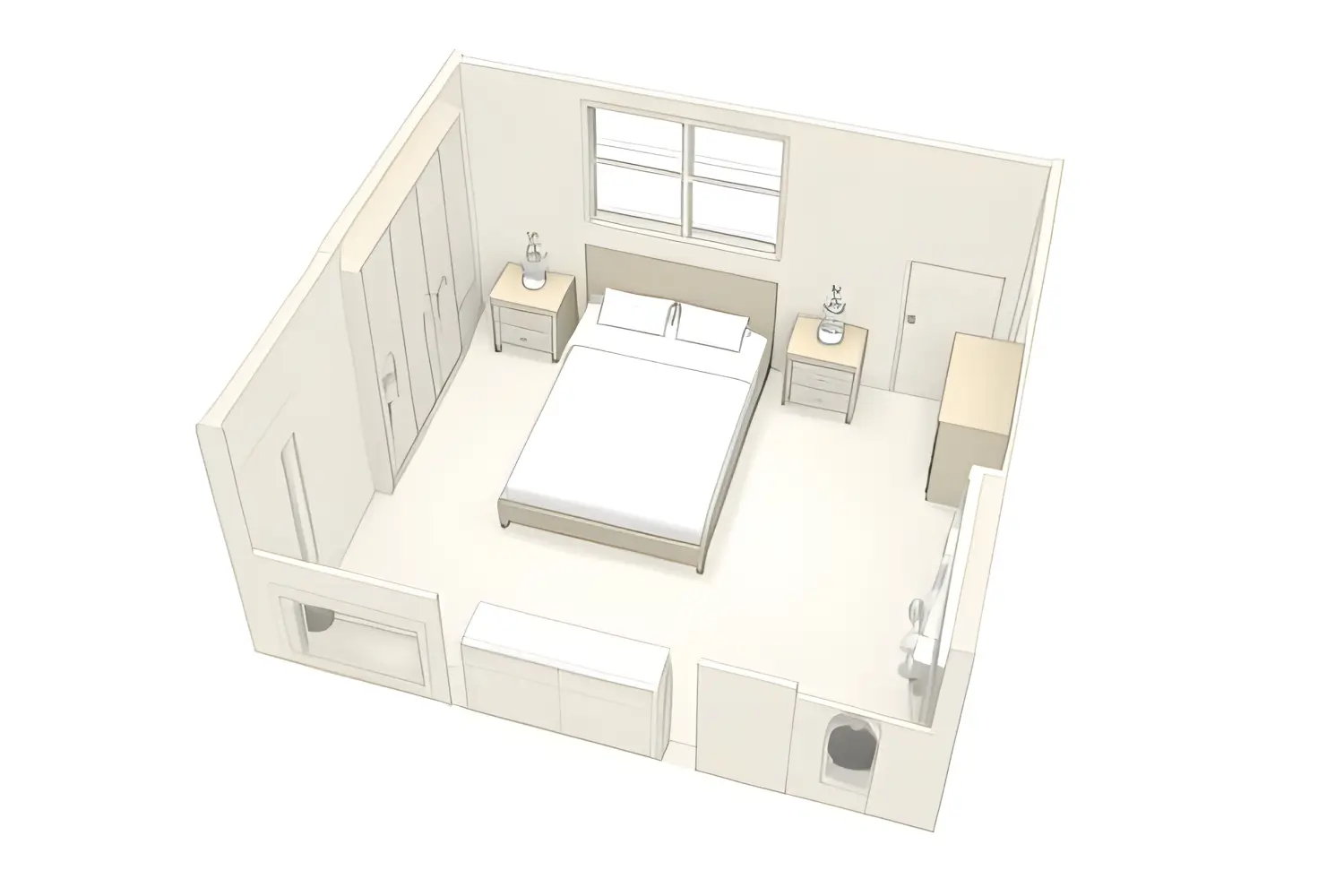
LAYOUT 2 OVERHEAD
Overhead plan of a small square bedroom with the bed under the window, balanced bedside tables and storage placed on the side walls.
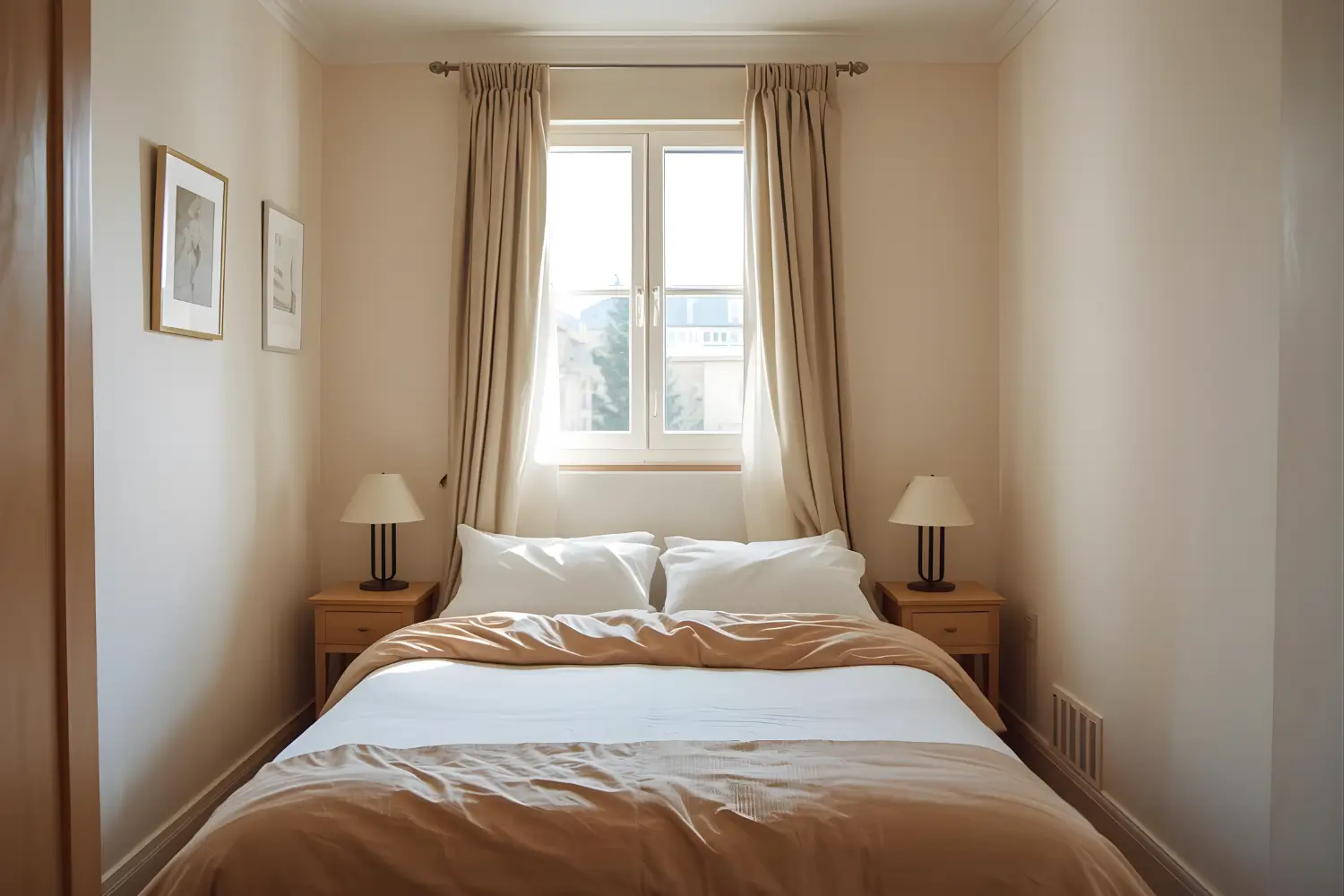
LAYOUT 2 IN REAL LIFE
Real small square bedroom with the bed under the window, matching bedsides, soft bedding and compact storage that fits the proportions.
Layout 3, small bedroom that doubles as a home office
The challenge: the room needs to function as both a place to sleep and a place to work without feeling like an office with a bed in it.
The solution: create two zones. Position the bed and desk as far apart as possible, ideally on opposite walls or in opposite corners, and use rugs and lighting to reinforce the separation.
- Bed: against the wall opposite the door or on the longest wall to form the sleep zone.
- Desk: on a different wall, facing away from the bed so you do not stare at it while working.
- Divide the zones: rug under the bed, bare floor or a different smaller rug near the desk.
- Storage: keep work items near the desk and clothes storage near the bed so each zone has its own purpose.
What to avoid: a desk at the foot of the bed or directly beside it. You should not be looking at your laptop from your pillow.
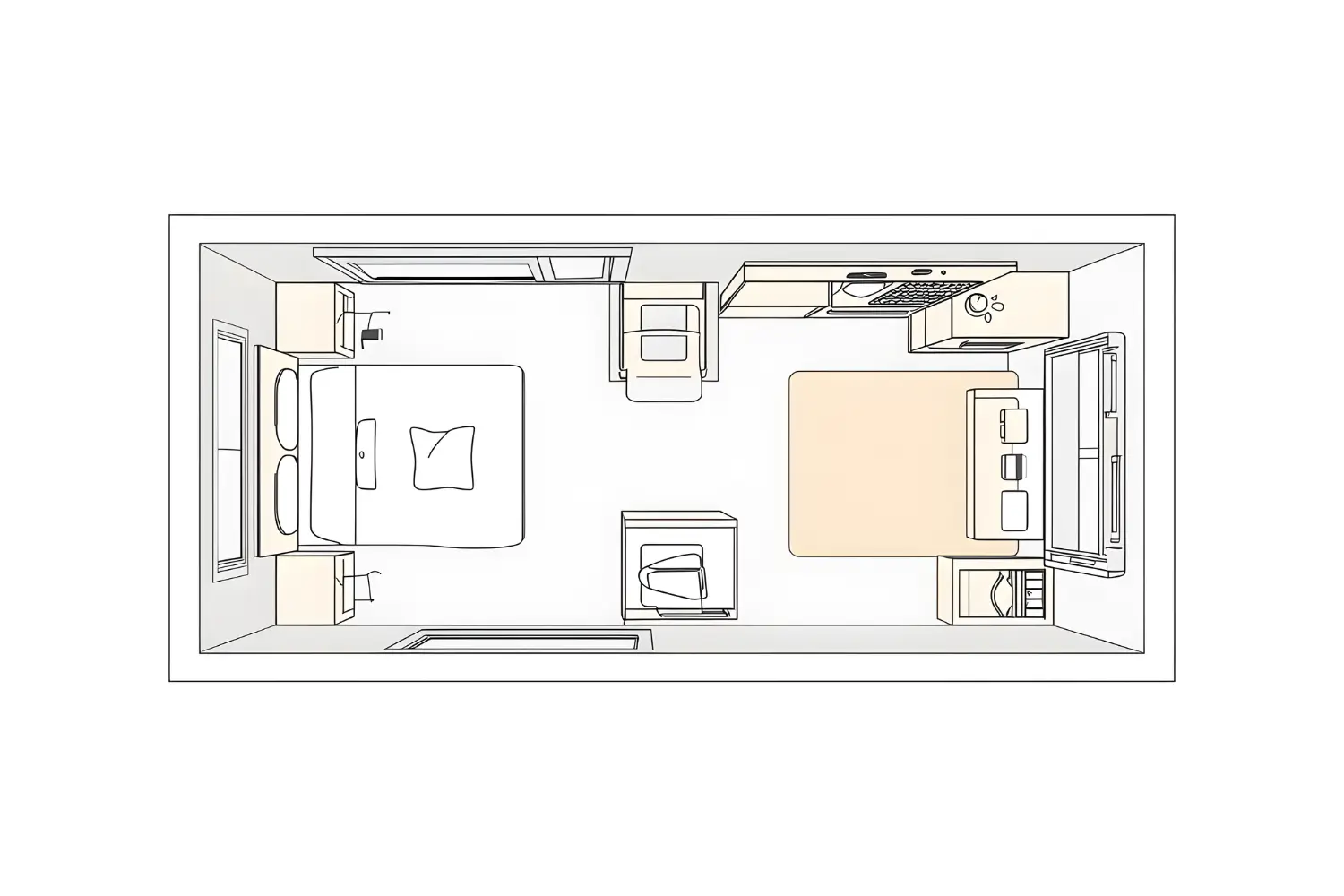
LAYOUT 3 OVERHEAD
Overhead plan of a small bedroom with a defined sleep zone and a separate desk zone on the opposite wall.
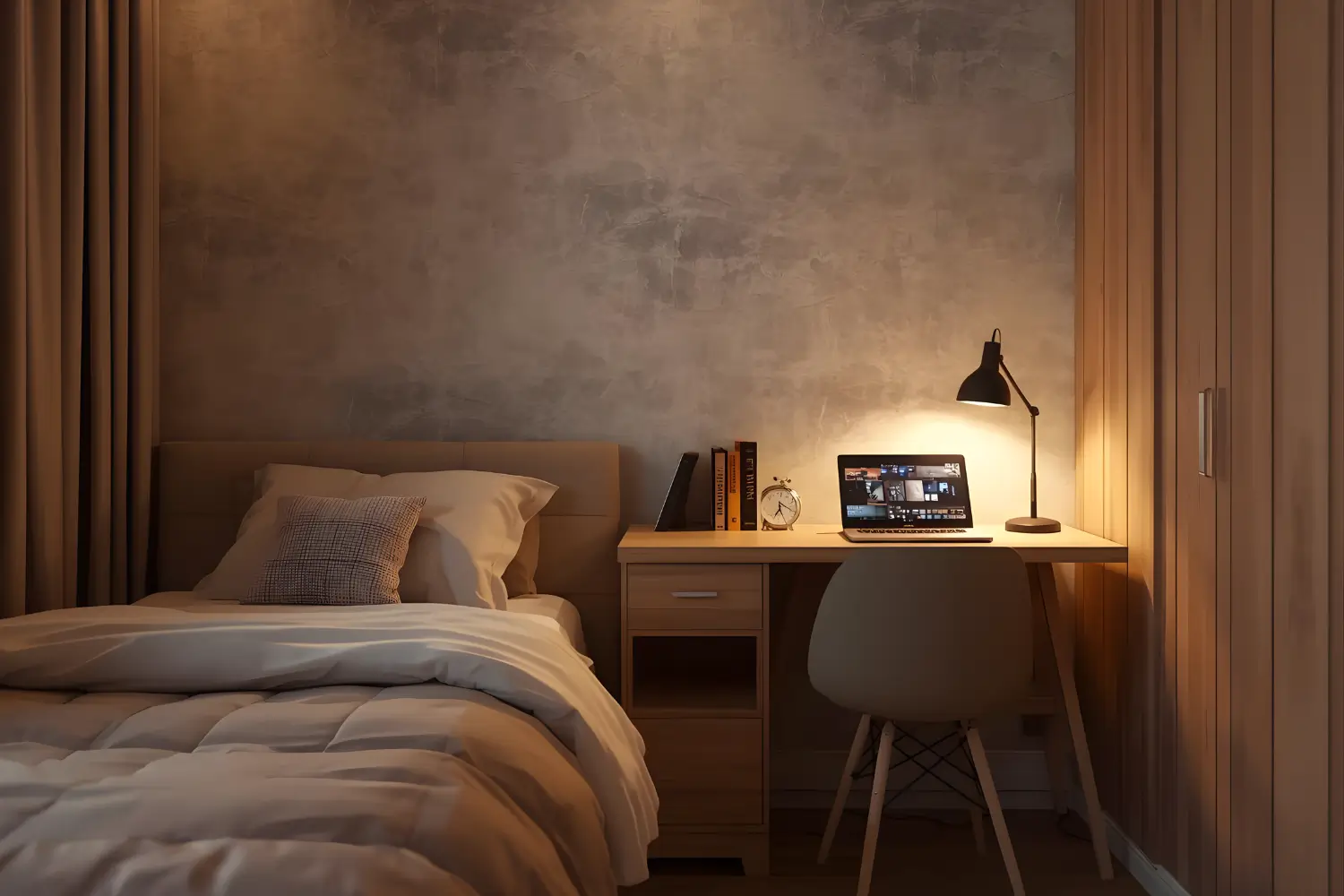
LAYOUT 3 IN REAL LIFE
Real small bedroom and home office in one, with a calm bed zone and a compact desk setup kept visually separate.
Layout 4, tiny bedroom corner in a studio apartment
The challenge: in a studio there is no separate bedroom, just a sleeping area carved out of one open space.
The solution: treat the bed area as a room within a room, using furniture, rugs and lighting to create boundaries.
- Bed: against a wall in a corner or alcove if you have one; otherwise against the longest uninterrupted wall.
- Create boundaries: a folding screen, tall bookcase or even the back of the sofa can act as a divider between bed and living area.
- Rug: a large rug under and around the bed defines the sleep zone.
- Lighting: bedside lamps and softer lighting in the bed zone, different from the lighting in the rest of the studio.
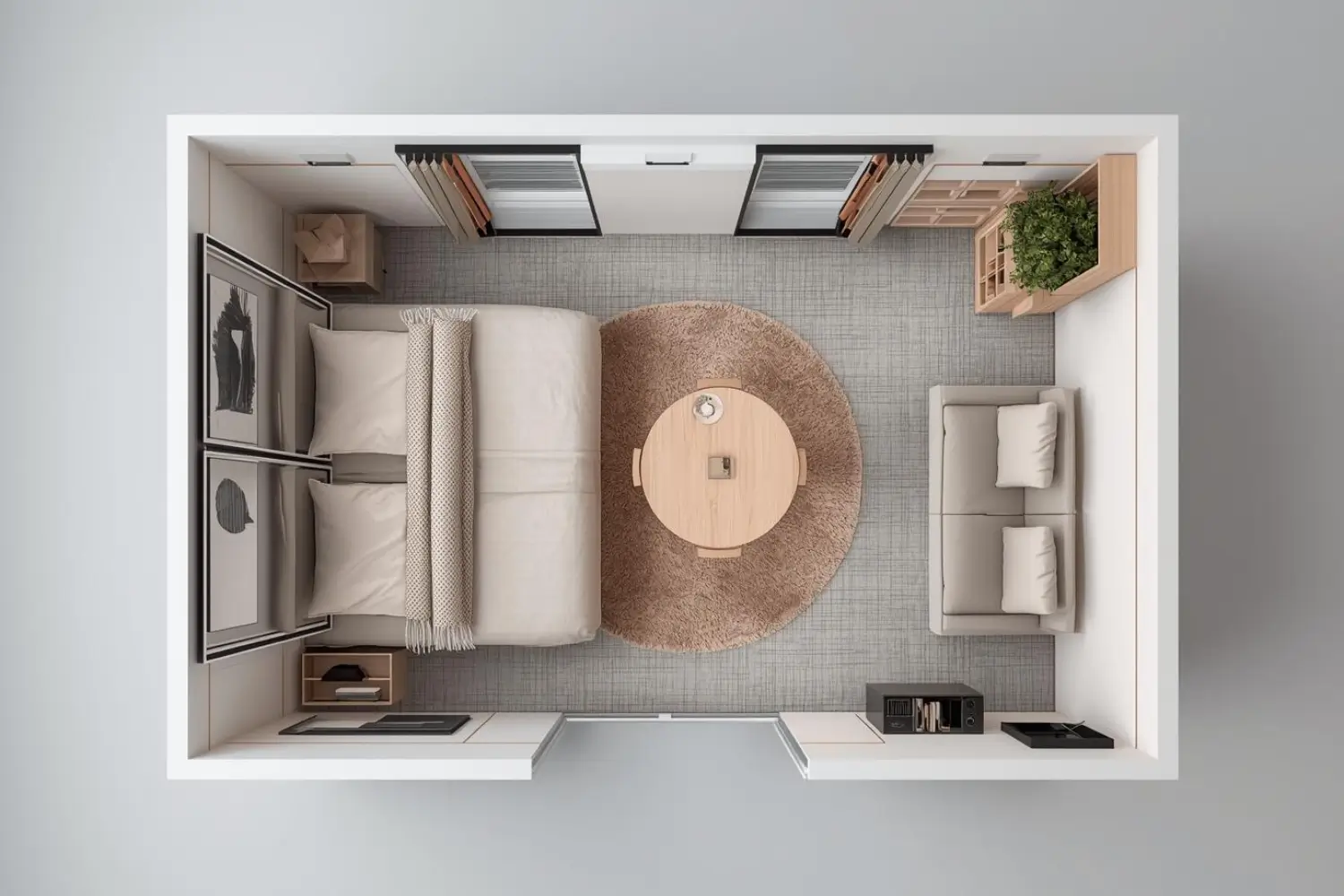
LAYOUT 4 OVERHEAD
Overhead plan of a studio with a clearly defined bedroom corner, rug, divider and the rest of the living space oriented away from the bed.
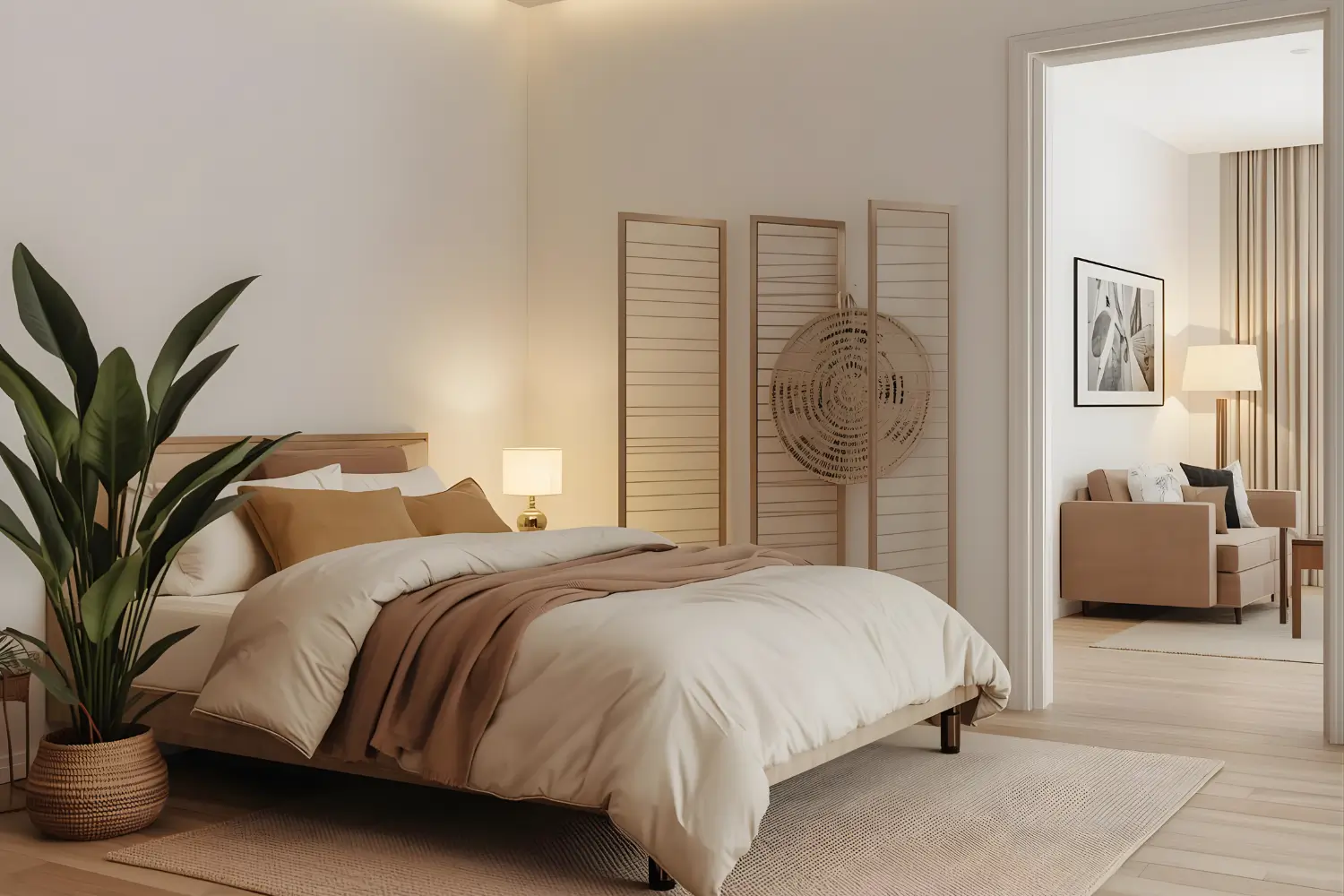
LAYOUT 4 IN REAL LIFE
Real studio bedroom corner with a defined sleep zone, soft textiles and a partial divider that keeps the bed feeling separate from the living space.
Storage and furniture that do not suffocate a small bedroom
Layout is the foundation, but furniture choices still have huge impact in small rooms.
Choose furniture with the right proportions
Scale is everything. Oversized bed frames or wardrobes dominate a small room no matter where you place them. Aim for pieces that are slim and appropriately sized.
Beds: low profile frames make rooms feel taller and more open than high divans with bulky storage. If you need under bed storage, use slim boxes rather than built in drawers.
Bedside tables: small and simple is better – narrow tables, stools or floating shelves. Avoid chunky three drawer units unless absolutely necessary.
Wardrobes and dressers: slim and tall beats wide and low. A narrow wardrobe to the ceiling uses less floor space than a squat piece spreading across the wall.
Vertical storage versus horizontal storage
Vertical storage draws the eye up and frees floor area. Horizontal storage spreads along the walls and makes the room feel more crowded. Use shelves above the bed or beside the door, hooks on the back of the door and wall hooks for bags and accessories.
Multi functional furniture, use sparingly
Multi functional pieces – storage ottomans, beds with drawers, desks that fold away – can be helpful but easy to overdo. Too many and the room feels utilitarian instead of calm.
What to leave out
Consider which items can live elsewhere:
- Full length mirrors on the back of doors or in hallways.
- Exercise equipment in the living room or a cupboard.
- Excess books and decor stored in another room or edited down to favourites.
- Extra seating that only holds clothes instead of being used.
Two complete small bedroom layout recipes to copy
To bring everything together, here are two complete layout recipes – specific combinations of placement, furniture and styling that work in real small bedrooms.
Recipe 1, serene neutral retreat, narrow bedroom 3m × 4m
Vibe: calm, airy, quietly feminine.
Colour palette: warm whites, soft greige, light wood and a touch of blush.
Layout:
- Bed against the long wall closer to the window.
- One bedside table on each side if there is space or one on the door side only.
- Narrow oak dresser near the door on the opposite wall, around 40 cm deep.
- Rectangular jute rug under the front two thirds of the bed.
- Floor length cream linen curtains hung from ceiling height.
Furniture:
- Low profile wooden bed frame in light oak or white.
- Two small round side tables or one simple rectangular.
- Three drawer oak dresser as slim as possible.
- No wardrobe in the room if there is a separate closet.
Bedding and textiles:
- Warm white linen duvet cover.
- Four pillows, two sleeping and two decorative.
- Chunky cream knit throw at the foot of the bed.
- Jute rug with subtle texture.
Lighting & styling:
- Two ceramic lamps with linen shades and warm 2700K bulbs.
- One plug in wall sconce above a piece of art near the dresser.
- Large abstract print above the bed, simple tray on the bedside with candle and book, dried grasses in a vase on the dresser.
Why it works: the layout maximises the narrow room by keeping the clear pathway, while the light palette and low profile furniture prevent it from feeling cramped.
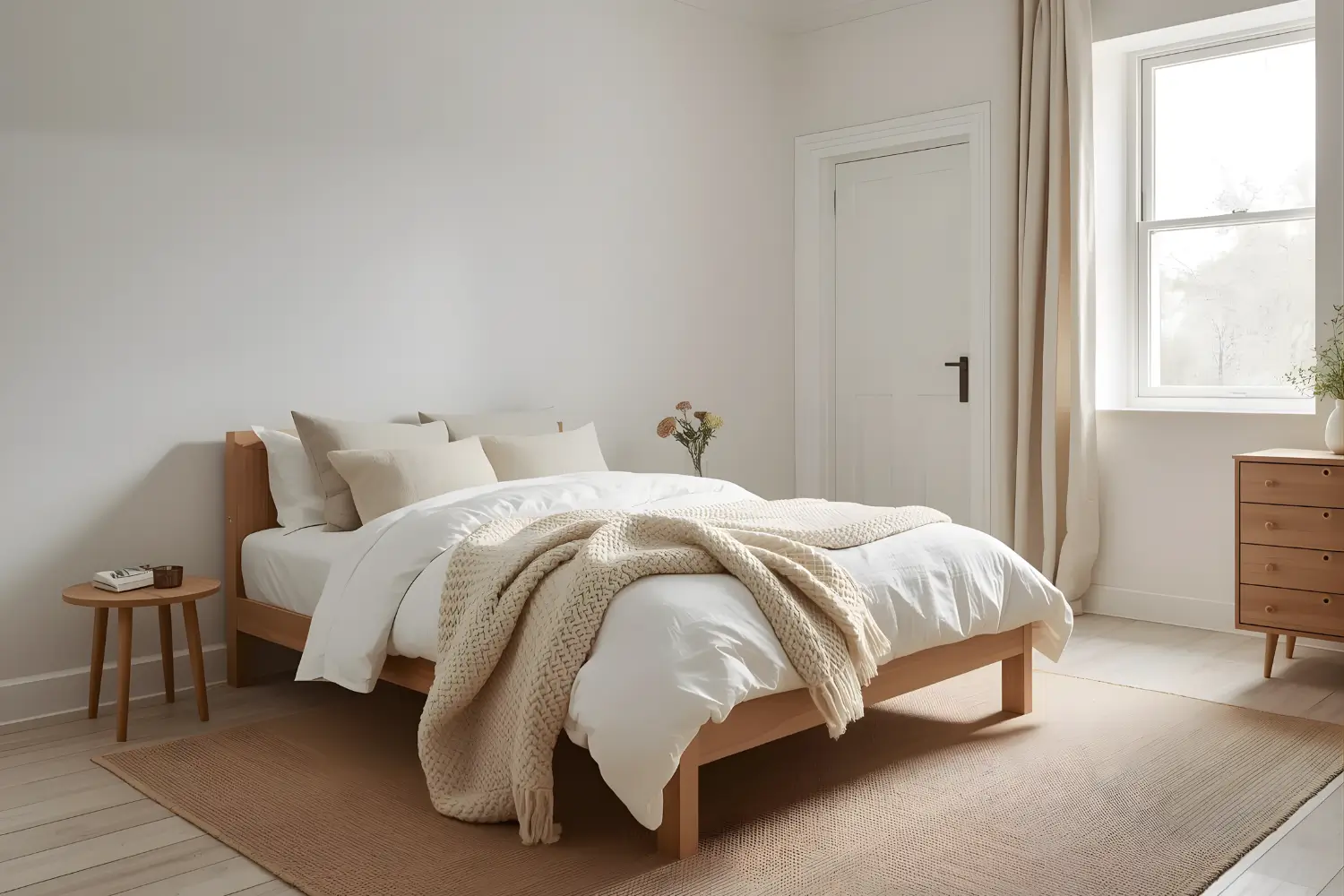
RECIPE 1, SERENE NEUTRAL RETREAT
Real narrow bedroom following Recipe 1 with light neutral bedding, slim furniture and a clear pathway along one side of the room.
Recipe 2, warm work from bed studio corner
Vibe: cozy, multi functional, warm and grounded.
Colour palette: soft taupe, camel, warm white and terracotta accents.
Layout:
- Bed in a studio corner to create natural boundaries on two sides.
- Folding screen or tall bookshelf perpendicular to the wall to act as a partial divider.
- Small wall mounted fold down desk on the adjacent wall, not directly beside the bed.
- One bedside table on the open side of the bed.
- Large cream wool rug under the bed defining the bedroom zone.
Furniture & styling:
- Low platform bed in natural wood or soft grey.
- Small wooden stool or side table as a bedside.
- Wall mounted desk or slim console, tall bookshelf as divider and storage.
- Clothes rail with curtain near the bed if there is no built in wardrobe.
- Gallery wall of prints above the bed, woven basket for throws, a large plant on the bookshelf.
Why it works: the rug, partial divider and separate desk area create a bedroom inside the studio instead of a bed floating in the living room.
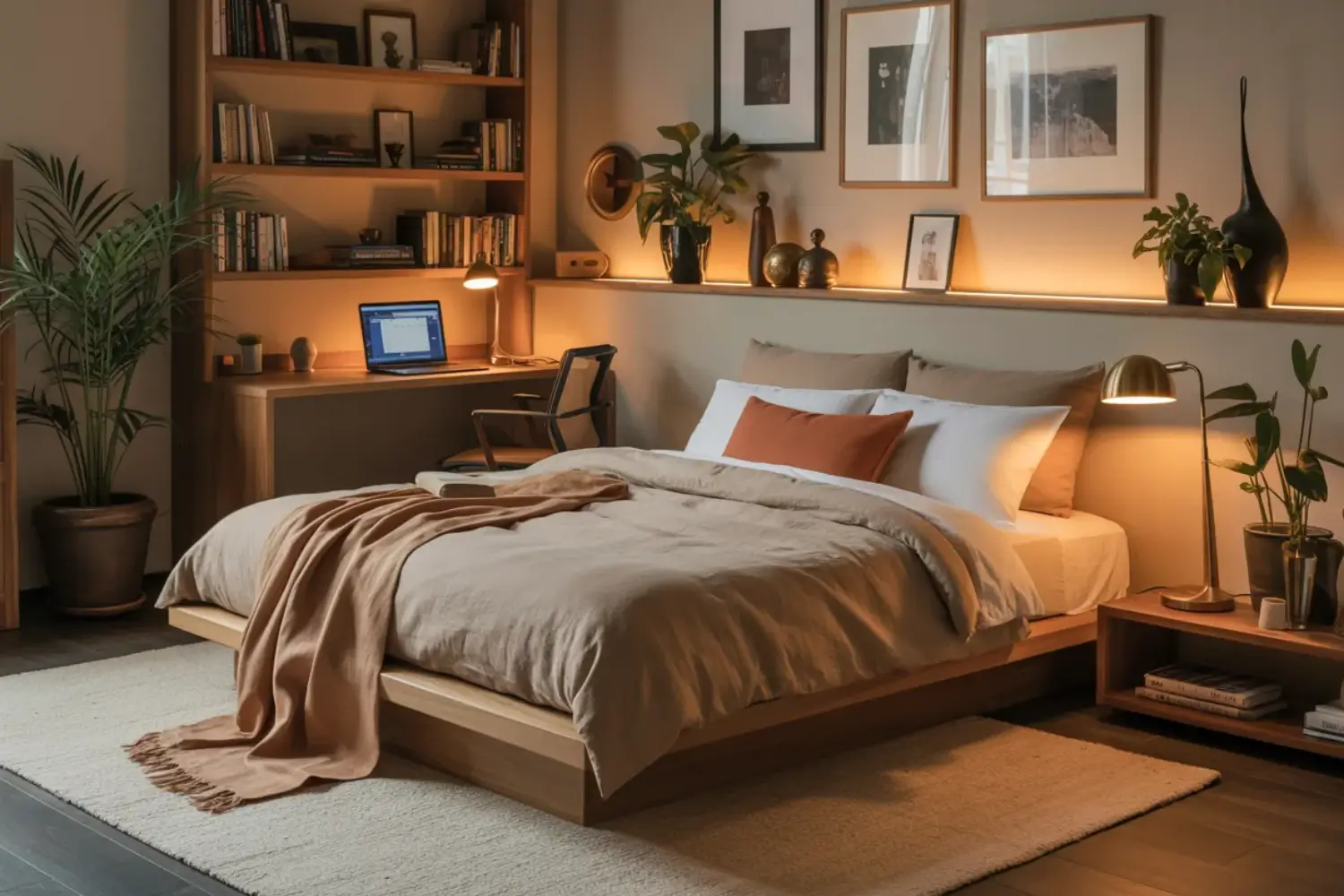
RECIPE 2, WARM WORK-FROM-BED STUDIO CORNER
Real studio apartment bedroom corner with a cozy bed, bookshelf divider and compact desk area, showing how the layout works in practice.
Your next steps
Start by assessing your own room: sketch the fixed elements, identify the natural focal point and choose the layout recipe that most closely matches your configuration. Then experiment. Move the bed, reposition the wardrobe and try small tweaks until the room feels calm instead of cramped.
Layout is the foundation. Once the furniture is in the right place, everything else – colour, textiles, lighting and styling – becomes easier. A well laid out small bedroom feels calm even with minimal decor. A poorly laid out bedroom feels chaotic no matter how much you style it.
Lighting & color ideas for cozy small apartment bedrooms
Think about the last time you walked into a bedroom that felt immediately, instinctively right. Chances are it wasn't the furniture that did it or the square footage. It was the light, warm and layered rather than glaring from a single fixture, and the colour, soft and cohesive instead of competing with everything else.
Most small apartment bedrooms start with two strikes against them: a single overhead bulb that fills the room with flat, clinical light, and walls painted in a landlord-approved shade that makes the space feel like a waiting room. Neither costs much to soften. You don't need to repaint or hire an electrician; you need a few well-placed lamps, the right bulbs, and a clear sense of how colour can work for you even when the walls won't cooperate.
In this pillar you'll walk through a simple framework for layered bedroom lighting, soft feminine colour palettes that work in real rentals and a few complete room recipes you can copy or adapt.
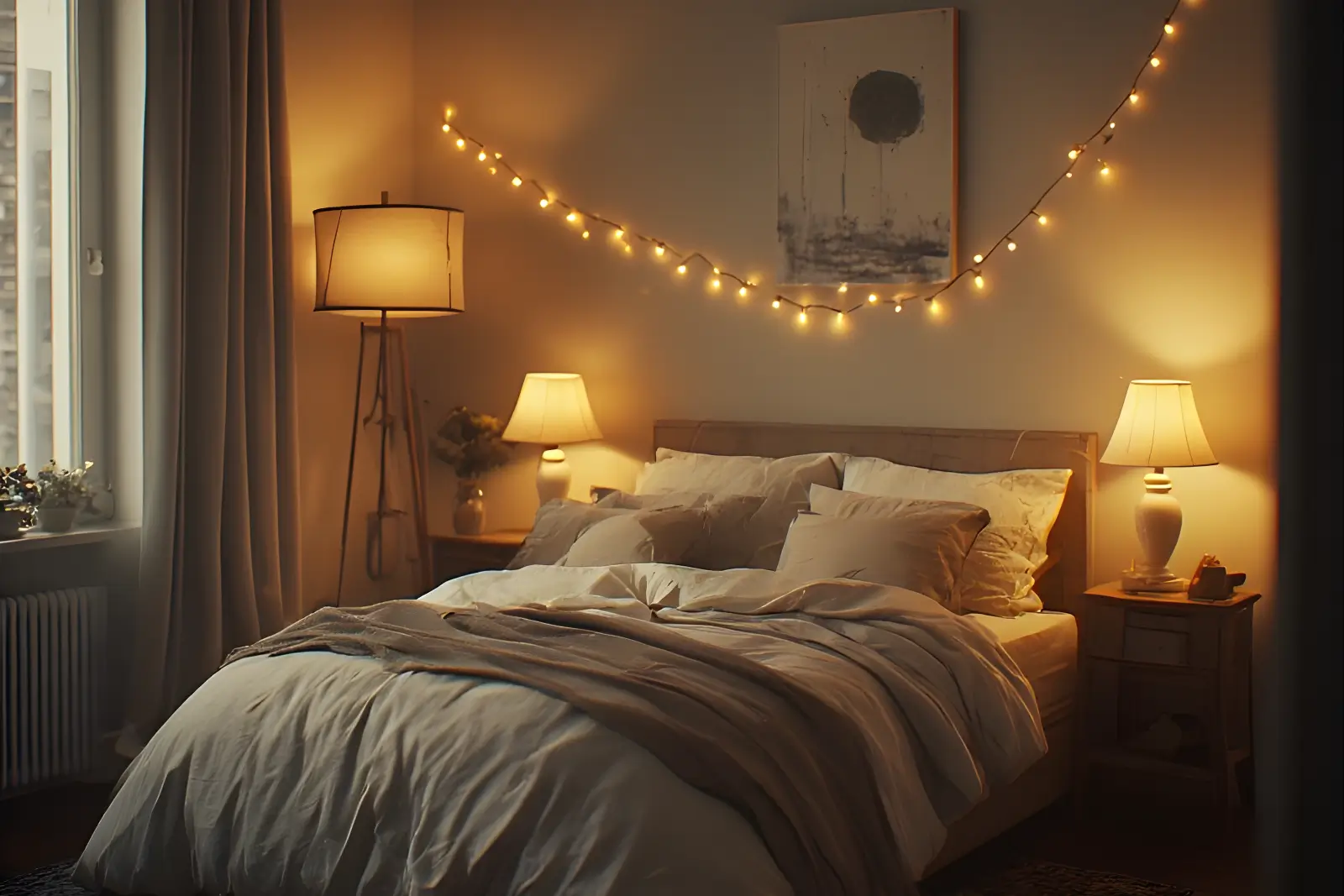
LIGHTING OVERVIEW
Example of a small bedroom where layered warm lighting and a soft colour palette do most of the work, even with simple furniture and a basic layout.
Why lighting & color matter so much in small bedrooms
Small rooms are unforgiving. In a large bedroom, a bad overhead light is annoying. In an 11 m² rental, it is defining. The entire mood of the space is set by how it is lit, because there isn't enough volume to absorb harsh light or dilute it with distance. Every shadow, every glare, every cold blue cast is felt immediately.
Colour works the same way. A stark white that reads as clean and modern in a spacious loft can feel sterile and small in a compact room. Conversely, a warm oatmeal that might seem unremarkable in a large space can feel genuinely cozy and embracing when the walls are close. In a small bedroom, colour is mood control – and you have more control than you think, even without a paintbrush.
The emotional difference between a room that feels clinical and one that feels cozy usually comes down to a handful of specific decisions: how many light sources you use, how warm they are and how well your textiles talk to each other.
- The room feels larger, not smaller, because warm, layered light creates depth instead of flattening the space.
- Furniture looks more expensive under soft, directional light than under a cold overhead bulb.
- Cohesive, muted colour – even just in textiles – gives the impression of a considered, styled space.
- Warm, dimmable light supports winding down at night instead of keeping your brain in office mode.
A simple three layer lighting framework
The single change that does the most for a small bedroom is replacing a single overhead source with layered, warm light at multiple heights. Think of it in three layers: ambient light that replaces or softens the overhead glare, task light for reading and dressing and accent light that adds depth and warmth without having to do any real work.
Ambient light
Ambient light is the base layer, the general illumination that fills the room without coming from a single, flat, overhead source. In a rental where you can't touch the ceiling fixture, the goal isn't to remove it but to supplement or soften it with something warmer.
The most reliable ambient source for a small bedroom is a floor lamp with a fabric or linen shade placed in a corner or beside the bed. The shade diffuses light upward and outward rather than straight down, which immediately softens the room. Swapping overhead bulbs to warm 2700K LEDs and using a plug–in dimmer instantly improves even basic fixtures.
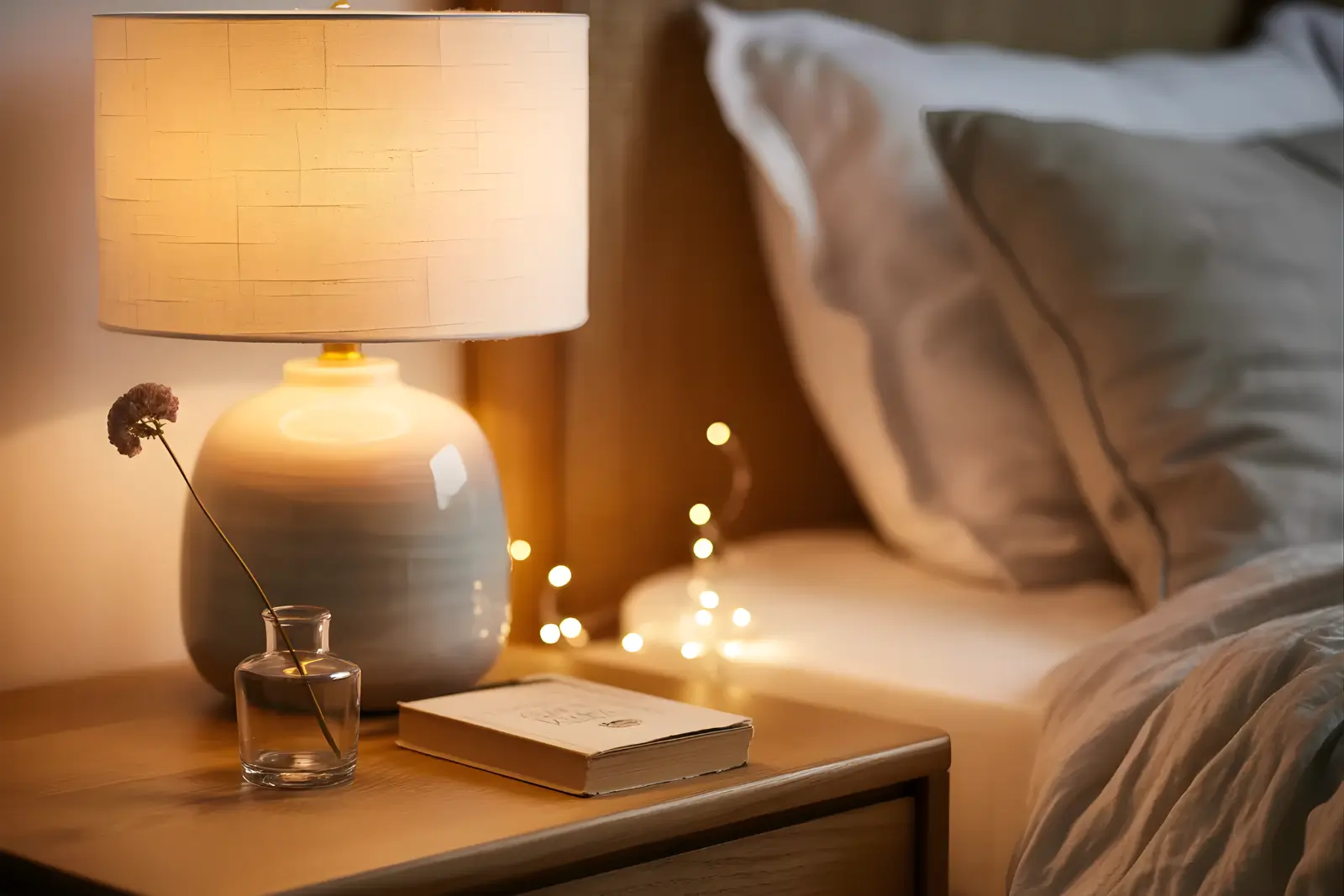
LAYERED LIGHTING DETAIL
Bedside vignette showing how a warm table lamp and subtle accent lights work together to create a soft, cozy glow in a small bedroom.
Task light
Task light is directional and purposeful – the bedside lamp you read by, the mirror light you use when getting dressed or the desk lamp if your bedroom doubles as a workspace. In a small bedroom this usually means bedside lamps, and getting them right makes a disproportionate difference to how the whole room feels.
Aim for lamp shades roughly at shoulder height when you're sitting up in bed so the light falls onto the page rather than into your eyes. Clip–on reading lights or plug–in sconces are ideal when surfaces are tight, because they free up your bedside table.
Accent light
Accent light is the layer most people skip and the one that makes a bedroom feel genuinely atmospheric rather than just well lit. Think warm fairy lights on a shelf, LED candles on a windowsill or a small picture light above art. These sources aren't meant to illuminate tasks; they exist purely to add depth, warmth and a sense of life.
Use accent lights in the evening when you want the room to shift from functional to restorative. They are the equivalent of dimming the lights in a restaurant – the physical environment hasn't changed, but the feeling has.
For most small bedrooms you only need one improved ambient source, two bedside lamps and two or three accent sources. If you switch the overhead off in the evening and rely on these layers instead, the room will feel different before you move a single piece of furniture.
Bulbs, colour temperature and mistakes that ruin the mood
Colour temperature, measured in Kelvin, is the most overlooked variable in bedroom lighting. A low number around 2700K produces soft amber white light that mimics candlelight, while higher numbers around 5000K produce cold blue white light more suited to offices and hospitals.
For cozy bedroom lighting, keep bedside and ambient lamps in the 2700K–3000K range. This is warm enough to feel relaxing without making reading difficult. Most bulbs marketed as warm white sit here, but always check the packaging.
- Cold blue white bulbs make even beautiful bedding look clinical and washed out.
- A single bare ceiling light flattens the room and makes it feel like a utility space.
- Spotlights directly above the bed create harsh shadows and feel interrogative rather than restful.
- Mixing warm and cool bulbs in the same room creates subconscious visual dissonance; match bedside and ambient sources.
Soft colour palettes for cozy, feminine bedrooms
In a small bedroom, the relationship between wall colour and textile colour is everything. Stark contrasts feel visually busy in a compact space and make the room feel smaller and more chaotic. Warm, muted palettes where tones relate to one another do the opposite: they make the room feel intentional, calm and surprisingly spacious.
The good news for renters is that you don't have to touch the walls. Soft palettes work through bedding, throws, cushions, curtains and rugs – almost entirely within your control regardless of what your landlord chose years ago.
Warm neutrals with blush accents
Vibe: soft and feminine but grown up, calm rather than cutesy and quietly luxurious rather than overtly pretty.
Base colours: warm white, oatmeal and light greige in the main textiles like duvet cover, curtains and rug.
Accent colours: blush pink, dusty rose and soft terracotta in cushions, throws and small decor.
Soft taupe, camel and cream
Vibe: earthy, serene and warm, like being wrapped in something natural and unprocessed. Works especially well with wood tones and woven textures.
Base colours: cream, warm ivory and light taupe in bedding and curtains with camel, tan and natural wood accents layered in.
Muted mauves and dusty rose
Vibe: romantic without being cloying, soft and slightly vintage in feel – the palette that photographs beautifully in warm golden light.
Base colours: warm white or ivory bedding with mauve, dusty rose and soft lavender as secondary tones.
This palette needs warm light to sing; under cool white light dusty rose looks dingy and mauve can read as grey, so commit to warm bulbs if you choose it.
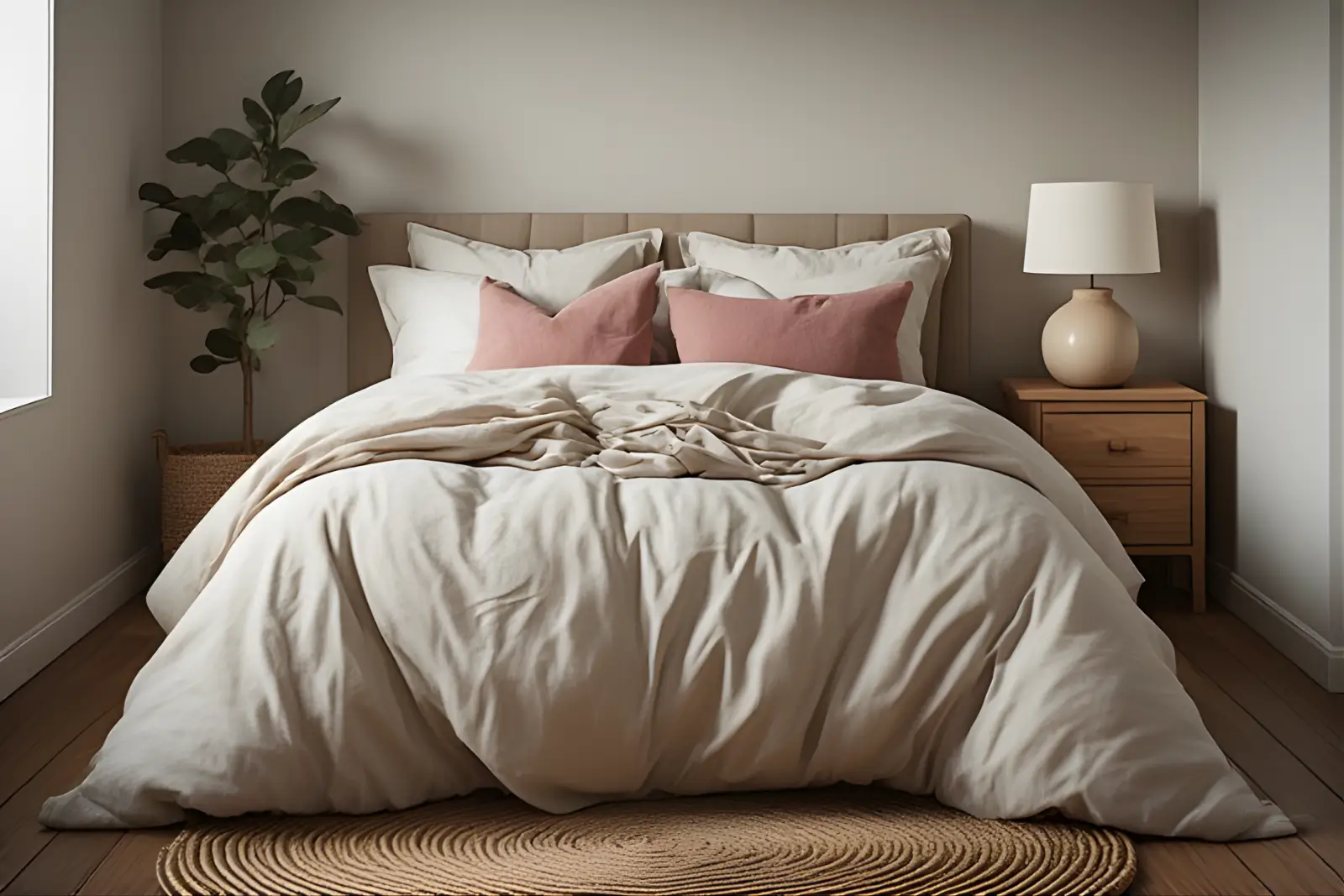
WARM NEUTRAL PALETTE
Realistic warm neutral bedroom scheme with soft oatmeal bedding, blush accents and natural textures that photograph beautifully but are easy to replicate.
Deep plum with warm neutrals
Vibe: intimate, candlelit and intentionally cocooning. This palette leans into the smallness of the room rather than trying to minimise it.
Dark tones appear in heavy curtains, a velvet cushion or a lampshade against a backdrop of cream and warm white. Warm brass, honey and terracotta accents keep everything from tipping into gloomy.
Lighting & color recipes you can copy
These recipes combine palette, lighting layers, textiles, furniture and styling into cohesive, realistic plans for small rental bedrooms. Use them as starting points and adjust to what you already own and the room you actually have.
Recipe 1, serene neutral glow in an 11 m² rental
Vibe: calm, airy and quietly feminine, the room that feels like a long, slow exhale.
Colour palette: warm white and oatmeal as primary tones, soft greige in textiles, light oak in furniture and a single blush accent.
Recipe 2, warm rosy glow in a studio bedroom corner
Vibe: romantic, warm and gently feminine, like the last hour of light on a summer evening.
Colour palette: warm white, blush pink, dusty rose, terracotta and soft gold accents with layered warm lighting.
Recipe 3, moody cocoon for a darker bedroom
Vibe: intimate and deliberately cocooning, a room that leans into its darkness rather than fighting it.
Cream and ivory form the backdrop with deep plum or charcoal in curtains and cushions, warm brass lamps and clustered LED candles replacing harsh overhead light.
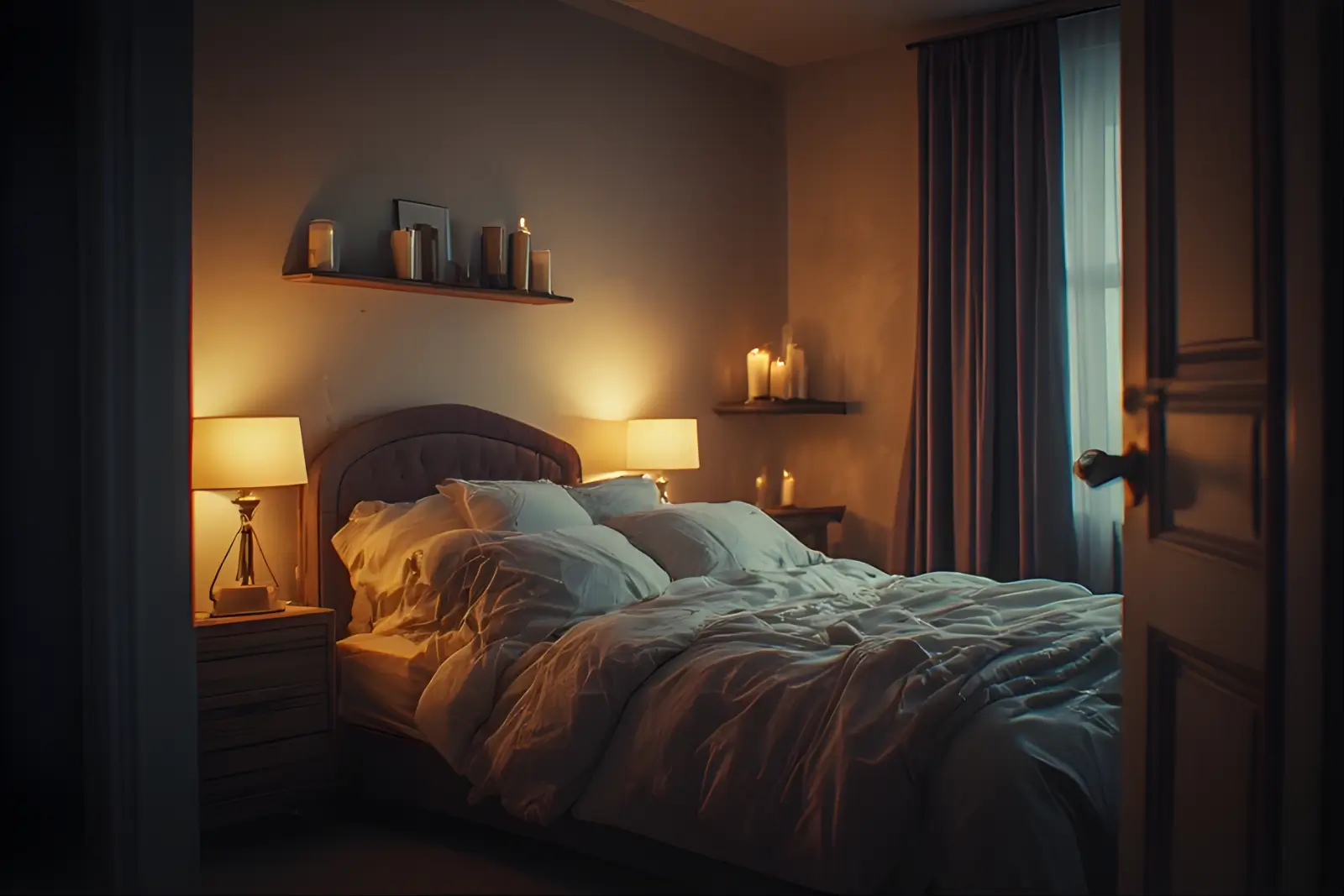
MOODY BEDROOM RECIPE
Darker, cocoon-like bedroom with deep plum accents and warm layered light, showing how to lean into a naturally darker room without making it feel gloomy.
No-drill, renter-friendly upgrades
Most meaningful changes to lighting and colour in a rental don't require drilling or rewiring. Swapping every bulb in the room to 2700K warm white LED is a two minute upgrade that transforms the mood. From there, plug–in floor lamps, table lamps and wall sconces provide all the layering you need.
Colour can be built almost entirely through textiles: curtains hung on tension rods or adhesive hooks, a large rug that effectively becomes a new floor, duvet covers and throws that set the palette and removable wallpaper or fabric panels behind the bed if your tenancy allows.
Putting it all together
Three things matter most for lighting and colour in a small bedroom: warm, layered light; muted, tonal palettes; and the understanding that almost everything meaningful can be done without repainting or drilling. You don't need a bigger room, just more deliberate choices.
Start with bulbs, then add one new lamp and one large textile in your chosen palette. Clear your surfaces so only intentional arrangements remain. The room will begin to feel more like a retreat and less like a temporary space long before the floor plan changes.
Storage & furniture ideas for small bedrooms in real rentals
Most small rental bedrooms start with the same set of problems. There may be a single shallow closet wedge in a corner, a radiator that rules out one wall and a door that steals another as soon as it opens. The only wall long enough for furniture might have a socket right in the middle of it. Somehow, despite all of this, you still need to fit a bed, somewhere for your clothes, a place to put things down at night and enough clear floor that it does not feel like you are sleeping in a storage unit.
The instinct is usually to look for a bigger wardrobe or a more elaborate storage system. In a small rental bedroom, more furniture is rarely the answer. What you actually need is a strategy: a clear sense of what belongs in this room, what does not and how to organise what stays so the space feels calm and considered instead of chaotic.
This section focuses on the things that work in real small bedrooms, not dream closets, and will help you decide how to handle clothing storage with or without a closet, under bed and vertical solutions, multi use furniture, renter friendly hooks and rails and where it is worth spending money.
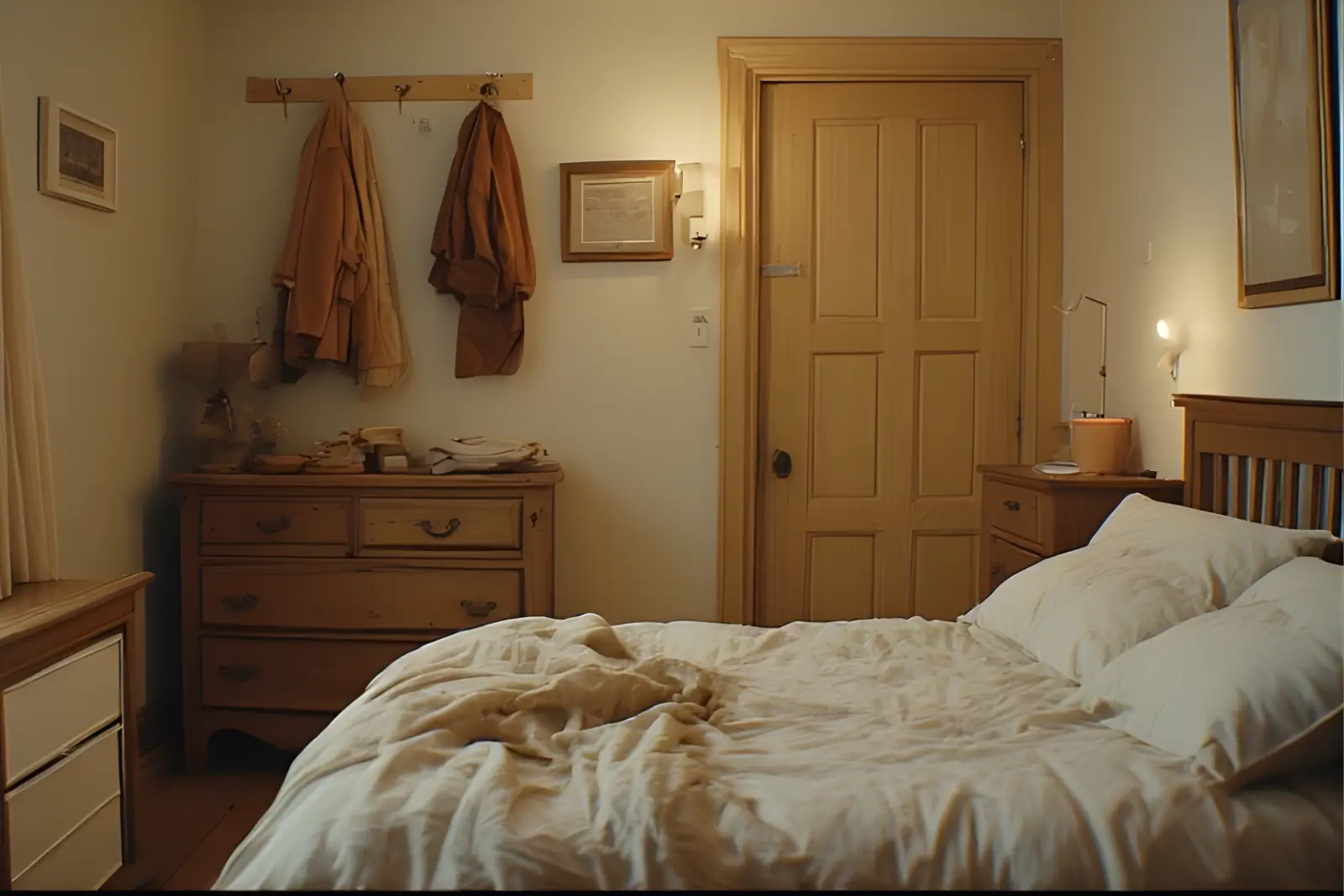
STORAGE OVERVIEW
Real life rental bedroom with simple furniture, hooks and under-bed storage creating a calm, organised look without built-in wardrobes.
What makes storage in real rentals different
Storage advice designed for homeowners rarely translates directly to rental bedrooms. Homeowners can install built in wardrobes, add alcove shelving or move walls to make a better layout. Renters, for the most part, cannot touch the bones of the room.
What you actually get in a typical rental bedroom is something messier: a shallow built in wardrobe on the only dark wall, a hanging rail too short for dresses and a shelf above that is just out of reach. Or no closet at all. Or a studio where the bed lives in one corner of the main room and the idea of a separate bedroom is theoretical.
A few common scenarios:
- Small bedroom, one shallow built in: the wardrobe technically exists but holds only a fraction of what it needs to, so everything else piles up on chairs and the floor.
- No closet at all: the bed has to go under the window because it is the only viable wall, leaving no obvious place for clothes or shoes.
- Studio apartment: the bed shares space with the sofa and kitchen, so everything that would normally live in a bedroom has to coexist with the rest of the flat.
In all of these situations the goal is not a perfect, magazine ready storage system. It is simply enough organisation to feel calm, to find what you need without digging and to see clear surfaces when you walk in.
Build storage around how you actually live
Before you buy a single shelf or basket, it is worth deciding what genuinely belongs in the bedroom and what does not. Most small bedroom storage problems are overflow problems – the room is trying to hold things that do not need to be there.
What belongs in the bedroom: daily clothing, underwear, sleepwear, everyday shoes, bedding in use and the few things you need within reach at night.
What can often live elsewhere: seasonal outerwear, luggage, gym bags, sports equipment or anything you only touch a few times a year.
A simple three tier framework helps decide where everything goes:
- Daily reach – items you use every day, like underwear, pyjamas and the pieces you wear on rotation. These belong at eye or hand level in top drawers, low shelves or the front of a hanging rail.
- Weekly reach – items you use a few times a week, such as gym clothes or certain shoes. These can sit a little higher or lower, in a second drawer or a basket on a higher shelf.
- Occasional – seasonal clothes, spare bedding and luggage. These belong in the hardest spots: under the bed, on the highest shelf or inside an ottoman.
The biggest mistake in small bedrooms is treating all storage as equal and filling the easiest spots with rarely used items. When daily essentials are genuinely easy to reach the room works far better than with a more elaborate system built around the wrong priorities.
Smart clothing storage in tiny bedrooms
Clothing is usually the main event for small bedroom storage. Everything else is secondary. The right approach depends on whether you have a closet at all.
When you have a small closet
A shallow built in wardrobe with a single rail and one shelf is not useless, it is just under optimised. A few changes make a big difference.
Slim velvet hangers are the easiest upgrade. Standard plastic hangers take up far more horizontal space. Swapping out a full rail can almost double hanging capacity without changing the wardrobe itself.
Multi tier hangers for trousers, skirts or folded jeans let you stack several pieces on a single hook and use the vertical space that usually goes to waste.
The shelf above the rail works best with two or three matching boxes for seasonal accessories, spare bedding or rarely worn pieces. Labels mean you actually open them instead of treating the shelf as a random dumping ground.
An over door organiser on the inside of the closet door can handle shoes, scarves or small folded items and effectively adds a second storage surface. Just make sure the door still closes comfortably.
Avoid overstuffing the rail. A wardrobe that is packed so tight you have to force hangers apart will stop working. When it is a chore to look through what you own, clothes migrate to chairs instead.
When there is no closet at all
In many rentals there is no built in storage. The solution is to build a system from individual pieces rather than hunting for one wardrobe that will fix everything.
A clothes rail with a curtain is the most renter friendly alternative to a built in wardrobe. A freestanding rail can sit in a corner or alcove and a full length curtain, hung from a tension rod above, hides the contents and makes the whole thing look intentional.
A slim dresser, around 40 centimetres deep or less, can hold folded items that would normally live in a wardrobe. Combined with a rail for hanging pieces this gives you a complete clothing system without anything that feels makeshift.
The combination that works best in most no closet bedrooms is an open rail for hanging pieces, a dresser beside it for folded items and closed boxes or baskets above for occasional reach things. The visually messiest items are contained in one zone so the rest of the room can breathe.
If you own more clothing than your bedroom can reasonably hold, create a mini capsule inside the room and let the rest live elsewhere. The bedroom does not have to store everything, only the pieces you reach for most.
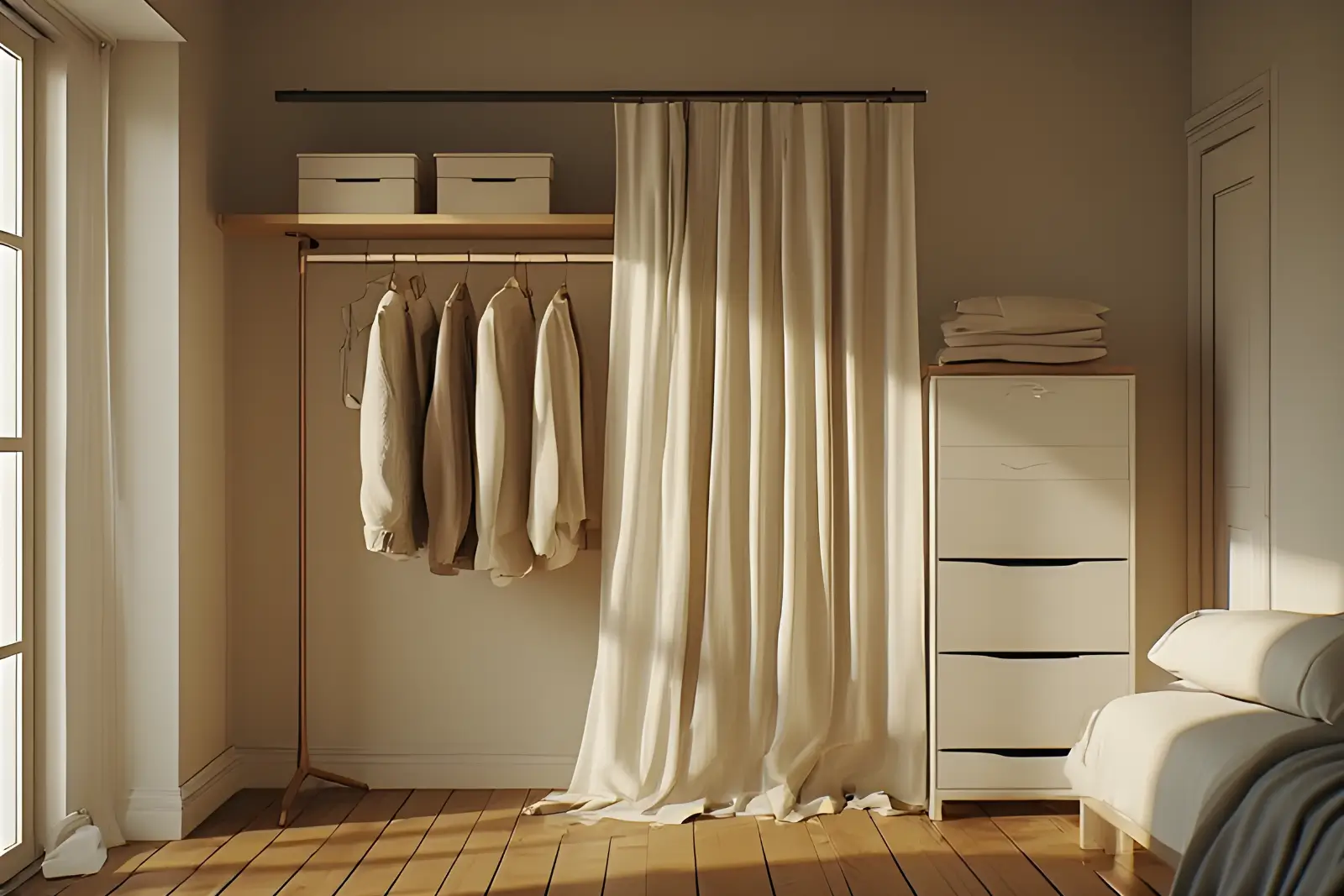
WARDROBE CORNER
Clothes rail with curtain and a slim dresser working together as a renter-friendly wardrobe corner in a small bedroom.
Under-bed and vertical storage that doesn't feel cluttered
Once clothing is handled, under bed and vertical storage are the next zones to develop. Both can add a lot of capacity to a small room or make it feel oppressive depending on how they are used.
Under the bed
The space under your bed is most valuable when you use it for things you rarely need to access, like off season clothing, spare duvets and extra pillows.
Low profile storage boxes with lids are calmer visually than open crates or random bags. Choose a few in the same neutral colour so that if they are visible they still look intentional.
Vacuum storage bags are ideal for off season bedding and bulky knitwear. One duvet can shrink down to almost nothing, freeing up entire drawers elsewhere.
Under bed storage is not for daily essentials. If you are pulling things out from under the bed regularly the system will quickly fall apart.
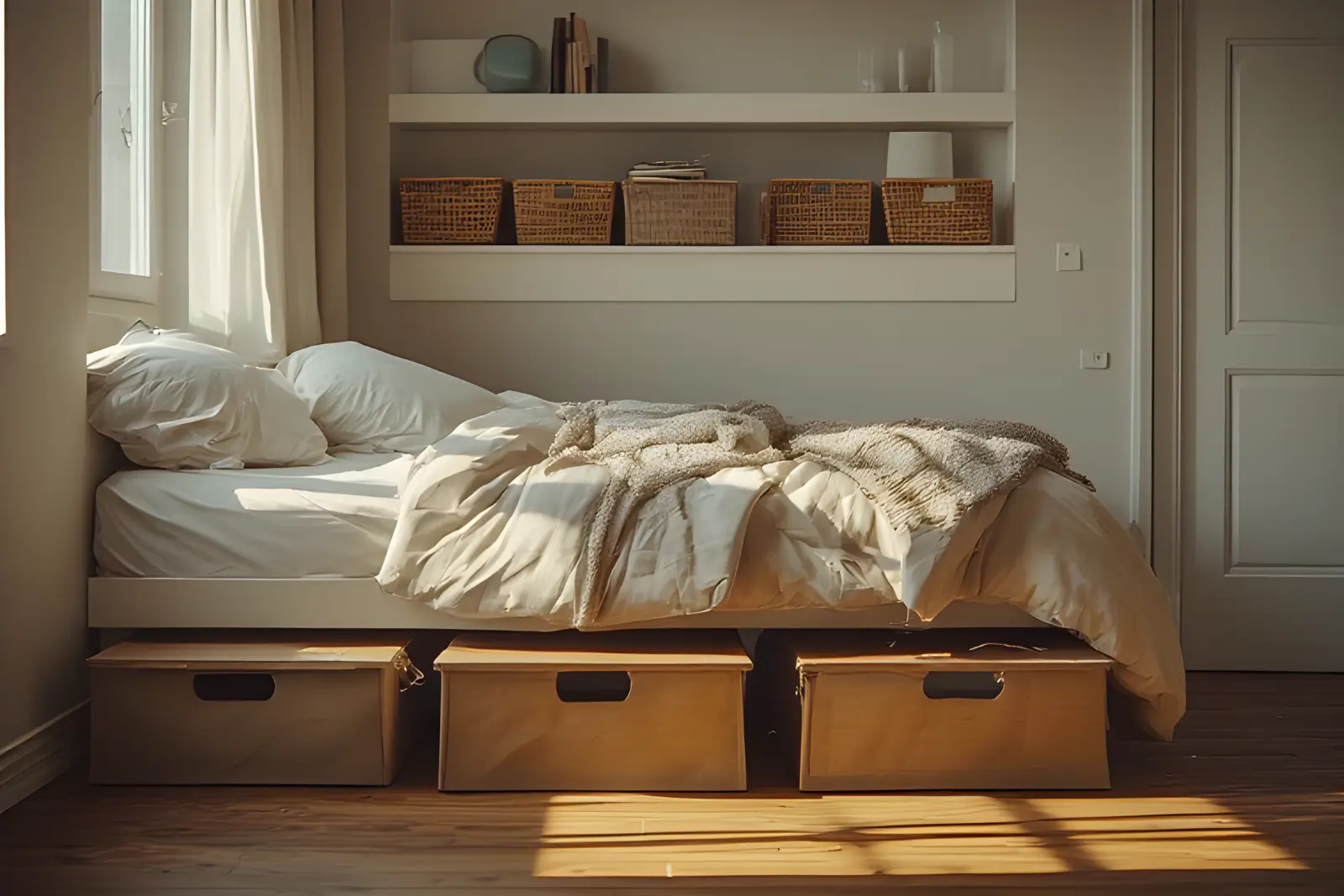
UNDER-BED & VERTICAL STORAGE
Under-bed boxes and a shelf above the door adding storage capacity without making a small rental bedroom feel crowded.
Vertical storage
Walls above eye level are often completely unused in small bedrooms and are the easiest place to add capacity without taking any floor space.
A shelf above the bedroom door is quietly very practical. The door occupies wall that cannot host furniture, but the space above it can hold a row of boxes or baskets for spare bedding and seasonal items.
A shelf above the bed can double as a nightstand alternative if your ceiling height allows it, but keep storage here light and visually simple. No overloaded shelves and nothing heavy enough to feel unsafe.
Tall, narrow cabinets or bookcases with some closed inserts can provide vertical storage without consuming much more floor than a dresser. The general rule is to keep the top half of the room visually lighter than the bottom half so it does not feel claustrophobic.
Multi-use furniture that earns its footprint
In a small bedroom every piece of furniture should do at least two jobs. A bed that only sleeps, a nightstand that only holds a lamp or a bench that only looks pretty are luxuries in a compact space.
The bed frame
The bed is the largest piece in the room, so the ground beneath it is either used or wasted. A storage bed with drawers is worth paying more for if you have limited storage elsewhere, because two deep drawers can replace an entire dresser.
A bed frame on legs high enough for boxes is a more budget friendly alternative. A frame with around 30 to 35 centimetres of clearance lets standard storage boxes slide underneath and is far more flexible than built in drawers.
Very low platform beds only make sense if you truly have storage elsewhere. Do not buy one hoping to figure out storage later.
The storage ottoman or bench
A storage ottoman at the foot of the bed uses a footprint that is often empty or purely decorative and turns it into useful volume. It is perfect for bedding, blankets or seasonal items.
Nightstands
Open, leggy nightstands look light but do very little practical work. In a small bedroom a nightstand with at least one drawer is far more useful because it hides chargers, skincare and small clutter that would otherwise live on the surface.
Wall mounted shelves at mattress height can act as nightstands when there is not enough room for a full table and work well in rentals if they are installed with removable fixings.
The wardrobe question
It is tempting to solve a no closet room with one large freestanding wardrobe. Sometimes this works, but more often a double wardrobe devours a full wall, narrows the room and still does not store enough because the interior is not organised.
Combining several smaller, lower pieces is usually more effective: a slim dresser, a rail with curtain, a storage ottoman and good under bed storage. The overall footprint can be similar, but the room feels noticeably more open.
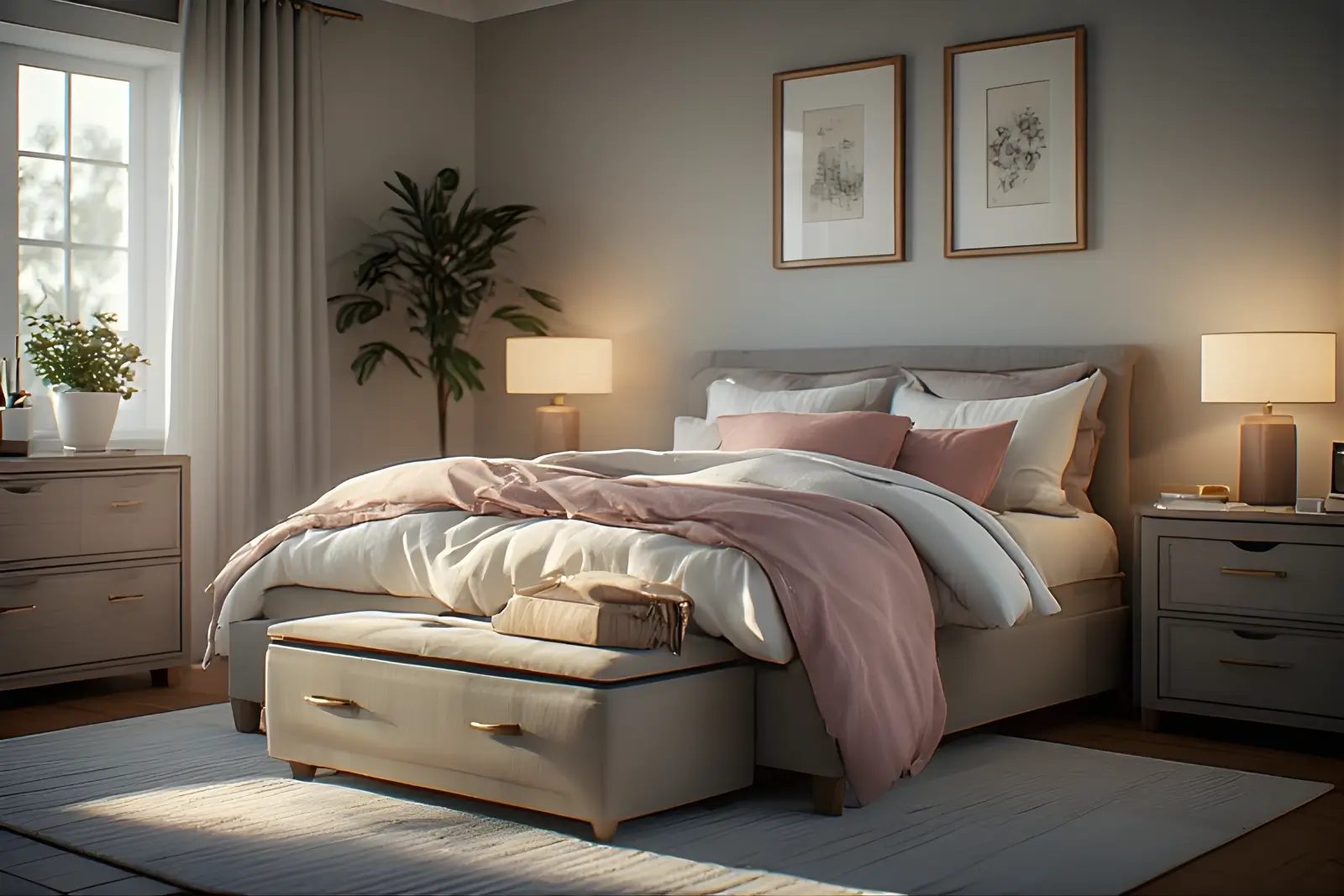
MULTI-USE FURNITURE
Storage bed, ottoman and drawer nightstands working together to maximise storage in a small, feminine bedroom.
No-drill hooks, rails and over-door solutions
Hooks are one of the most underestimated tools in a rented bedroom. Done properly, a deliberate arrangement of hooks and rails can replace a piece of furniture and solve specific daily problems without adding bulk.
Over door hooks are the simplest starting point. A set over the back of the bedroom door can hold a robe, a bag or tomorrow's outfit. An over door shoe organiser can handle accessories and smaller items that usually end up in a random pile.
Adhesive hooks have improved and can easily hold handbags and light coats. Use lower hooks for bags you grab daily and higher hooks for outfits or coats that do not live in the wardrobe. A single valet hook behind the bedroom door is a good place for the next day's clothes.
Tension rods can create hanging rails between two walls with no drilling and make simple closet alternatives in alcoves or studio corners. A rod at ceiling height with a curtain hung from it can act as a gentle room divider.
A hook rail or a strip of evenly spaced hooks on one wall can function as a clothing system in its own right if you prefer to see what you wear. The key is consistency, same height hooks, similar hangers and items grouped by type, otherwise it will look chaotic rather than intentional.
Budget priorities – where to spend and where to save
Small bedroom storage involves some buying decisions, so it is worth being clear where money actually makes a difference and where it does not.
Worth spending on
- A bed frame with real storage value, either a good storage bed or a frame with enough clearance for proper under bed boxes.
- A slim dresser that fits the space perfectly in depth and height and has drawers that open smoothly.
- A storage ottoman or bench that is sturdy enough to sit on and keeps its shape.
Fine to save on
- Simple open shelves and wall brackets – they just need to be level, secure and in a colour that suits the room.
- Under bed storage boxes, as long as they have lids, fit under your frame and are a neutral colour.
- Hooks, rails and over door organisers – basic versions do the job and let you spend more on pieces that stay visible.
Putting it all together
Getting storage right in a small rental bedroom is less about a perfect product and more about making a series of deliberate decisions in the right order. Once you choose what belongs in the room and where each category lives, furniture and organisers become much easier to pick.
A practical checklist to work through:
- Decide what truly lives in your bedroom and what can move to a hallway cupboard, another room or storage elsewhere.
- Choose an under bed storage solution for at least one category of occasional items such as spare bedding or off‑season clothes.
- Add at least one multi use furniture piece – a storage bed, an ottoman at the foot of the bed or a nightstand with a drawer.
- Create one vertical storage zone above eye level, like a shelf above the door, a wall shelf or a taller narrow unit.
- Set up hooks or over door solutions for daily items that do not need a drawer or hanger.
- Do one declutter pass before you consider buying anything else and remove items that live in the bedroom only because they have nowhere else to go.
- Check in after a month and notice which surfaces have become dumping grounds again, then adjust the system rather than blaming the room.
Once the framework is in place a well organised small bedroom becomes an easy, low maintenance habit rather than a constant fight against clutter.
Explore more small-space ideas
If you want to keep planning your apartment, these guides go deeper into layouts, walls and workspaces:
- Small Apartments & Studio Decor – zoning, furniture placement and cozy ideas for one-room flats.
- Walls, Color & Art – renter-friendly wall ideas that connect with your bedroom palette.
- Feminine Home Office Design – how to fit a desk into a small, aesthetic apartment.
- Aesthetic Styles & Vibes – choose the overall mood for your whole home.
Dive deeper into each bedroom step
Choose the stage you are working on and explore more bedroom articles for that step.
Step 1
Cozy bedrooms
Mood, textiles and the overall cozy feeling of your small bedroom.
Step 2
Small bedroom layouts
Bed placement, walking paths and where storage and desks can fit.
Step 3
Lighting & color
Layered lighting and soft colour palettes that flatter a compact room.
Step 4
Storage & furniture
Practical storage pieces, hooks and multi-use furniture for small bedrooms.