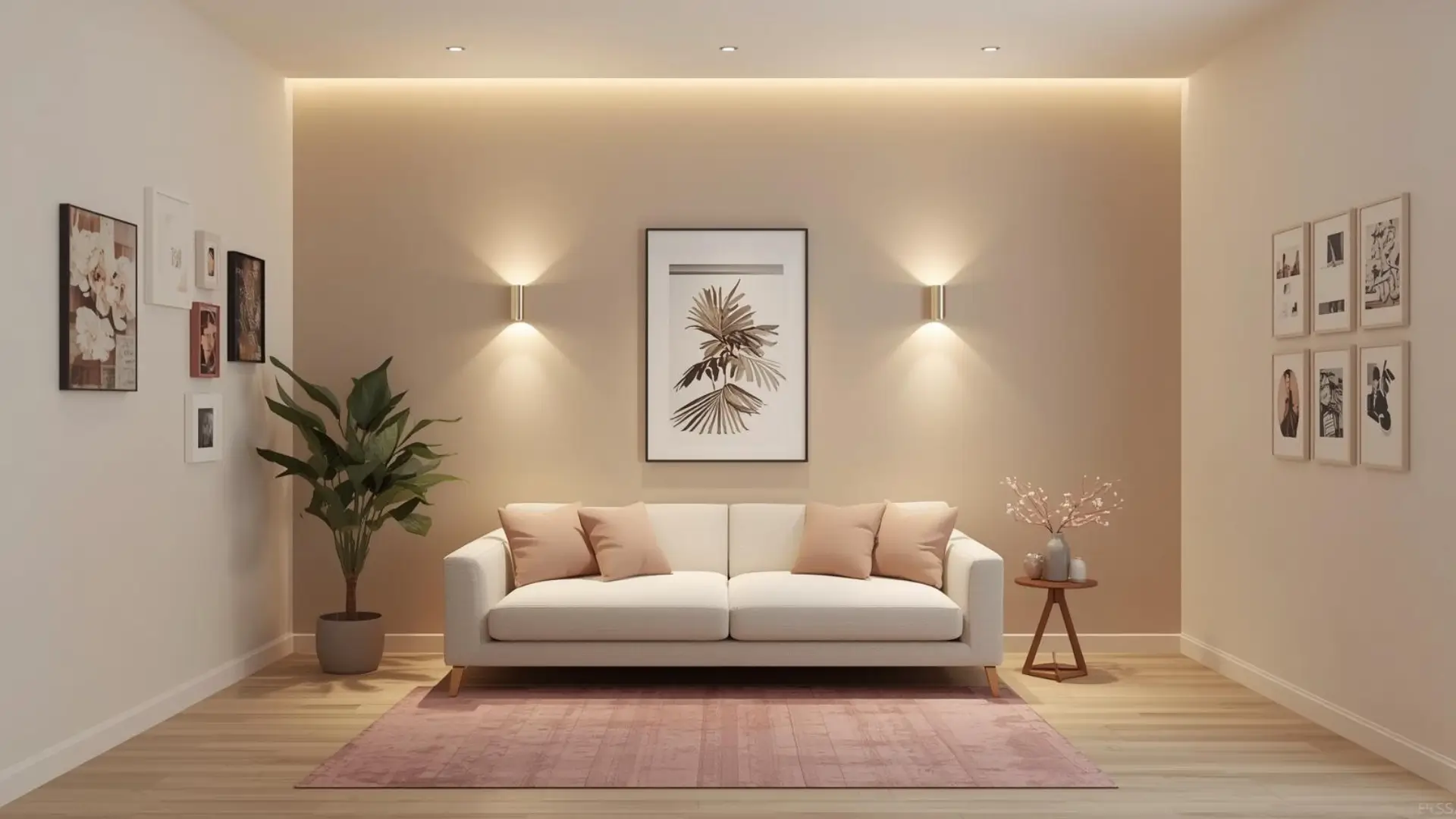


Wall planning for small apartments: decide what each wall should do
Most people start their wall makeover by asking what colour they should paint or where to hang a particular print. The real question that changes everything is what each wall in the room is supposed to do. In a small apartment you cannot afford to let every surface shout at once. Every wall is doing a job, whether you planned it or not.
This pillar walks through a simple framework for assigning clear roles to each wall so your space feels intentional, calm and put-together without needing renovations. Once wall roles are decided, choosing colour, art and storage becomes a series of straightforward decisions instead of endless guesswork.
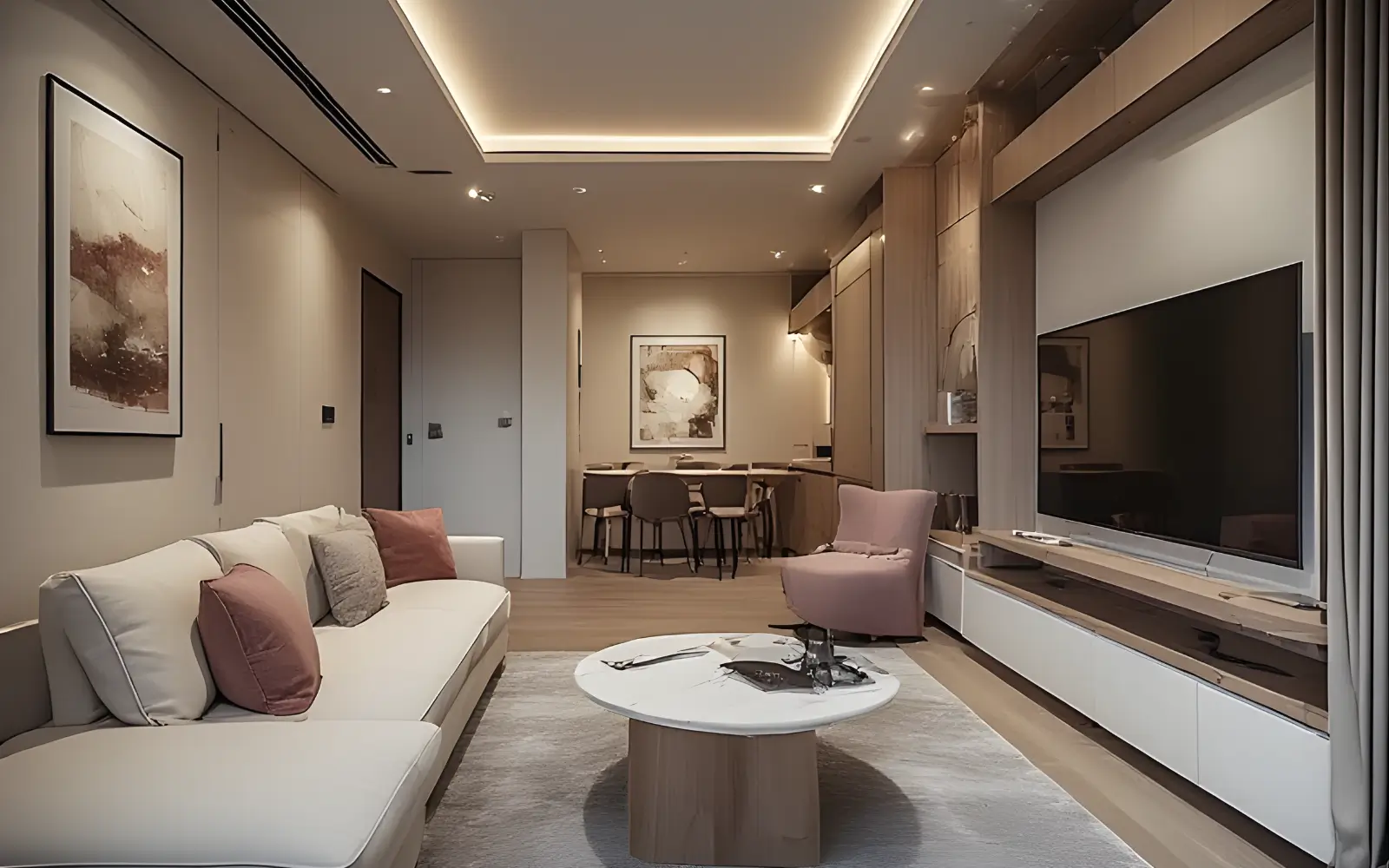
WALL ROLES IN ACTION
A small living room where one wall clearly leads, one wall stores and one wall stays calm so the whole space feels intentional.
Why wall planning matters more than choosing paint chips
In a small room, walls carry enormous visual weight. They are competing with your sofa, bed frame, shelving, curtains and door frames. When every wall tries to make a statement, the room feels cramped even if it is completely tidy. Visual noise is just as exhausting as physical clutter.
Planning wall roles before you choose colours, art or storage gives you a clear filter for every decision that follows. Instead of asking whether you like something in isolation, you can ask whether it belongs on this particular wall.
- You create one clear focal point that anchors the room.
- The other walls become a calmer backdrop for furniture and decor.
- Shopping for art, shelves and accessories becomes easier because you know exactly what you need and where.
- The room looks designed rather than random, as if someone made deliberate choices.
Step 1: Audit your room and each wall
Before you assign anything, you need to see your walls clearly. It is easy to stop noticing them and treat them as background noise. Stand in the doorway of your room; this is how you and every guest first see the space. Look slowly from left to right and pause at each wall.
For each wall, ask yourself:
- What is already on it? Windows, doors, radiators, wardrobes?
- Which walls are most visible from where you sit or sleep?
- Where does your eye go first, and is that intentional?
A quick way to make this concrete is to draw a rough floor plan and label each wall A, B, C and D. Next to each letter note what is physically on that wall and how it feels: too busy, too empty, awkward or fine. The sketch does not need to be accurate; it simply separates the walls in your mind as individual surfaces with their own possibilities.
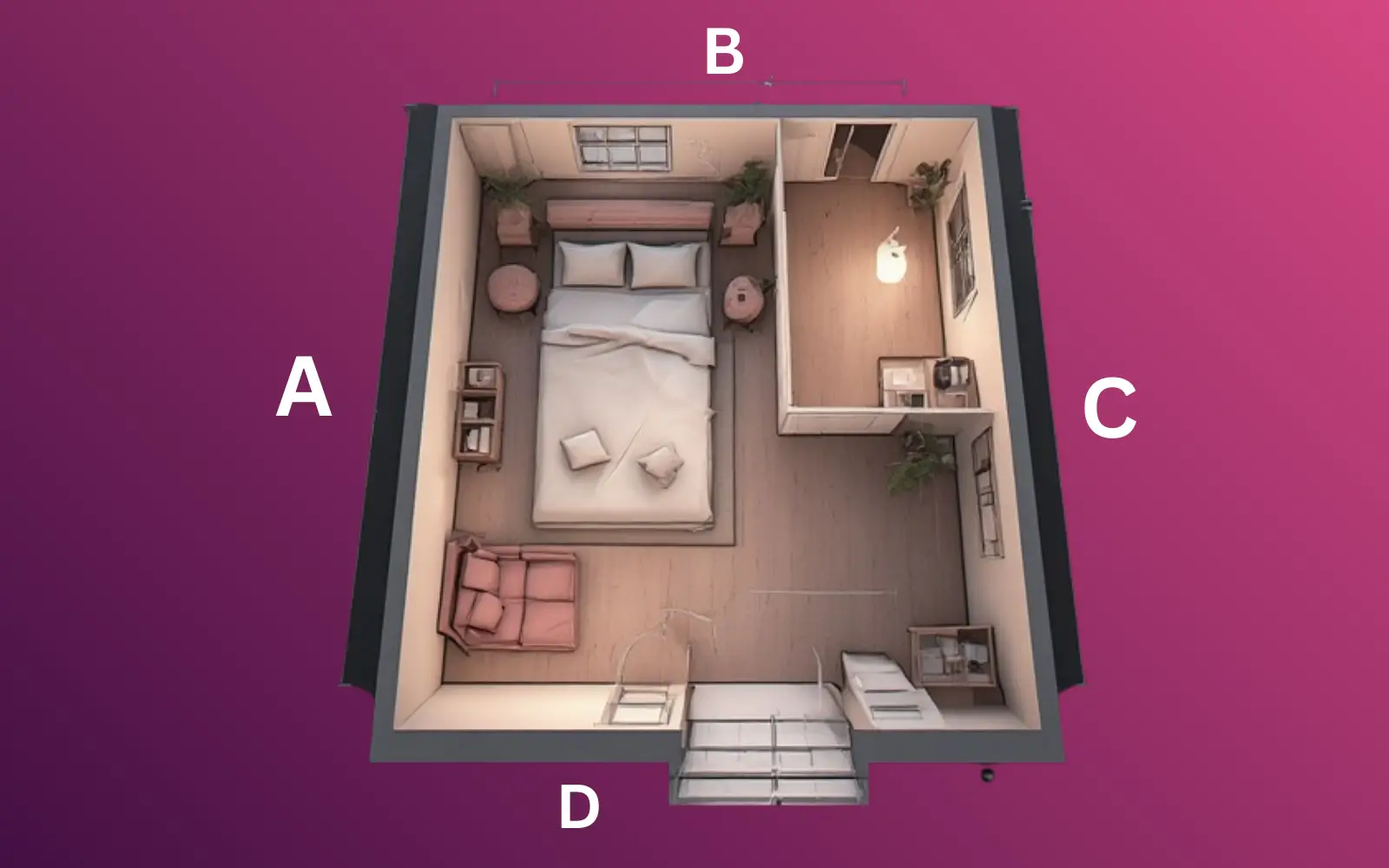
SIMPLE ROOM MAP
A quick sketch that makes each wall visible as its own surface with its own constraints and potential.
Step 2: Assign roles to your walls
Once you can see your walls clearly it is time to give each one a job. In most small apartments there are four core wall roles: feature wall, support wall, storage wall and calm wall.
Feature wall
The feature wall is the wall that gets to show off. It is your focal point and the place for a deeper colour, a statement wallpaper, one oversized art piece or a large mirror. It should be the most visible wall in the room so it can deliberately draw the eye and let everything else relax.
In a small bedroom this is almost always the wall behind the bed. In a living room it is usually behind the sofa or the media unit. In a studio it might be the wall that visually separates sleeping and living zones. If you are renting, a feature wall does not have to be painted; large removable art, a tapestry or a gallery of frames can do the job and come down when you move.
Support wall
The support wall is visible but quieter. It might hold a few framed prints, a wall-mounted light or a slim shelf, but it does not compete with the feature wall. It adds character without stealing focus.
In a small bedroom the side walls often play this role. In a living room a wall with a window can act as a support wall because the natural light already does most of the work. For renters, this is where smaller, lower-commitment decor lives: a couple of prints, a hanging plant or a simple mirror.
Storage wall
The storage wall is the hardest-working surface. Wardrobes, bookcases, tall shelving and pegboards belong here. The goal in a small home is to consolidate storage so one organised wall carries most of the functional load instead of scattering cupboards and shelves around the room.
Visually, a storage wall should be as calm as possible: uniform shelving, matching boxes and neutral wardrobe fronts. Save the personality for the feature wall. Freestanding units and modular systems work well for renters and leave little trace when removed.
Calm wall
Every small room needs at least one wall that does almost nothing. A calm wall might simply be a soft neutral colour or a plain curtain. Its job is to give your eye somewhere to rest. It balances the busy-ness of feature and storage walls and often makes the room feel bigger.
Do not panic about a wall that feels empty. That intentional emptiness is doing real work for the space.
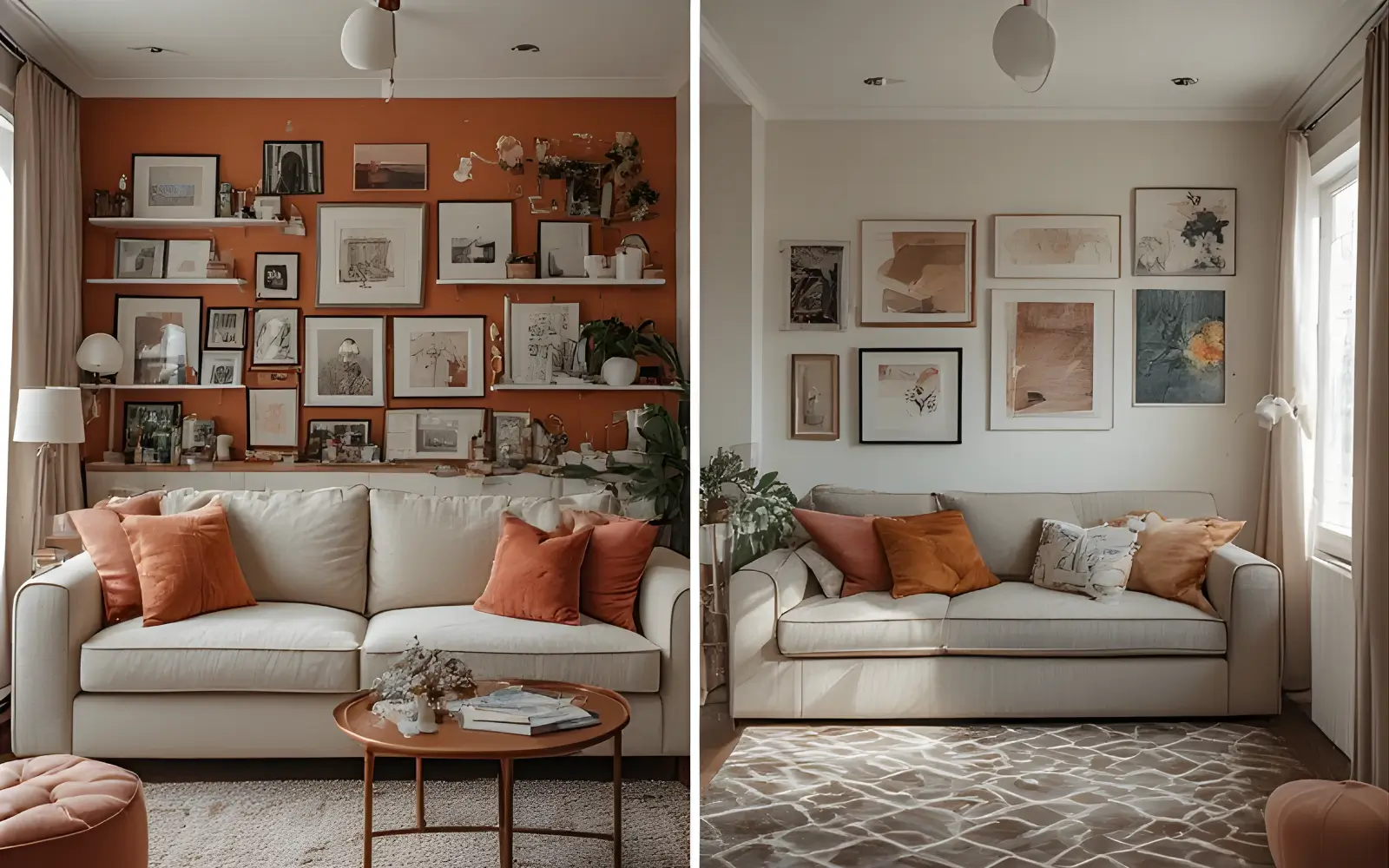
BEFORE AND AFTER
The difference between treating every wall as a feature and using one clear hero wall with supporting and calm surfaces.
Step 3: Choose one hero wall per room
In most small rooms, one feature wall is enough. Two strong feature walls fight each other and three create visual chaos. Your hero wall is the single wall that receives the most attention, investment and personality; everything else in the room frames it.
To choose a hero wall, start with the room type:
- Small bedroom: usually the headboard wall, because it anchors the bed and is often what you see first when you walk in.
- Small living room: typically the sofa wall or the media wall. Choose the one that is most visible from your main seating spot.
- Studio apartment: often the wall that marks the transition between sleeping and living zones, helping to define them without a solid partition.
Sometimes the obvious wall is full of awkward obstacles, such as a central door, a radiator or a chopped-up window arrangement. In that case skip it and choose the next most visible wall that you can treat more cleanly.
Good and weak hero wall candidates
Good candidates:
- The largest unbroken wall surface in the room.
- The wall you face from your main seat or when you walk in.
- The wall directly behind the bed or sofa.
Weak candidates:
- Walls with multiple doors or openings.
- Walls dominated by radiators or immovable pipework.
- Very narrow walls between doors that cannot hold art or storage.
A simple rule of thumb is to choose the wall your eye already goes to first when you enter or sit down. Your brain has picked a hero wall; you are just confirming it and using it on purpose.
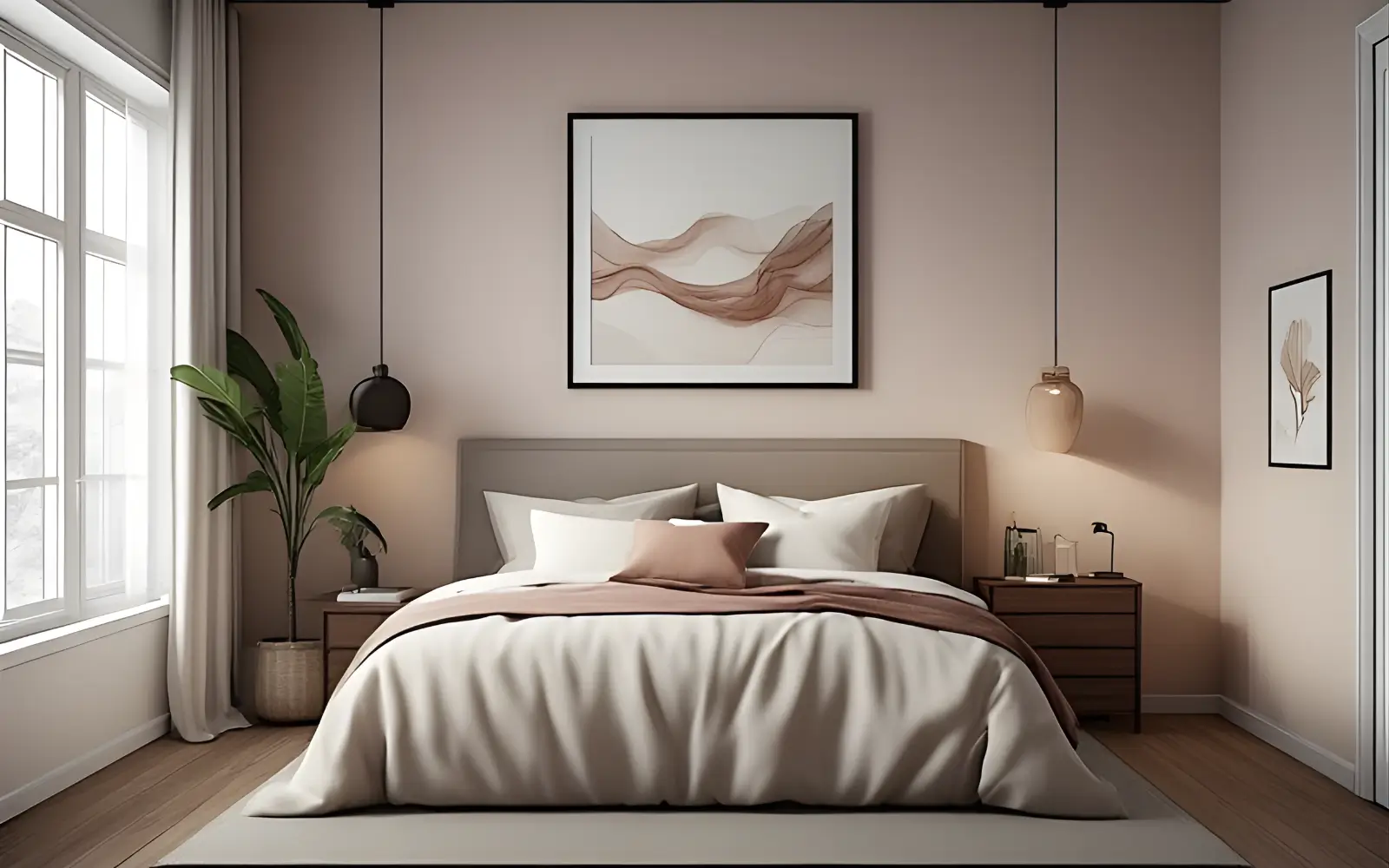
SINGLE HERO WALL
One wall gets the statement colour and art so the rest of the room can stay calm and feel larger.
Step 4: Plan the other walls around the hero
Once your hero wall is chosen the rest of the room becomes easier. Every other wall exists to support it rather than compete. The principle is one strong moment and three quieter ones.
If the headboard wall has bold art or a rich colour, the wall opposite should be calm with soft paint and minimal decor. If the TV wall is built up with a media unit and shelving, the wall across from it should breathe. Think of visual balance the same way you would balance furniture: a heavy piece on one side needs lighter pieces on the other.
Mini layout examples
Small bedroom
- Hero wall: the headboard wall with a large art print or panel.
- Support walls: side walls with small bedside sconces or one framed print each.
- Calm wall: opposite wall kept simple and in the same soft tone as the ceiling.
Small living room
- Hero wall: sofa wall with a coherent art grouping.
- Storage wall: opposite wall with a low media unit and one bookshelf.
- Calm walls: side walls with curtains, a plant or a floor lamp but little else.
Studio apartment
- Hero wall: long wall that runs through the main living zone with art that marks the lounge area.
- Storage wall: the section behind the sleeping area with wardrobe and shelving consolidated neatly.
- Calm wall: the wall at the foot of the bed, kept almost bare to signal rest.
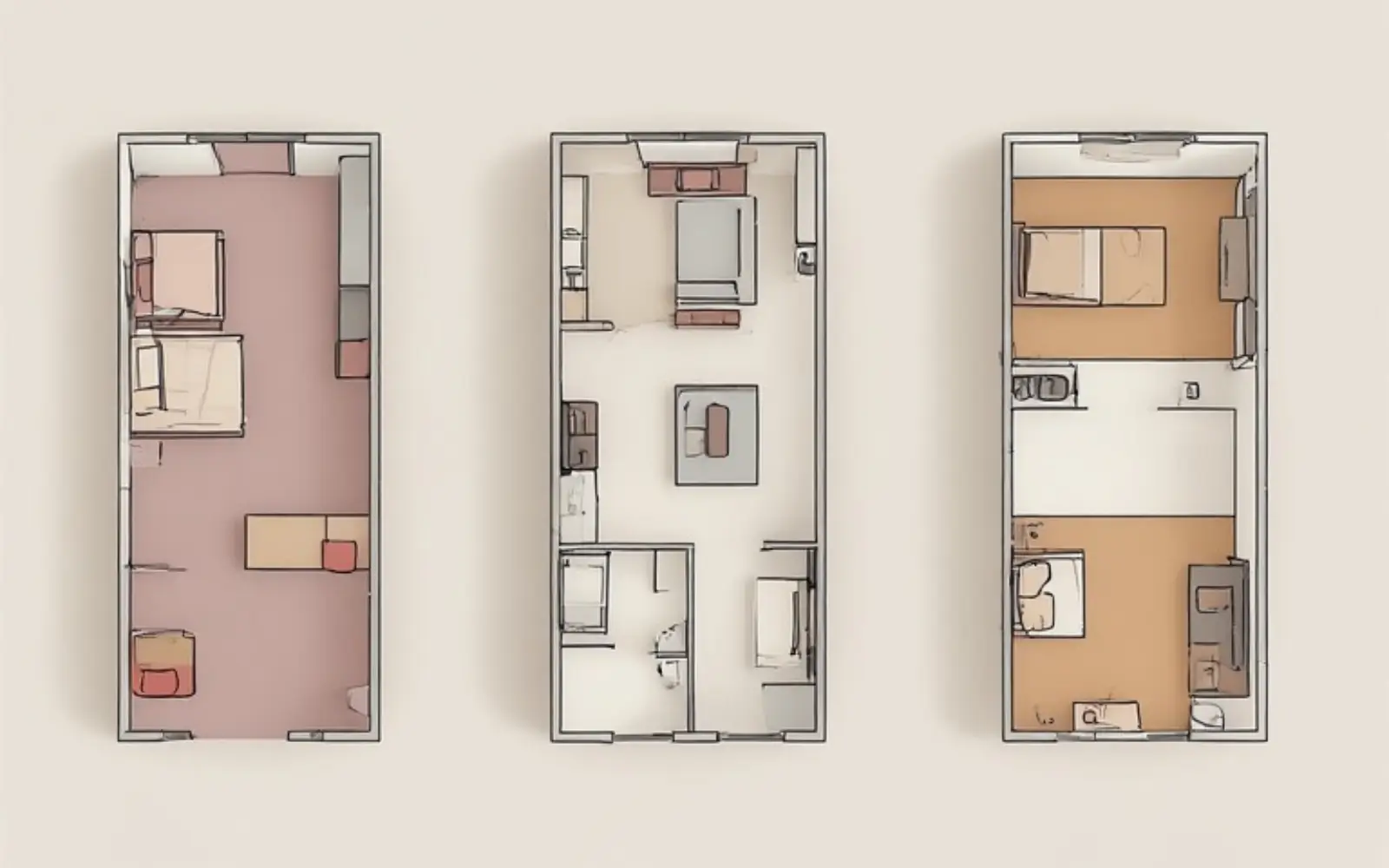
WALL ROLE LAYOUTS
Visual recipes for how feature, storage and calm walls can be arranged in bedrooms, living rooms and studios.
Common wall-planning mistakes in small apartments
Mistake 1: Every wall is a feature wall
When two or three walls all shout with colour, art and shelving, the room feels overwhelming and it is hard to rest. There is no visual hierarchy.
Fix this by choosing one hero wall and deliberately stripping back the others. Keep at least one wall almost completely empty. The contrast is what makes the feature wall feel special.
Mistake 2: Art is hung too high or too scattered
Art that floats near the ceiling or tiny prints spread across a big wall with huge gaps between them makes the room feel unfinished.
Instead, connect art to the furniture beneath it. Above a sofa, frames should sit roughly 15–20 centimetres above the back. Group frames closer together with smaller gaps so they read as one composition rather than unrelated pieces.
Mistake 3: Storage everywhere, but no calm surface
Shelves on three walls and a wardrobe on the fourth turn the room into a storage unit. There is nowhere for your eyes to rest.
Consolidate storage onto one or two walls at most, then leave at least one wall mostly empty. A bare painted wall can still feel designed when it is clearly intentional.
Mistake 4: Copying layouts from larger rooms online
Layouts and wall treatments that look perfect in big open-plan spaces often do not translate to a compact apartment with awkward doors and radiators.
Start with the room you actually have. Map doors, windows and fixed elements first, then decide where a hero wall, storage wall and calm wall make the most sense. A plan that works with your architecture will always look better than a copy of someone else's room.
Real-life examples: three small rooms with clear wall roles
1. Tiny rental bedroom with one window
Before: three walls each hold a framed print and the fourth wall holds a wardrobe. Everything is at the same visual volume and the room feels smaller than it is.
After wall-role decisions, the headboard wall becomes the hero with a warm fabric panel hung behind the bed. The window wall becomes the calm wall left almost bare so the light can do its job. The wardrobe wall stays as storage but with simpler, more unified fronts. One side wall holds a small bedside shelf and a single print.
2. Narrow living room with doors at both ends
Before: both end walls have doors, making them awkward to decorate. The long side walls are unbalanced: one has a sofa, the other a window and radiator. Art is hung randomly and nothing feels connected.
After wall-role decisions, the long wall with the sofa becomes the hero with three prints treated as one composition above the sofa. The window wall opposite becomes the calm wall and stays almost empty. One end wall gains a slim console and mirror; the other is kept practical for circulation.
3. Studio apartment with one dominant long wall
Before: one long wall runs the length of the apartment with a mix of wardrobe, floating shelves and random art across both the sleeping and living halves. There is no clear sense of zones.
After wall-role decisions, the long wall is divided deliberately. The half behind the sleeping area becomes a storage wall with wardrobe and a single calm piece of art. The half behind the living zone becomes the hero with a low bookshelf, two larger prints above and a floor lamp. Short end walls stay mostly calm. The studio now feels like a home with distinct areas rather than one undifferentiated box.
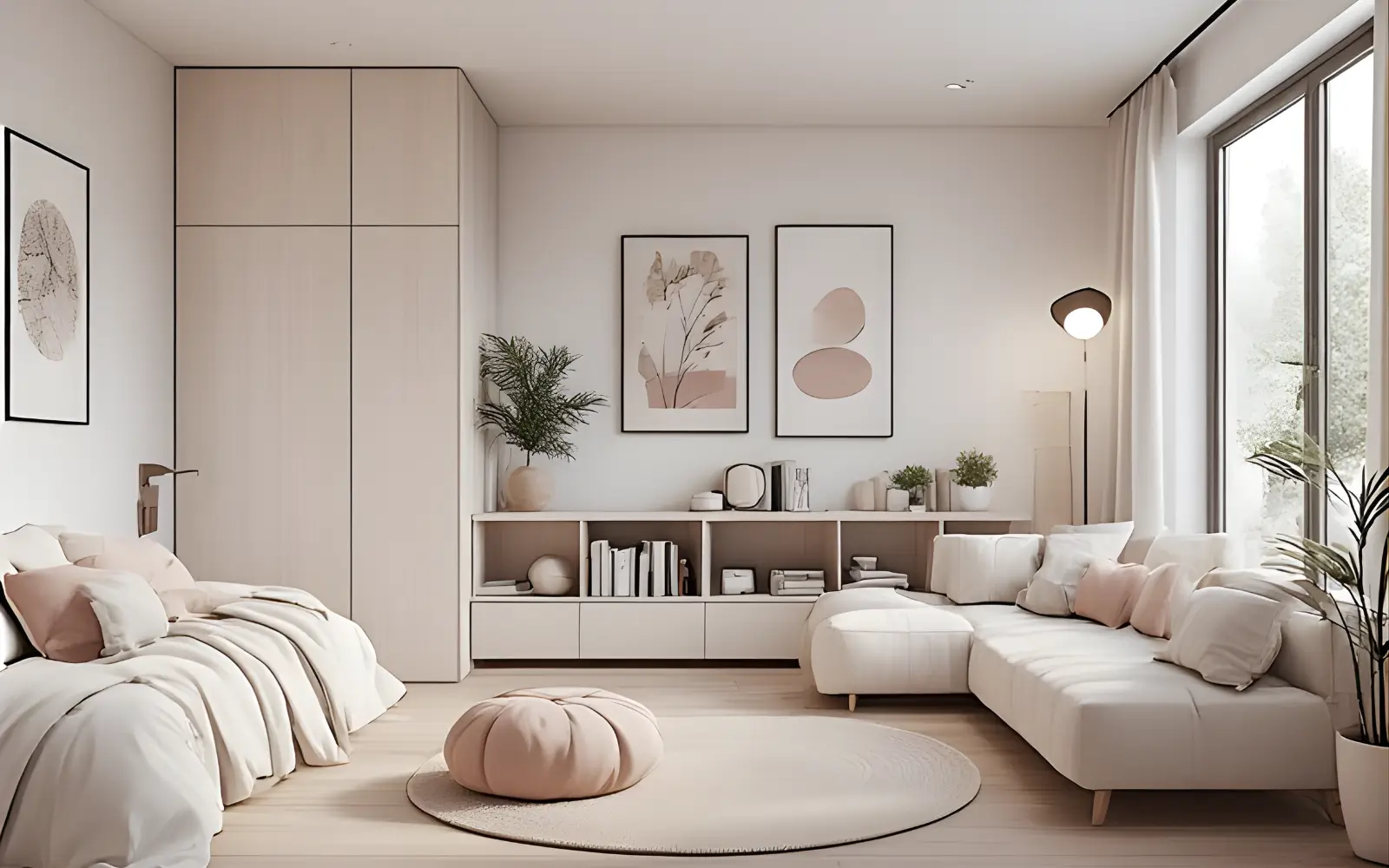
LONG WALL, CLEAR ZONES
A studio where one long wall splits cleanly into a calm storage section for sleep and a hero section for the living area.
How wall planning connects to colour, art and furniture
Once your wall roles are clear, decisions that used to feel overwhelming become straightforward. Colour and wallpaper go where your plan tells them to: the feature wall is where you invest in a deeper shade or printed paper, while calm and support walls stay in softer tones that suit rented spaces.
Art follows the same logic. The hero wall carries your largest or most curated arrangement, the support wall gets one or two smaller pieces and the storage and calm walls stay almost bare. Storage finally has a clear address so you stop spreading it across every surface.
If you want to go deeper into how layouts support your wall plan, the Small Apartments & Studio Decor hub walks through zoning and floor-plan recipes. For bedrooms, Aesthetic Room & Bedroom Ideas for Small Apartments shows how to style the headboard wall once you have chosen it as your hero.
Quick wall-planning checklist
Use this checklist before you buy anything, hang anything or pick a colour. It keeps every decision anchored to the roles you have given each wall.
- Have I chosen one hero wall per room?
- Do I know which wall is storage and which is calm?
- Is any wall trying to do too many jobs at once?
- Does the room have at least one quieter wall where the eye rests?
- Does my wall plan work with my actual doors, windows and radiators?
- Am I decorating the walls in service of the furniture?
- If I walk in right now, does my eye know where to go first?
Planning bedroom walls first
If you are starting your wall plan around the bed, pair this pillar with the main bedroom hub:
Aesthetic Room & Bedroom Ideas for Small Apartments – a full room-by-room framework that shows how wall roles, colour and storage come together.
Paint and colour palettes for small apartments: calm, cohesive and renter-friendly
Most people choose paint the wrong way. They screenshot a room they love on Pinterest, take the image to a paint shop and try to match the wall colour without considering the light in their actual apartment, the undertone of their existing floors or how that colour will feel at seven in the morning on a grey Tuesday.
In small spaces, colour mistakes are unforgiving. One wrong white makes a room feel cold and clinical. One harsh accent wall with nothing to tie it together makes an apartment feel like a patchwork of experiments. And a palette that looked perfect room by room can make the whole flat feel choppy and small.
This pillar gives you a step-by-step framework for choosing wall colours and palettes that make a small apartment feel soft, cohesive and considered and that actually work with your light, your floors and your landlord's rules.
Step 1: Decide how you want the apartment to feel, not just how it should look
Before you open a single paint chart, ask how you want to feel when you walk through the door. Not just what style you like or what is trending, but the physical, emotional feeling of your home. Do you want it to feel light and airy like a deep breath? Soft and cocooning like wrapping yourself in something warm? Or calm and grounded, quiet without being cold?
The answer to that question tells you a lot about the temperature, contrast level and saturation of your palette before you have looked at a single swatch.
Mood translates directly to colour choices:
- High contrast (very light walls with very dark accents) reads as energetic, graphic and modern. It can feel sharp in small spaces.
- Low to medium contrast (walls and accents close in value) reads as calm, gentle and cohesive. This is usually the right direction for small apartments.
- Warm undertones (cream, blush, sand, terracotta-adjacent) feel soft and enveloping.
- Cool undertones (grey, blue, green-grey) feel crisp and fresh but can feel cold in dark or north-facing rooms.
Three mood directions that work beautifully in small apartments:
- Soft & calm: warm white or very light greige walls, blush or dusty rose in textiles and one feature wall, gold or brass metal finishes. Gentle, feminine, effortless.
- Warm & cocooning: light greige throughout, a slightly deeper taupe on the hero wall, dark chocolate or soft bronze in small accents. Grounded and intimate.
- Fresh & airy: pale sand or warm off-white walls, sage on a feature wall or niche, natural wood and linen textures throughout. Clean without being cold.
As a quick exercise, write down two or three words that describe how you want your home to feel. Not what you want it to look like, but how you want it to feel: something like "soft and bright," "warm and quiet" or "calm and put together." Keep those words nearby as your filter for every colour decision that follows.
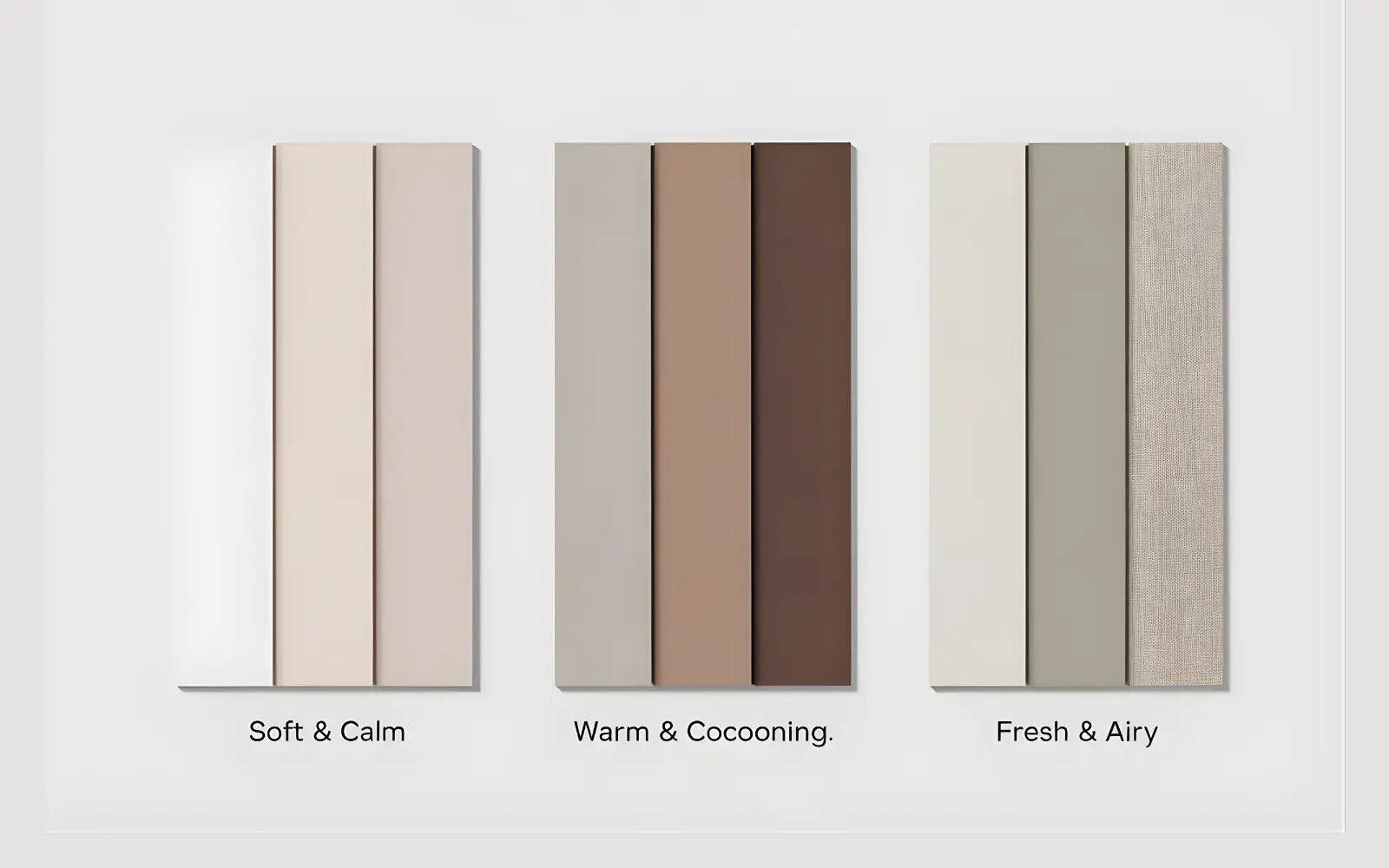
THREE MOOD PALETTES
Soft & calm, warm & cocooning and fresh & airy palettes that keep a small apartment feeling cohesive instead of chaotic.
Step 2: Understand undertones and light in a small apartment
Undertones are the reason two whites can look completely different on your wall. They are the underlying cast of colour hiding beneath what you see on the chip and, in small apartments, getting them wrong is one of the most common reasons a room feels "off" even when everything else is right.
The basics of undertones:
Every neutral has an underlying bias. Whites lean warm (creamy, ivory, shell) or cool (blue, grey, green). Beiges lean pink, yellow or grey. Greiges that ideal mix of beige and grey can lean warm or cool depending on their exact formula.
Undertones only really reveal themselves in context. A white with a pink undertone looks completely neutral on a chip, but put it next to warm orange floorboards and suddenly the pink pops. A grey with a blue undertone looks elegant in a showroom with south light but goes flat and slightly grimy in a north-facing bedroom.
How your existing finishes interact with paint:
Your floors, trim, kitchen cabinets and bathroom tiles are already part of your palette whether you chose them or not.
- Cool grey walls with warm orange-toned wood floors clash; the two undertones fight.
- Yellow-beige tiles with blue-grey paint look muddy; the yellow in the tile makes the blue look green.
- Greige walls with medium-warm wood floors feel harmonious because they sit in the same temperature family.
Before you choose any colour, look at the undertone of your biggest existing surfaces your floor and your largest piece of furniture and choose paint that shares their temperature.
How light direction changes everything:
- North-facing rooms receive only indirect, cooler light. Colours read colder and darker than they appear on the chip. Use warm neutrals creamy whites, warm greiges, soft oatmeal tones and avoid cool greys and icy whites, which will feel flat and draining.
- South-facing rooms get warm, direct light for much of the day. They can handle slightly cooler or more neutral tones without reading cold.
- Dark interior rooms with no direct window light need the lightest, warmest colours you can find. Avoid mid-tone greys entirely; they absorb light and make the room feel like a cave.
Colours that generally work well in low light:
- Warm whites with a cream or shell undertone
- Soft greige (beige-grey with a warm lean)
- Pale sand or warm oatmeal tones
- Very light blush or barely-there pink
Colours that are tricky in low light:
- Cool or blue-grey whites
- Mid-tone greys that are neither light nor dark
- Stark bright white with no warmth
- Strong saturated colours, which darken considerably in low light
How to test paint properly:
Never choose paint from the chip. Paint a large swatch at least an A4-sized block directly on the wall you are considering. Put it next to your trim and as close as possible to your floor or a flooring sample. Then look at it at three different times: morning light, midday and evening with artificial lighting on. The colour you see under artificial light at night is the colour you will live with most.
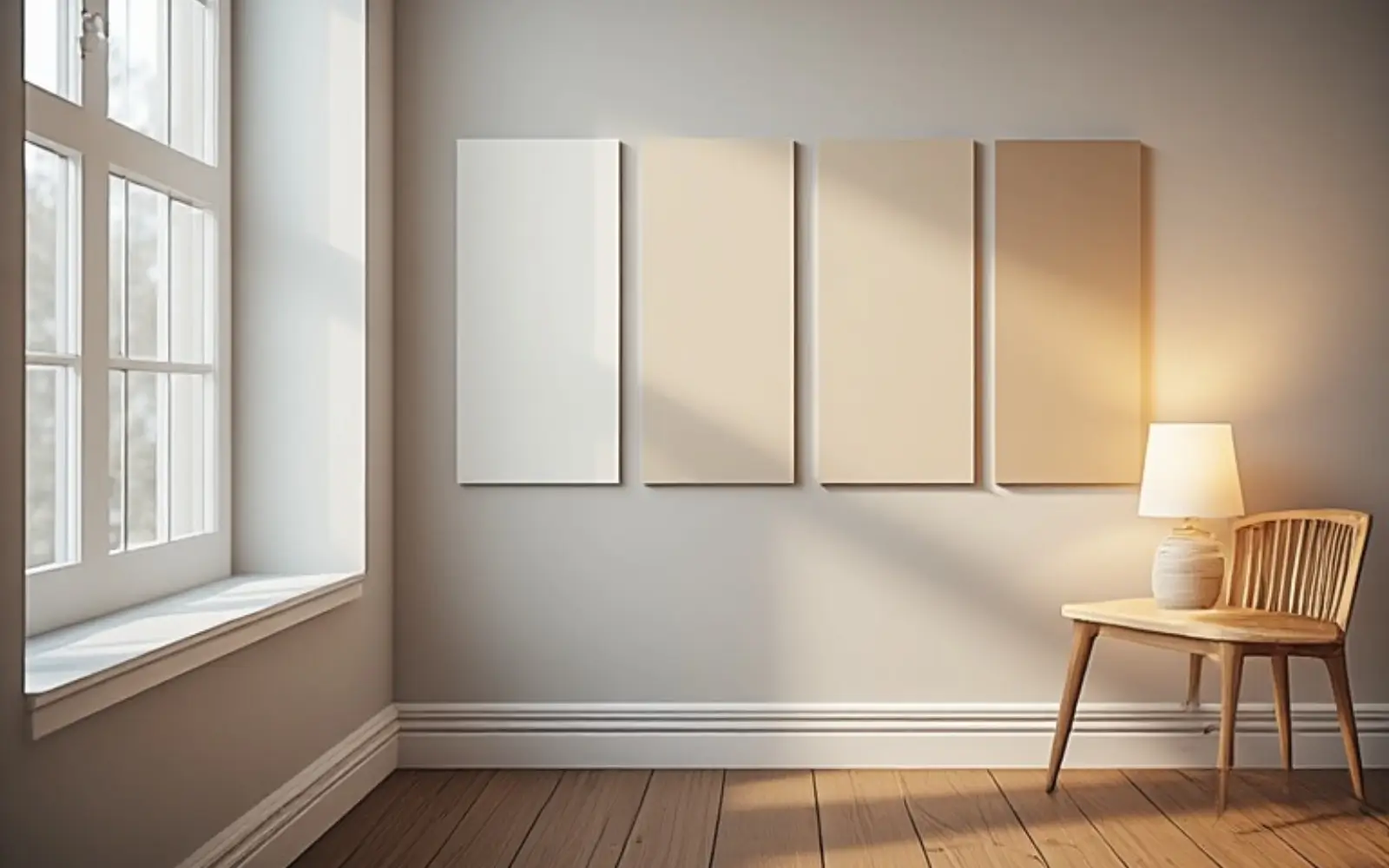
UNDERTONES IN REAL LIGHT
Large wall swatches reveal whether a warm white, greige or sand tone actually flatters your floors and lighting.
Step 3: Build a whole-apartment palette with 3–5 colours max
This is the most important concept in this guide: your palette is for the whole apartment, not for individual rooms. The biggest reason small apartments feel cramped and disjointed is too many unrelated colours competing across too small a space. When every room has a different wall colour, every corridor becomes a jarring transition.
A limited, cohesive palette usually three to five colours used consistently makes the whole apartment feel larger and more intentional. The eye moves through connected spaces without constant interruption.
The four layers of a small-apartment palette:
- Base colour: your main wall colour, used across most or all rooms. Usually a warm off-white, soft greige or pale neutral. This is the colour that unifies the apartment.
- Secondary colour: used on one or two feature walls or carried into large textiles and furniture. Slightly deeper or more saturated than the base but still in the same family.
- Accent colour: used in small amounts cushions, art, a vase, a lampshade. This is where personality lives, but it should appear in at least two or three places so it feels intentional rather than random.
- Metal and wood finish: your fourth colour the tone of your frames, light fixtures, taps and door handles. Repeating the same finish throughout ties everything together.
Three palette recipes for small apartments:
1. Soft neutral + blush
- Base: warm white or very light greige that is almost white.
- Secondary: blush or dusty rose in headboard fabric, curtains or on the headboard wall itself.
- Accent: soft gold or warm brass, plus warm wood tones in frames and furniture legs.
- Works best in low-light bedrooms, small living rooms and feminine studios.
2. Greige + taupe
- Base: light greige throughout all rooms.
- Secondary: a slightly deeper, warmer taupe on the hero wall.
- Accent: softened dark tones deep chocolate in a lamp base, dark bronze in a frame edge, matte black in very small doses.
- Works best in rentals with mixed existing finishes and open-plan spaces where consistency matters.
3. Sage + sand
- Base: warm off-white or very pale sand lighter than cream, warmer than pure white.
- Secondary: sage green on a feature wall, kitchen niche or bathroom alcove.
- Accent: natural materials linen textures, light rattan, woven baskets, pale unfinished wood.
- Works best in bright rooms and studios where you want a fresh but not cold feel.
Pick one palette and commit to it for the whole apartment. Colours can shift subtly room by room the base might be slightly lighter in the bedroom and slightly warmer in the living room but they must sit in the same family with the same temperature, saturation and overall mood.
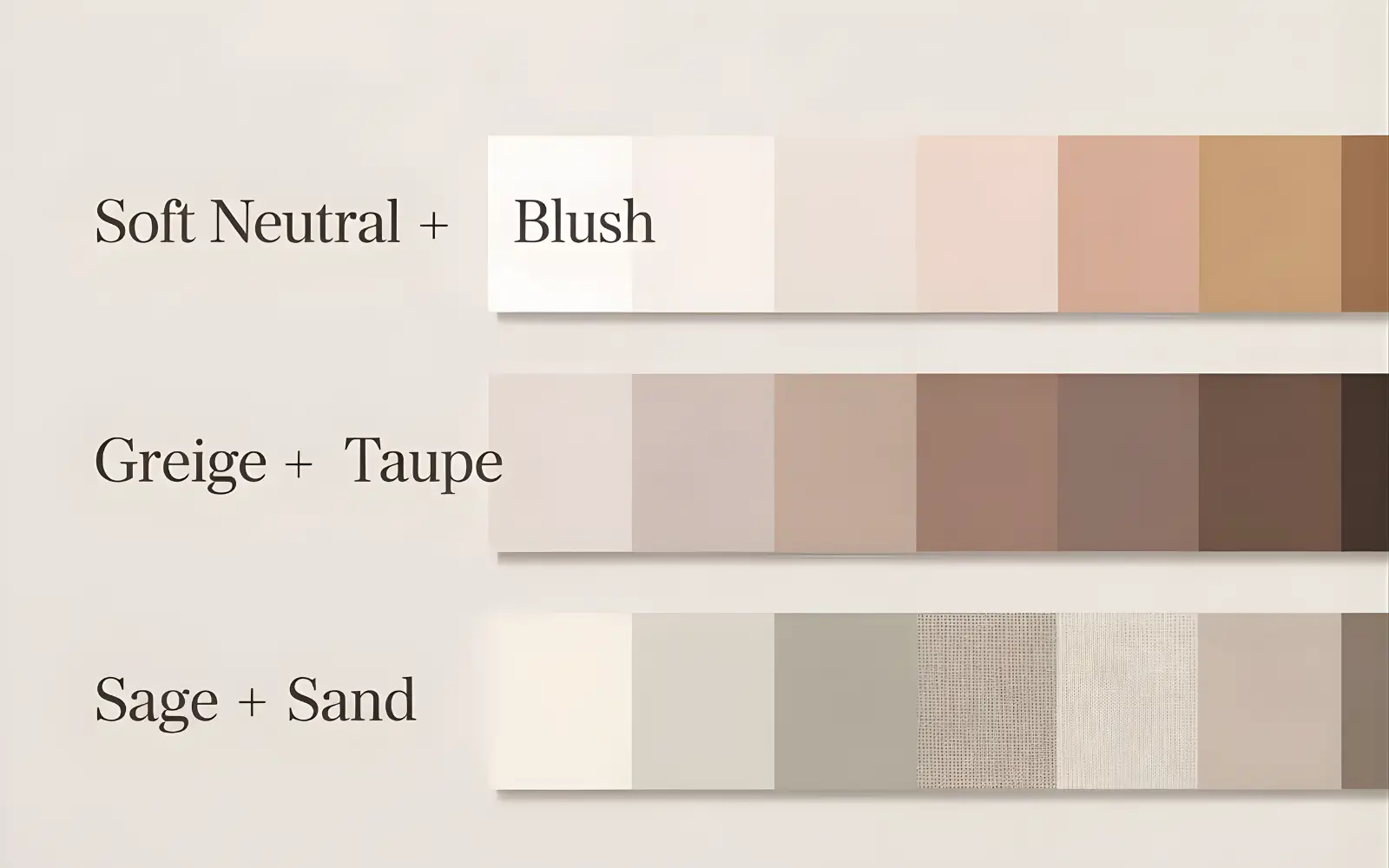
PALETTE RECIPES
Three simple palette families that keep walls, furniture and decor speaking the same soft, feminine language.
Step 4: Apply your palette to walls in different room types
Once you have your palette, the question becomes which colour goes where. This is where the wall roles from the wall-planning guide come back in. Your palette decides which walls stay light and which get depth, but your wall roles tell you which wall gets which treatment.
Bedrooms: calm envelopes with one gentle feature
The bedroom should be your most restful room. That means low contrast, warm tones and no colour that demands attention when you are trying to sleep.
Scenario 1 subtle depth on the headboard wall:
Your base colour warm white or very light greige covers three walls and the ceiling. The headboard wall your feature wall goes one step deeper or slightly more saturated. If your base is warm white, the headboard wall might be a soft greige; if your base is already greige, the headboard wall might be a gentle taupe. Trim stays in the same warm family as the walls or slightly lighter.
Scenario 2 all walls the same, colour in layers:
All four walls and the ceiling stay in the same soft neutral. Colour appears entirely in the headboard, bedding, curtains and art, not on the walls at all. This works beautifully in very small bedrooms where even a subtle feature wall might feel heavy and gives you flexibility to change the mood without touching the paint.
In both cases, if your headboard wall is your feature wall, that is where your secondary colour or deepest tone lives. The calm walls stay as close to the base colour as possible.
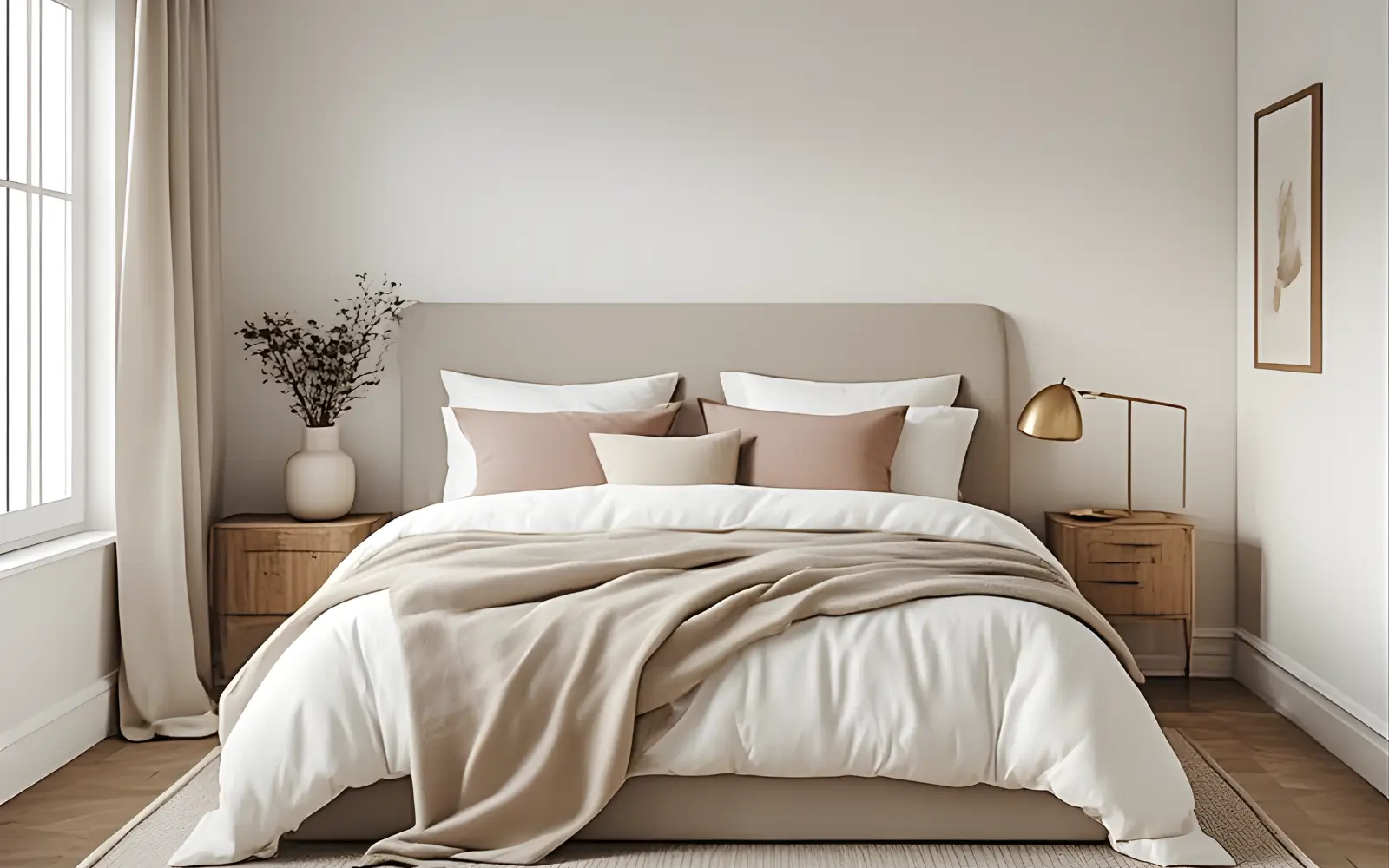
SOFT NEUTRAL + BLUSH IN ACTION
A small bedroom where warm whites, greige and blush work together so the feature wall feels gentle instead of loud.
Living rooms: one hero wall and supporting neutrals
The living room usually needs a little more personality than the bedroom. It is a space for being awake and present, not just resting.
Scenario 1 feature colour behind the sofa:
The sofa wall your hero wall takes your secondary colour a slightly deeper greige, a warm taupe or a very muted sage. The wall opposite, which is what you see from the sofa, stays in your base colour lighter, softer and quietly recessive. Side walls stay in the base colour too so the depth is directional and clearly anchored.
Scenario 2 all walls neutral, depth in the media unit:
If your living room has awkward architecture, let the walls all stay in your base colour and build depth through a painted or dark-toned media unit, a large art piece or a statement bookshelf. The effect is cohesive and adaptable while still giving the room a focal point.
Studios: making one palette do all the jobs
In a studio, your palette has to work as a bedroom, a living room and sometimes a workspace all in one connected space. The risk is that it tries to do too much and ends up doing nothing coherently.
The principle is simple: use your base colour everywhere and let the secondary colour mark the zones. Sage on the sleeping-zone wall and warm off-white everywhere else creates a visual zone without a physical partition. A slightly deeper greige on the living-zone feature wall while the sleeping area stays in pure warm white sends a subtle signal that these are different places.
Keep your accent colours consistent across both zones the same brass finish, the same blush in one cushion on each side so the whole studio reads as one coherent home.
Step 5: Renter-friendly colour strategies (including when you can't paint at all)
Many rental guides assume you can paint. Many of you cannot. This step is for both situations: when you can paint a little and when you cannot paint at all.
When you can paint a little
If your landlord allows painting with conditions such as repainting white before you leave or sticking to approved neutral colours use that access wisely. Pick one or two walls per apartment: your hero walls from the wall-planning framework. These are the walls with the most visual impact, so any colour investment here goes furthest.
Choose a colour that works with your existing trim and flooring, remembering the undertone rules. Go for low-VOC paint in a flat or eggshell finish; it is easier to repaint when you leave and kinder to shared ventilation.
If you are painting over landlord magnolia or a warm beige, choose your new colour in the same temperature family. Going from warm beige to cool grey often requires extra coats and still risks looking muddy. Going from warm beige to a soft greige or blush-white is much more forgiving.
When you can't paint at all
When painting is completely off the table, treat the existing wall colour as your base even if you did not choose it. If the landlord walls are a flat warm beige, you have a warm neutral base. Build your palette around it by choosing textiles, furniture and accents that belong in the same family.
Use large-scale elements to shift the visual temperature of the room: curtains hung wall to wall and floor to ceiling, large area rugs to neutralise floors, oversized art or fabric panels on feature walls and removable wallpaper on a partial wall. These pieces create new colour fields that visually compete with the landlord paint.
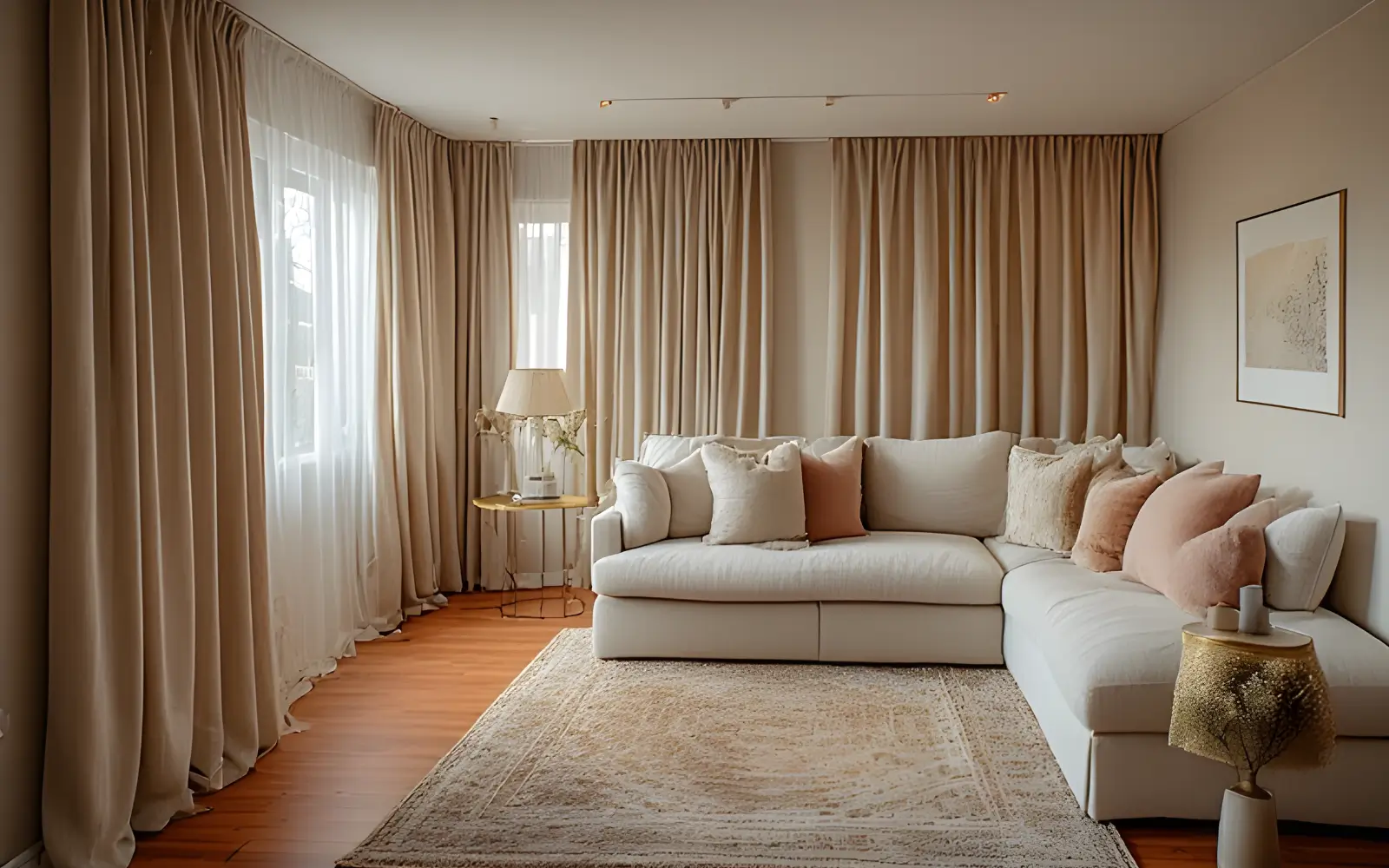
RENTAL FIX WITHOUT PAINT
Curtains, a big rug and soft textiles pull landlord beige walls into a calm, cohesive palette without breaking any rules.
Using textiles and large pieces as "paint"
In small rooms, your sofa, bedding, headboard and curtains cover a significant surface area. They function as colour fields in the same way walls do. A blush linen sofa in a beige-walled room reads as blush being part of the palette. A sage-green headboard against white walls reads as sage being your secondary colour.
Keep these large pieces aligned with your three to five colour palette. A dark navy sofa in a sage-and-sand palette introduces a colour the palette cannot absorb; a warm cream sofa in the same palette becomes the base colour in physical form and works with everything.
Step 6: Common small-apartment colour mistakes (and how to fix them)
Mistake 1: Too many unrelated colours
Every room has a different accent wall, every cushion is a different shade and art lives in colours that do not appear anywhere else. The apartment feels like a series of unrelated experiments.
Fix this by choosing your base and secondary colour and using them consistently. Walk through the apartment with a critical eye and remove or tone down anything that introduces a new colour not already in the palette. It does not have to go entirely; sometimes moving it to a less prominent position is enough.
Mistake 2: Cool grey in a dark or north-facing room
Mid-tone cool grey walls that look beautiful in a magazine shot with perfect studio lighting often read flat, cold and slightly grey-green in real north-facing rooms. They drain the warmth from everything else in the space.
Fix this by switching to a warm greige or creamy off-white. Even a slight shift in undertone from blue-grey to grey-beige will transform how the room feels. Keep the contrast level low with light walls, medium-toned furniture and no stark black accents.
Mistake 3: Strong accent walls with nothing tying them together
A teal wall in the bedroom, a navy panel in the living room and a dark olive in the hallway might each look fine in isolation, but together they make the apartment feel chaotic and smaller.
Fix this by making feature wall colours part of the same palette family or by choosing one accent colour and carrying it through all rooms in textiles and smaller pieces. A muted sage cushion in the bedroom, a sage print in the living room and a sage-toned candle in the bathroom make sage feel intentional rather than random.
Mistake 4: Ignoring the undertone of floors and existing furniture
New paint chosen in isolation, without reference to the floors or largest furniture pieces, almost always creates an undertone clash that is hard to name but immediately noticeable.
Fix this by identifying the undertone of your floor first. If it is orange-warm, cool-grey or yellow-warm, choose wall colours that share that temperature. If your floor is warm, your walls should be warm. If your floor is cool, you have more flexibility but warm walls will usually still work in both cases.
Step 7: Real palette examples for awkward real-life situations
Dark, north-facing living room with orange-toned wood floor
The wood floor reads warm and golden while the north light makes everything feel slightly cold and heavy. Any grey wall paint will turn greenish or muddy.
A better palette is a warm greige base with a very slight pink undertone, a soft warm taupe on the sofa wall and accents in matte gold, warm cream and dusty rose. The sofa wall takes the deeper taupe, all other walls stay in the warm greige, curtains are warm ivory linen hung wide and floor-length and a large cream-toned rug softens the floor.
The room now feels enveloping and warm. The orange floor becomes part of the palette instead of a problem.
Bright bedroom with cool-grey laminate floor
The floor is cool and slightly blue and the room gets good light, which saves it, but any cool wall colour echoes the floor and makes the whole room feel clinical.
A better palette is soft warm white on all walls, a blush-toned headboard and bedding and one large art print with warm pink and oatmeal tones. Metal finishes in brushed brass or warm gold keep everything in the same temperature.
The floor is then neutralised with a large, pale oatmeal-toned rug that covers most of the visible laminate so the room reads as soft and feminine and the floor barely registers.
Open-plan studio with a small kitchenette in a strong existing colour
The kitchenette has dark olive-green cabinet fronts. Fighting it with a completely unrelated palette makes the studio feel incoherent.
Lean into the olive instead. Use a warm off-white as the base colour for all walls, with the palest possible warm lean. Let the secondary colour be a very muted, desaturated sage that is lighter and softer than the olive but clearly in the same green family. Accent with natural wood tones, rattan and warm linen, and avoid introducing extra colours.
All walls stay in warm off-white, a sage linen throw on the sofa and a small sage ceramic on a shelf pick up the kitchen colour and make it feel deliberate. The studio feels calm, earthy and intentional; the cabinets look chosen, not inherited.
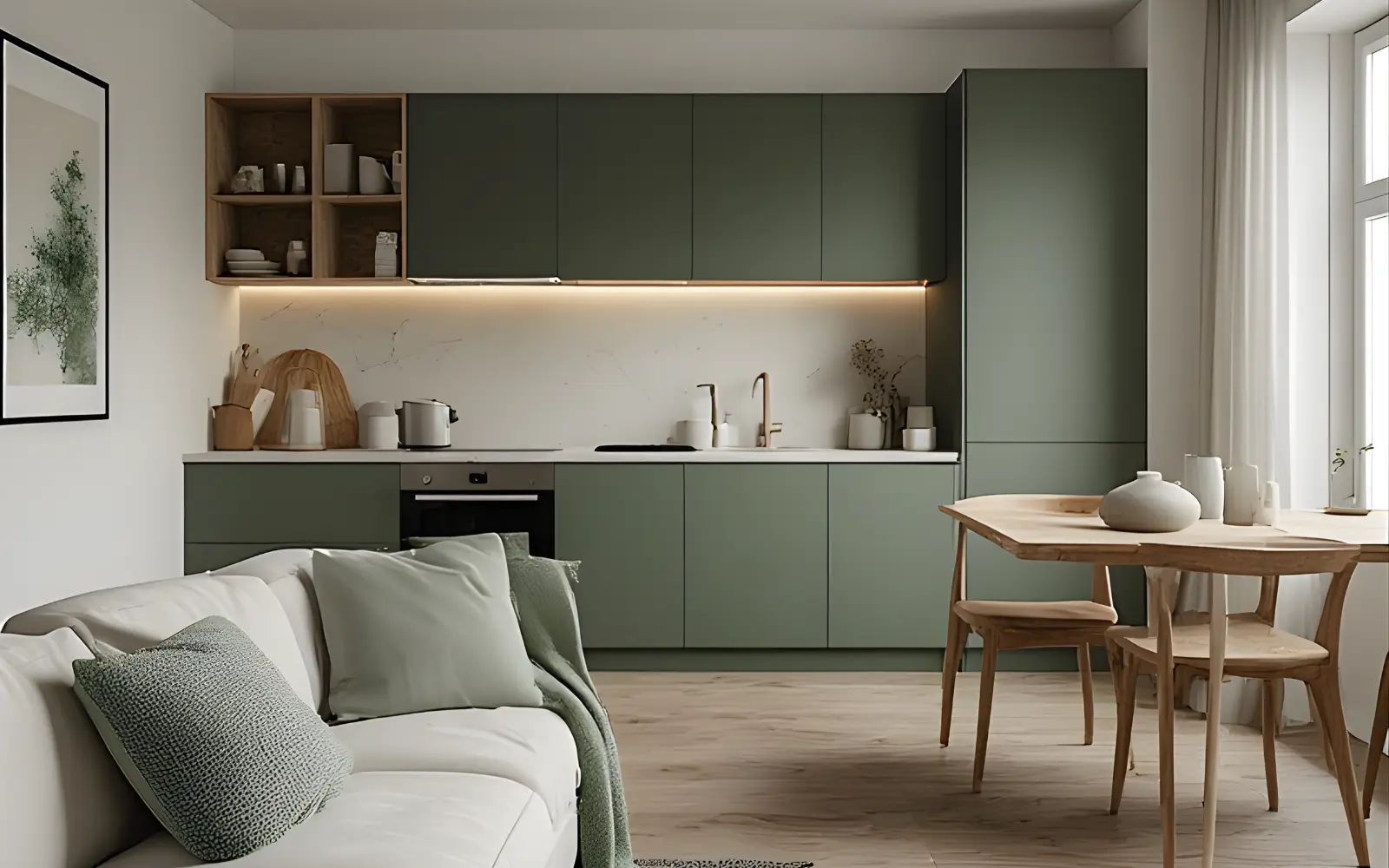
COHESIVE OLIVE STUDIO
A rental studio where an inherited olive kitchen becomes the anchor for a calm, nature-toned palette.
Step 8: Link your palette to art and decor so walls do not fight your style
Colour decisions do not stop at the wall. In a small apartment everything is visible from everywhere, which means your art, cushions, lamp bases and picture frames are all part of the palette too.
The most effective principle: repeat, do not add.
Every new colour you introduce even in a small cushion or a single art print is another thing the eye has to process. In a small space that adds up quickly. Instead choose art and accessories that repeat colours already in your palette.
Frames, metal finishes and wood tones are effectively your fourth colour. Once you have chosen a metal finish brass, matte black or antique silver use it as consistently as possible across lamps, picture frames and decorative objects. The same applies to wood tones: pick a family warm medium, light natural or dark and stick to it.
Once your wall roles are clear from the wall-planning pillar, your palette tells you which walls stay light and which get depth. Once your palette is set, your art choices have a filter so gallery walls feel cohesive instead of random. Your chosen aesthetic whether soft minimal, romantic and layered or modern classic will also influence how saturated your palette should be.
Colour becomes the thread that connects walls, art, furniture and textiles into something that feels like a home rather than a collection of rooms.
Quick colour-palette checklist for small apartments
Use this checklist before you commit to any purchase, paint chip or palette change.
- Do I have one base wall colour that works across most of the apartment?
- Have I chosen only one or two secondary colours, not one per room?
- Does my palette match the mood I want soft, cosy, airy, calm?
- Have I tested paint samples in my actual room light morning, midday and evening?
- Do my wall colours flatter my floors and big furniture instead of fighting their undertones?
- Does every accent colour appear in at least two places so it feels intentional?
- Have I kept my metal finishes and wood tones consistent throughout?
- If I walk through the apartment, does the palette feel like one story, not separate experiments?
Art and gallery walls for small apartments: scale, composition and renter-friendly hanging
Most small apartments have one of two wall problems. Either the walls are completely bare — because the owner is afraid to commit, afraid to drill, or just has not found the right thing yet. Or every wall has a few small prints scattered at random heights, nothing connected to anything, and the overall effect is busier but no more intentional than bare plaster.
In a small apartment, badly placed art does not just look wrong — it actively makes the room feel smaller. Art that is too small for the sofa beneath it leaves the walls looking unfinished. Art hung too high floats into no-man's land and disconnects from everything. A gallery wall in the wrong place on the wrong wall turns a calm room into a chaotic one.
This pillar shows you how to plan and hang art as a designer would — in deliberate compositions tied to your furniture, your wall roles and your palette — without needing to sacrifice your rental deposit to do it.
Step 1: Think in compositions, not individual prints
The most common art mistake is not buying the wrong print. It is buying prints one at a time with no plan for how they relate to each other, then hanging them wherever there happens to be space.
When you approach art one piece at a time, you end up with a series of small decisions that do not add up to a coherent whole. One print bought because you liked it in the shop. One poster from a market that does not quite match the room's palette. A photo from a trip that is meaningful but has no visual connection to anything else on the wall. The result: random heights, mismatched frames and visual noise.
The shift that changes everything is to think in compositions — groups of art that relate to something: to the furniture beneath them, to the wall role they are on, to the palette of the room.
A single large piece above a sofa will almost always read better than five small ones arranged without a clear logic. A structured grid of four frames the same size will look calmer and more intentional than eight different sizes scattered at different heights. The question is not "do I like this print?" — it is "where does this print belong in a composition, and what does it sit with?"
Common starting situations and what is actually wrong:
- One or two small prints floating high above the sofa: the scale is wrong and the placement is not connected to the furniture. The prints look like they drifted upward.
- A "gallery wall" of tiny frames in a corner with no clear shape: there is no anchor piece, no consistent boundary and no relationship to the rest of the room.
- A favourite print that does not match the room's palette: the colour jumps out in a way that draws attention to the mismatch rather than to the art itself.
By the end of this guide you will not be "hanging some art". You will be creating intentional shapes on the wall — compositions with clear edges, correct scale and a relationship to everything around them.
Step 2: Master scale and proportion to your furniture
Scale is the thing most people get wrong, and it is the thing that has the biggest visual impact. The subject of the art matters far less in a small space than whether the size of that art works with the furniture it sits above.
Too-small art makes furniture look heavy and walls look unfinished. Too much empty wall above a piece of art looks cheap, even if the art itself is beautiful. The goal is a relationship between art and furniture that feels balanced — not accidental.
Above a sofa:
- The total width of your art or grouped gallery should be approximately 60–75% of the sofa's width.
- The bottom edge of the lowest frame should sit 15–20 cm (about 6–8 inches) above the back of the sofa.
- Example: a 180 cm sofa — your gallery block should be roughly 110–135 cm wide.
- Wrong: an A4 print centred over a 180 cm sofa. It looks lost, the sofa looks enormous and the wall looks bare.
- Right: a single print at 80×60 cm or a grouped gallery that reads as one cohesive block approximately 120 cm wide.
Above a bed:
- For one large piece: aim for width approximately 50–70% of the headboard width.
- For two or three pieces grouped together: treat them as a single block and apply the same proportion rule.
- Example: a standard double headboard at 140 cm — art block of around 80–100 cm wide.
- Two A5 prints side by side above a double bed is a very common mistake — the combination reads as undersized and tentative.
On narrow walls or between windows:
- Resist the urge to use horizontal pieces when the wall is narrow. Tall, slender verticals emphasise height and make narrow spaces feel more deliberate rather than squeezed.
- A column of two or three vertically stacked frames on a narrow hallway wall reads much more confidently than a row of horizontals that have to be miniaturised to fit.
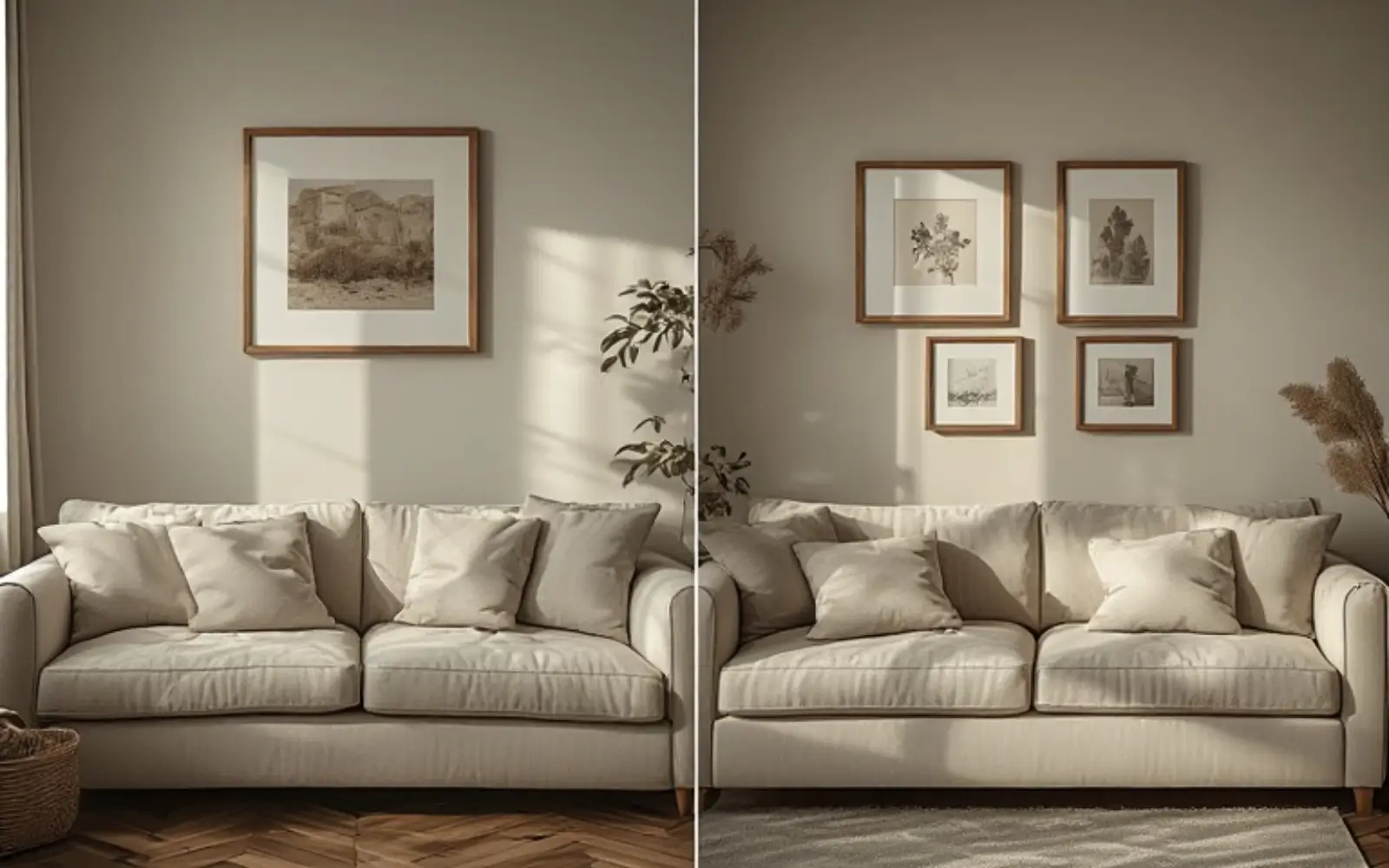
SCALE ABOVE THE SOFA
The same small apartment sofa with two completely different stories: a lost, too-small print versus a correctly scaled gallery that finally finishes the wall.
Step 3: Choose the right gallery wall shape for your room
Not every wall and not every person suits the same gallery style. The layout you choose should work with your room's architecture, your wall roles from the planning stage and your own aesthetic.
Single statement piece
One large piece — usually at least 60×80 cm, often larger — hung centred above the sofa or bed. Clean, calm, minimal effort. Works best for a minimalist or modern aesthetic where the art is strong enough to carry the wall on its own. Ideal for a hero wall where you want one clear focal point without visual complexity.
Grid layout (3×2, 2×2, 2×3)
A structured arrangement of frames the same size, evenly spaced. Reads as a single designed object on the wall. Calmer than an organic gallery, easier to plan and execute. Works beautifully on hero walls in bedrooms and living rooms. Suits a modern, clean or Scandinavian-influenced aesthetic.
Linear or row-based layout
A horizontal row of two to four pieces, all aligned at the same top or centre line. Neat and disciplined. Works especially well above a long sofa or a console table, or in a hallway. Suits someone who wants a gallery but with a sense of order and restraint.
Organic or salon-style gallery wall
A looser arrangement of different sizes and orientations, with more visual energy. It can look deeply curated or chaotic — the difference lies in having a clear overall shape, the invisible rectangle your gallery fits inside, consistent spacing and a cohesive frame style. Suits a romantic, layered or eclectic aesthetic. Requires more planning time, but the result can be the most personal and characterful of all the layouts.
Connecting layouts to wall roles:
- Hero wall: the best place for a single large statement piece, a structured grid or a well-composed gallery wall. This is where you invest your most impactful art.
- Support walls: one or two smaller pieces, or a simple pair. Not a full gallery — just enough to show the wall is not empty.
- Calm wall: possibly one quiet piece, possibly nothing. The restraint is intentional.
Choose one layout type per room and commit to it on your hero wall. Mixing a grid gallery on one wall with a salon-style arrangement on another in a small room creates competing visual systems that exhaust the eye.
Step 4: Build a gallery wall step by step — floor first, then wall
Planning on the floor is the single step that separates galleries that look designed from galleries that look accidental. It costs you fifteen minutes and saves you ten unnecessary holes in the wall.
1. Gather your art and frames on the floor
Lay everything you are considering using on the floor in front of the wall, roughly in the arrangement you are planning. Keep a consistent gap — 5–8 cm between frames is usually right. Start with your anchor piece, the largest or most eye-catching item. Everything else builds around it.
2. Define invisible boundaries
Your gallery should fit inside an imaginary rectangle. Define that rectangle based on the furniture width rules from Step 2. The centre of the whole composition should sit at roughly eye level — approximately 150–155 cm from the floor to the centre of the group. Mark the top and sides of your invisible rectangle lightly with painter's tape on the wall so you have a guide.
3. Create balance
Heavier visual pieces — larger frames, darker art — should not all sit on one side. Distribute them across the composition and use smaller or lighter pieces to balance. Repeat frame colours and materials so the gallery reads as one system: all light wood frames, all black frames, or a considered mix, but a decided mix, not a random one.
4. Test before drilling
Trace each frame on paper, cut out the shapes and tape them to the wall. Or use painter's tape rectangles to represent each frame. Step back. Walk to the doorway and look again. Adjust until the composition feels centred, balanced and right. Only then mark and hang.
In a small apartment you have less wall space and less margin for error than a larger home. A few minutes planning on the floor is always worth it.
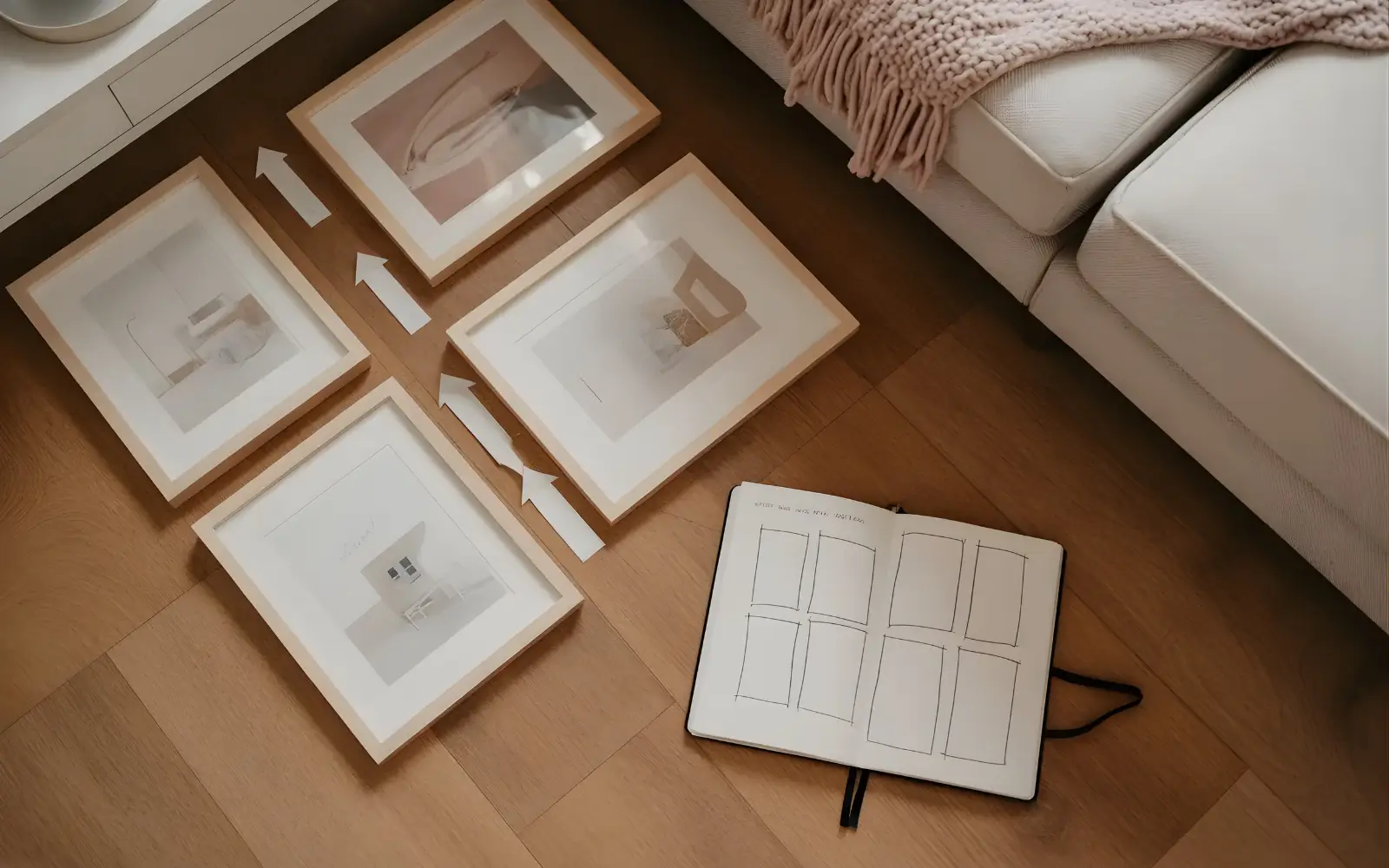
PLAN ON THE FLOOR FIRST
A simple floor layout with consistent gaps makes it much easier to see your gallery wall as one composition before you ever make a single hole.
Step 5: Choose art that supports your palette and mood
Art is not separate from your colour palette — it is part of it. In a small apartment where everything is visible from nearly everywhere, art that introduces new, unrelated colours disrupts the visual story the palette is telling.
The most effective approach is to look for art that contains colours already in your palette: your base colour, secondary colour or accent colour. You do not need an exact match. A warm off-white base, blush secondary and brass accent palette will be supported by art in creamy whites, dusty pinks, warm ochres and muted golds. Art that introduces cobalt blue or bold red will compete rather than complement.
Three to four recurring colours in art across the whole apartment is plenty.
That does not mean every print needs to be identical — it means the colour temperature and saturation level should feel related. A set of soft botanical prints, a muted abstract and a simple line drawing in warm tones all belong to the same visual family even if their subjects are completely different.
Colour checklist for art:
- Does this art contain my base wall colour, secondary colour or accent colour?
- Does the saturation level match the rest of the room — soft and muted, or bold and saturated?
- If it introduces a new colour, does that colour appear at least one other time in the room in a cushion, object or textile?
Mood matching:
- Soft minimal palette: low-contrast art, muted abstract shapes, simple line drawings, monochromatic photography. Avoid heavy black outlines or busy pattern.
- Romantic or layered palette: art with more texture and softer subjects — botanicals, watercolour, loose brushwork. Can handle overlapping frames and more visual complexity.
- Modern classic palette: art with stronger lines and higher contrast, but still within a controlled palette. Architectural photography, graphic botanicals and bold typographic prints, but sparingly and as a clear focal point.
On subject matter:
Soft abstract shapes, minimal line drawings, botanical and nature-inspired imagery and quiet landscape photography all work well in small apartments. Avoid very busy typographic posters with multiple font sizes and dense text — in a small space they read as noise rather than art.
Coordinating art with your palette makes even inexpensive prints look deliberate and premium. A modestly priced print in the right tones, in the right frame, in the right position feels designed. An expensive print in a colour that clashes with everything else looks like a mistake.
Step 6: Frames, mats and spacing for a cohesive look
Frames are not just containers for art. They are part of the visual system of the room, and in a small apartment inconsistent frames are one of the fastest ways to make a gallery wall look like a collection of accidents.
Frame finishes:
Choose one or two frame tones for the entire apartment and stick to them. Light oak and white is one of the most versatile combinations for soft, feminine spaces. White and thin brass works for a more polished, modern feel. Black frames are clean and contemporary but can feel heavy if overdone in small rooms — keep them light and thin-profile.
The rule is not that every frame must be identical — it is that every frame should belong to the same family. Three slightly different light wood frames in the same gallery will read as cohesive. Three frames in black, red lacquer and chunky silver will read as chaos, regardless of how beautiful the individual pieces are.
Mats:
White or off-white mats around art do two important things: they make the art feel more considered and gallery-quality, and they increase the visual weight of smaller prints so they hold their own in a gallery arrangement.
If you are using mats, keep the mat width consistent within a gallery — all 5 cm, all 4 cm, whatever you choose. Inconsistent mat widths look unplanned even if the frames match.
Spacing:
- Small galleries of two to four pieces: aim for 3–5 cm between frames.
- Larger walls or salon-style arrangements: 5–8 cm between frames.
The most important rule is consistent spacing throughout. Equal gaps read as intentional. Inconsistent gaps — some 3 cm, some 12 cm — read as though you ran out of either art or planning.
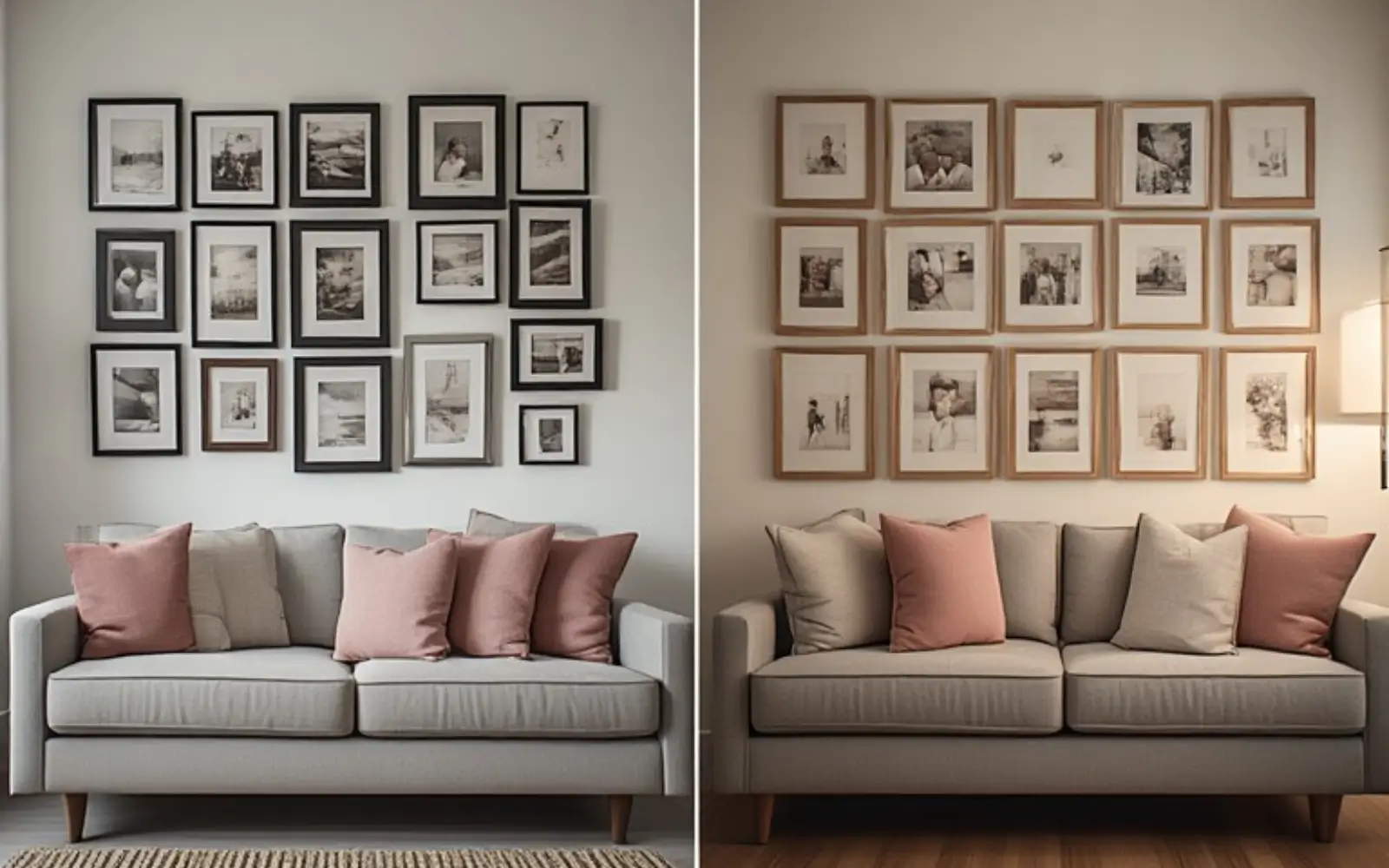
FRAMES AND SPACING MAKE THE WALL
The art can stay the same, but consistent frames, mats and even gaps turn a noisy wall into something that looks designed.
Step 7: Room-by-room gallery and art ideas for small apartments
Living room: art above the sofa and media unit
The sofa wall is almost always your hero wall in a living room, and it is where your primary art investment goes. A single large statement piece — 80×60 cm or larger — or a gallery of three prints treated as one block are both strong choices here.
Concrete example: three-print gallery above a 180 cm sofa
Three prints in a row above a 180 cm sofa — one 60×40 cm in the centre, one 40×30 cm on each side, all with white mats and light oak frames, spaced 6 cm apart. The total block reads as approximately 130 cm wide. This is proportional, balanced and easy to execute.
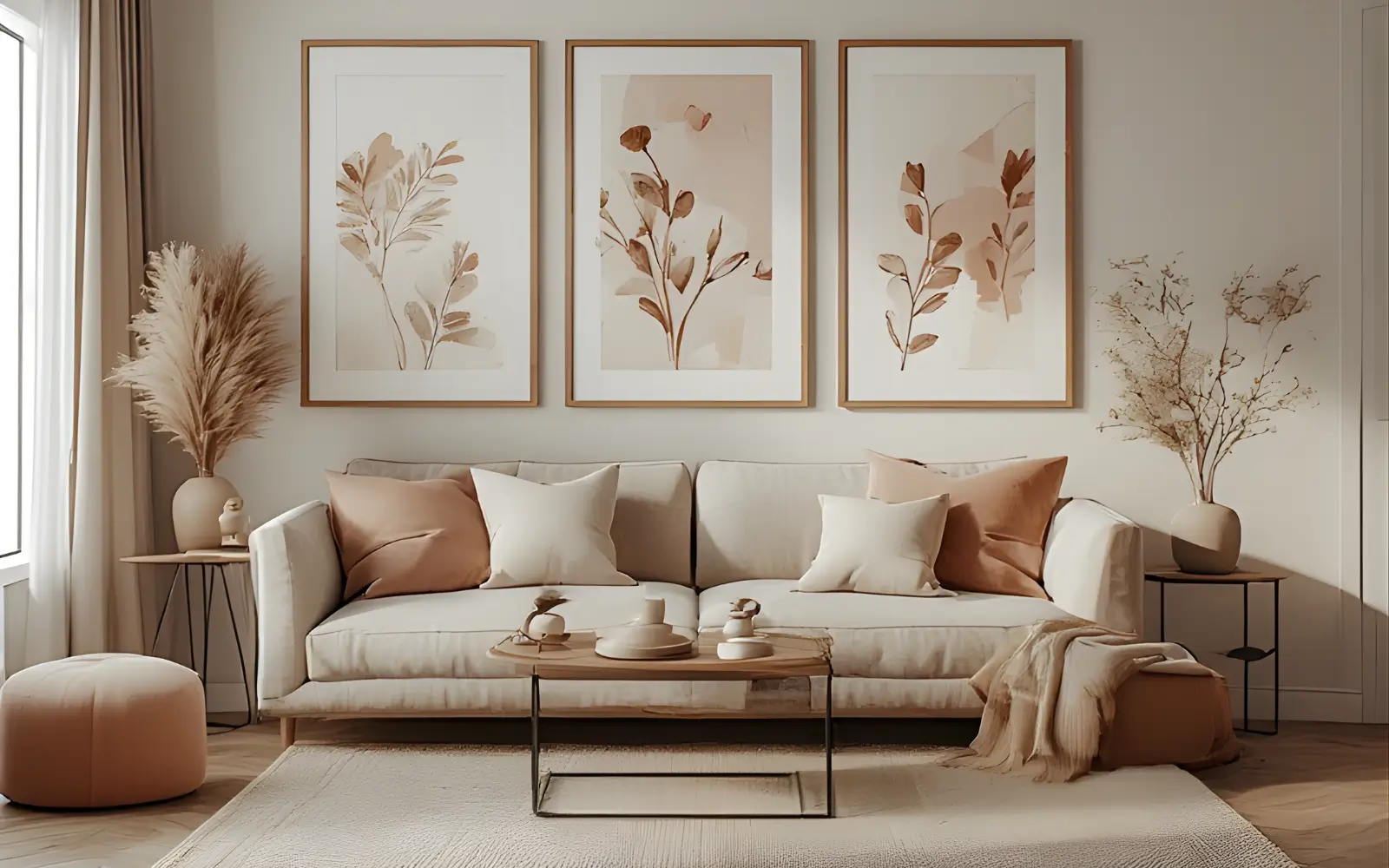
LIVING ROOM GALLERY BLOCK
A three-print gallery sized to the sofa width shows how a small apartment living room can look finished without feeling crowded.
The media unit wall opposite the sofa is a support wall. One or two small pieces — or a mirror — is enough here. Keep it calm: the sofa wall should be the visual priority.
Bedroom: headboard wall and quiet side walls
The headboard wall is your bedroom hero wall and the most common place for a curated gallery in the bedroom. Two vertical frames flanking the bed create symmetry and a sense of calm ritual. A 2×2 grid centred above the headboard reads as a single designed object. A single large piece — 60×90 cm or similar — is the simplest and often most elegant option.
Concrete example: paired prints flanking the bed
Two 40×50 cm prints in matching frames, hung symmetrically with the outer edges roughly aligned with the edges of the headboard, centres at around 150 cm from the floor. The result is clean, balanced and quietly sophisticated.
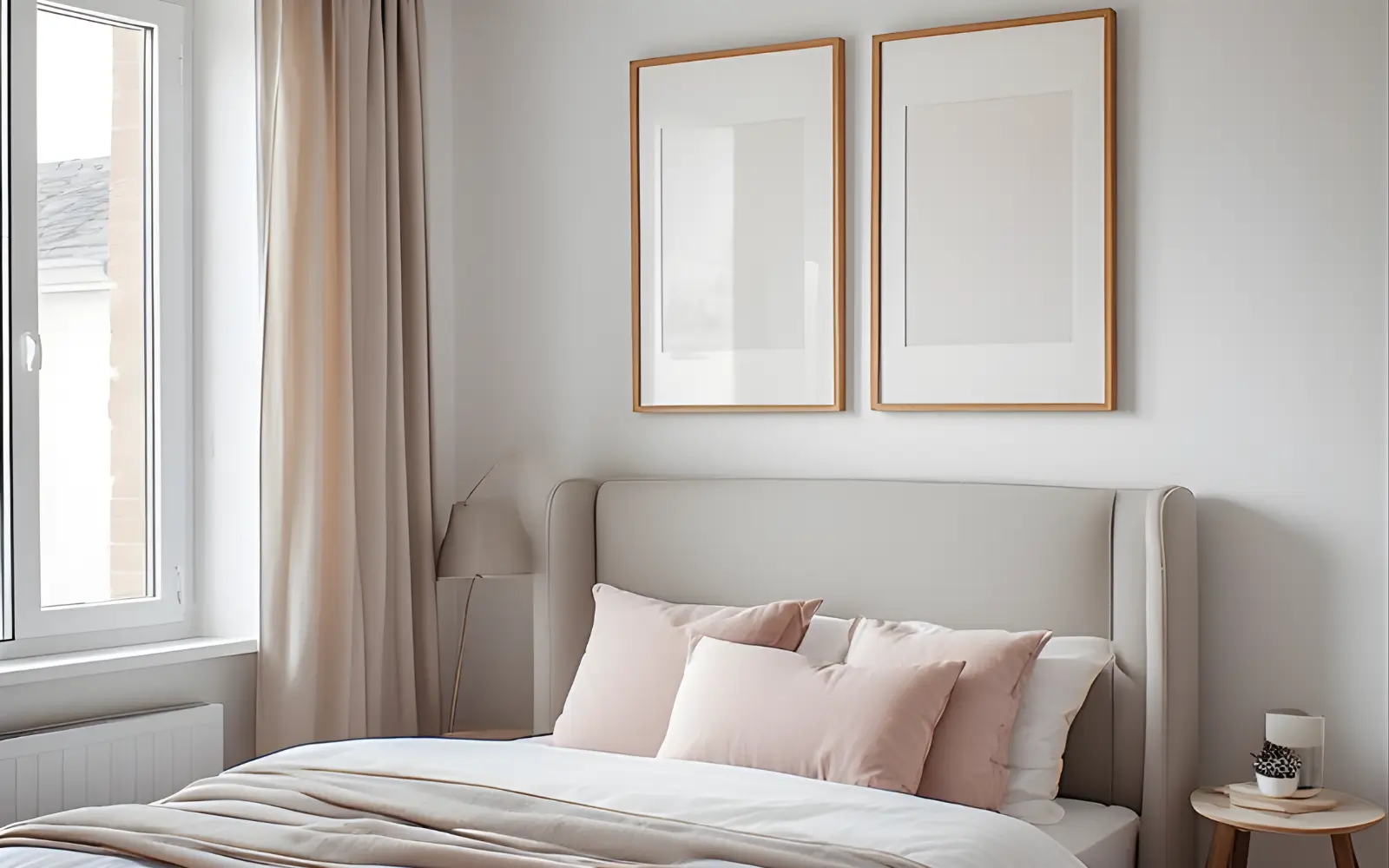
BALANCED BEDROOM WALL
Treating the bed, not the off-centre window, as the anchor gives a calm, deliberate headboard wall even in a tricky rental layout.
Side walls in the bedroom are support or calm walls. If you use them at all, a single small print or a simple pair is enough. Not a gallery. Not a bold colour. Just a quiet presence.
Hallways and entryways: narrow walls and small moments
Hallways are often the most overlooked space in a small apartment — and one of the most rewarding to get right, because the improvement is disproportionate to the effort.
The constraint is usually width: most hallway walls are narrow. This makes vertical arrangements the right choice. A column of two or three vertically stacked prints, all in matching frames, creates a moment in a space that would otherwise feel like a forgotten corridor.
Concrete example: vertical series in a narrow hallway
Three 20×25 cm prints stacked vertically with 5 cm between each, centred on the wall at eye-level centre. If the hallway has a console or small shelf, one leaning print on the surface adds another layer without another nail.
Home office corner: art in a tiny workspace
Even a small desk corner benefits from art — it frames the workspace and gives the eye somewhere intentional to rest. The scale should be smaller here, and the composition focused.
One statement piece above or beside the desk — 40×50 cm or similar — or a tight mini-gallery in a compact rectangle, such as four small prints in a 2×2 grid, works well. Keep it calm: the workspace needs to feel productive, not visually overwhelming.
Step 8: Renter-friendly hanging — hooks, ledges and leaning art
Renter-friendly does not mean your walls have to look like a temporary installation. With the right tools and approach, a no-damage or low-damage art arrangement can look just as deliberate and high-end as anything drilled into solid plaster.
Damage-minimising hardware:
- Adhesive hooks: suitable for lighter frames — most manufacturers specify weight limits clearly. Work best on smooth painted walls, less reliable on textured surfaces. Remove carefully and slowly to avoid pulling paint.
- Command-style strips: similar principle to adhesive hooks; excellent for frames up to around 3–4 kg if applied correctly. Look for locking strip designs for anything you want to stay up long-term.
- Narrow picture nails: a 1 mm pin nail leaves a hole so small it fills with a dab of filler in seconds. For anything over 3–4 kg, a nail is usually both safer and less visually risky than relying on adhesive.
Picture ledges:
One of the most renter-friendly approaches available — and one that actually looks better than traditional hanging in many situations. A single ledge 12–15 cm deep above a sofa or bed lets you arrange and rearrange art without a single new hole. Swap prints seasonally, add a small object or plant, layer frames at different depths.
Stacked ledges work beautifully in an office corner — three narrow ledges at different heights, each holding two or three small prints, create a layered gallery feel with complete flexibility.
Leaning art:
Large frames leaned against the wall on a console, dresser or the floor itself look deliberately casual in the right setting. This works best for larger pieces — 60 cm or taller — small prints leaning on the floor just look like they have not been hung yet. A large leaning print on a console, with a smaller piece or object layered in front, is a considered styling choice, not a compromise.
Smaller frames layered on a shelf or picture ledge, slightly overlapping, create an organic, lived-in gallery feel that is easy to change and requires no hardware at all.
Planning holes wisely:
If you do drill, plan your holes so they can be reused. Three aligned holes in a row can hold a series of prints now, and a longer shelf later. A single centred hole can hold one piece now and another next year. Consolidate holes where possible. When you leave, fill small holes with a white wall filler, sand lightly and touch up with the closest white paint available.
Step 9: Common small-apartment art and gallery mistakes (and how to fix them)
Mistake 1: Art hung too high
Art hung too high looks like it is floating free of the room — disconnected from the furniture beneath it and drifting towards the ceiling where nothing else is happening. The relationship between wall and sofa or bed simply is not there.
Fix:
Lower everything. The centre of a piece of art above a sofa or bed should sit at roughly eye level when seated — approximately 140–150 cm from the floor. The bottom edge of any frame above a sofa should be 15–20 cm above the sofa back, not 40–50 cm. Take everything down and rehang it closer to the furniture than feels instinctive. It will look right.
Mistake 2: Too many small pieces, no anchor
Every wall has a few small prints, but nothing feels important. The room is technically decorated but does not feel designed. There is no moment that draws the eye or gives the space a focal point.
Fix:
Create one or two anchor pieces or groupings — a single large print, or a gallery treated as one substantial block — and let the rest of the room calm down around them. Remove art from at least one wall in each room entirely and let it breathe. Anchors work precisely because they have contrast around them.
Mistake 3: Frames and styles that do not match anything
A black metal frame next to a chunky pine frame next to a thin silver frame. Three different frame widths. Some mats, some without. The result is visual noise that comes not from the art itself but from the containers.
Fix:
Edit the frames down to one or two finishes across the apartment. Reframe key pieces in matching frames if necessary — this is often a small investment that transforms how a whole room reads. White or light oak is a safe starting point if you are not sure what to commit to. Remove any frame that fights the others.
Mistake 4: Ignoring wall roles — gallery on every wall, no calm surface
Every wall in the room has some form of art, and none of it feels special because there is no contrast. The room is busy everywhere, which means it feels busy everywhere, with no place for the eye to land and rest.
Fix:
Go back to the wall roles you established for the room. The hero wall gets the gallery. The support wall gets one or two quiet pieces. The calm wall gets nothing, or almost nothing. Take art down from the wall that should be calm and live with the emptiness for a week — you will almost certainly find the room feels better, not worse.
Step 10: Real-life gallery wall examples for tricky spaces
Narrow living room with a small sofa
Before:
A single A4 print hung 50 cm above the centre of a 140 cm sofa. Big empty walls on either side, too much space between the print and the sofa, the room feels unresolved.
After:
A three-print gallery treated as one block — a 50×40 cm print flanked by two 30×40 cm prints, all with white mats, light oak frames and 5 cm spacing. Total block width approximately 110 cm — close to 75% of the sofa width. Hung so the bottom edge sits 18 cm above the sofa back, centre at around 148 cm from the floor.
The room now reads as complete. The sofa wall is a deliberate composition; the art and sofa feel connected rather than coincidental.
Rental bedroom with an off-centre window
Before:
The window sits closer to the left side of the headboard wall, making everything feel visually unbalanced. Art placed centrally above the bed looks like it is reacting to the window rather than to the bed. One small print on the right makes it worse, not better.
After:
Abandon strict centre symmetry and work with the bed as the anchor instead of the wall. Two 40×50 cm prints hung symmetrically relative to the bed — outer edges aligned with the outer edges of the headboard — with the window treated as part of the room, not as a composition element. The gallery relates to the furniture; the window exists independently.
The bedroom now feels balanced around the bed, which is the right anchor. The asymmetry of the window is less noticeable because the eye goes to the composed art arrangement first.
Tiny hallway with no natural light
Before:
Completely bare walls. The hallway feels like a transition space that was never designed, a corridor between real rooms.
After:
A vertical column of three 15×20 cm prints in matching thin frames, 5 cm gaps between them, centred on the longest wall. A small round mirror at the end of the hallway bounces what light exists and gives the space a terminus.
The hallway now has a moment — a reason to look and pause. The art scale is small, which is correct for the space: the aim is not to create a full gallery, but to give the wall a clear intention. The corridor feels like part of the apartment rather than an afterthought.
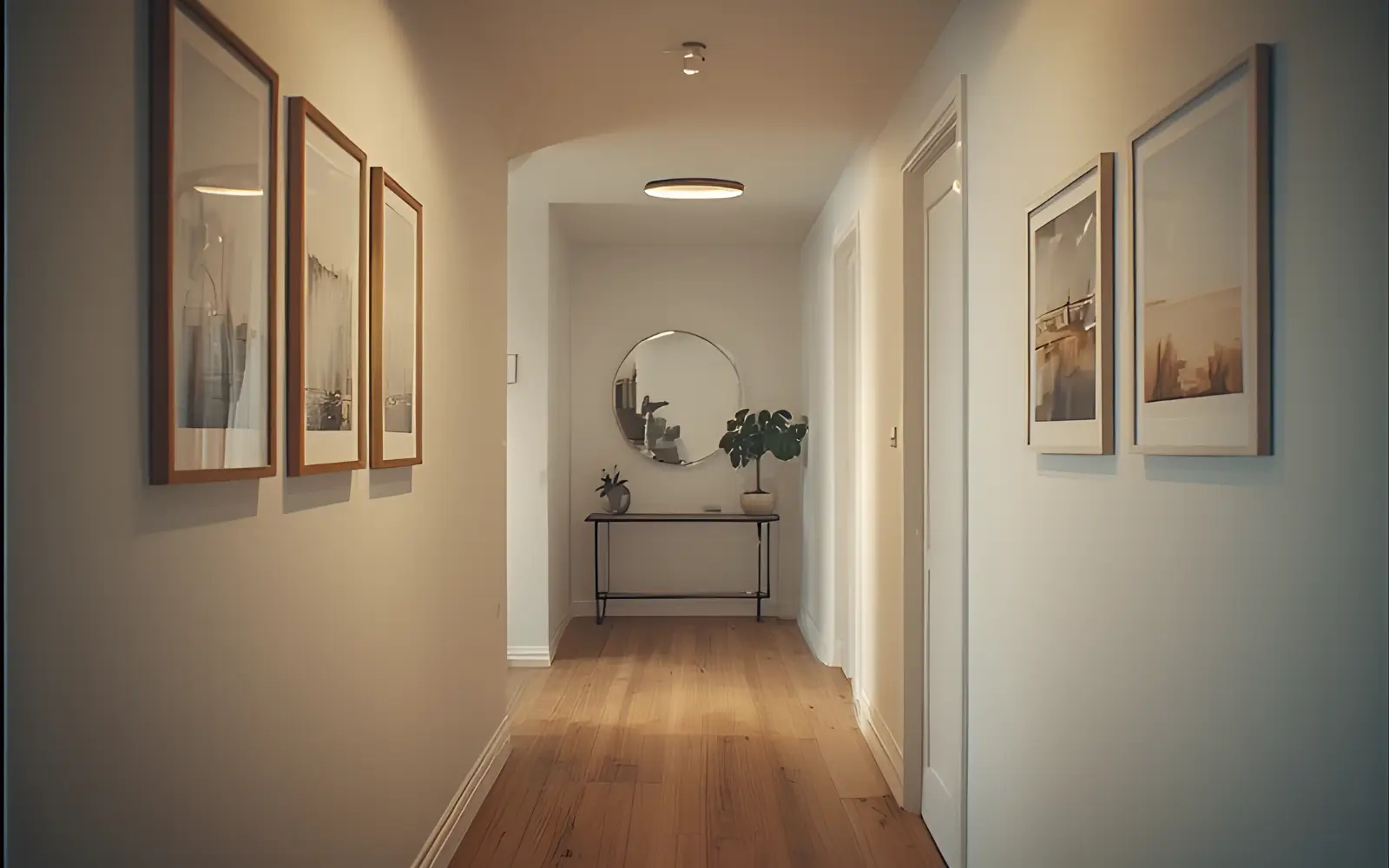
HALLWAY GALLERY MOMENT
A tiny hallway turns into a designed moment with one simple vertical column of art and a small mirror to catch the light.
Quick gallery-wall checklist for small apartments
Use this before hanging anything — and before buying anything new.
- Have I chosen one hero wall per room for the main gallery or statement piece?
- Does the art above each sofa or bed relate proportionally to the width of the furniture beneath it?
- Are frames centred near eye level — not floating above furniture?
- Does each gallery have at least one anchor piece that gives it weight and focus?
- Do my art colours repeat the palette rather than introduce unrelated new colours?
- Are frame finishes limited to one or two tones across the whole apartment?
- Are spacing gaps between frames consistent throughout each gallery?
- Do I have at least one calm wall in each room — with no art at all?
- If I walk through the apartment, do the galleries feel like intentional compositions, not a collection of random prints?
Renter-friendly wall ideas for small apartments: high-impact, low-damage updates
Most renters play it too safe. Bare white walls, furniture pushed against them, a few random sticky hooks from the supermarket that are already peeling — and a creeping sense that the apartment feels like somewhere you are waiting to leave, not somewhere you actually live.
The irony is that over-caution can cause as much damage as recklessness. Cheap peel-and-stick products strip paint on removal. Sticky residue from low-quality hooks leaves marks that take longer to fix than a small nail hole would have. Playing it completely safe often means you end up with a blank, unlived-in space that still has issues to fix when you leave.
This guide shows you what landlords actually care about, how to make walls look finished and high-end with minimal and repairable impact, and how to plan for a clean, confident move-out.
Step 1: Understand your real limits as a renter
The first thing most renters discover when they actually read their lease carefully is that it is far less restrictive than they assumed.
What most leases actually say:
- Small nail holes for hanging art are widely accepted as normal wear and tear in most countries and jurisdictions. A professionally patched nail hole is maintenance, not damage.
- Painting is often permitted if you return walls to the original colour before you leave — or at least repaint in a clean, neutral tone your landlord approves.
- Heavy structural alterations — knocking walls, installing built-in units, drilling large anchor holes for wall-mounted TVs without permission — are a different category entirely.
The damage that actually costs deposits tends to be stained walls, deeply gouged plaster, cheap adhesive that stripped the paint surface, or poorly filled holes that look worse than the original damage.
The damage spectrum, realistically:
- 1 mm picture nails: fill with a dab of filler or toothpaste. Nearly invisible and quick to repair.
- Standard screw holes (4–6 mm): fill, light sand, and a small patch of paint. Around thirty minutes of work on move-out.
- Larger structural anchors: more repair involved, but still manageable if planned carefully and filled properly.
- Cheap adhesive products removed incorrectly: can pull paint off in strips, leaving damage that is harder to fix than any nail hole.
Quick lease checklist — check these before anything:
- Are you explicitly allowed to hang pictures?
- Are you allowed to paint, and under what conditions?
- Are you allowed to use wallpaper or removable decals?
- What does “return to original condition” actually mean in your lease — and what photos exist of the original state?
- Is there a maintenance clause that distinguishes normal wear and tear from actual damage?
After reading your lease with fresh eyes, most renters find they have significantly more room to act than they thought.
Step 2: Hardware hierarchy — from no-holes to tiny holes
Not all wall solutions carry the same risk, and not all “damage-free” options are as safe as they claim. A clear hierarchy helps you choose the right approach for each situation.
No-holes options
Command-style adhesive strips and hooks are the right choice for lighter items: small frames under 2 kg, small mirrors, lightweight shelves holding books or decorative objects. They work best when the wall is clean, smooth and paint is not already flaking. Always read the weight specifications — overloading an adhesive hook even slightly is when things fail at 3am.
Tension rods require no holes at all and work in doorframes, between walls in an alcove or across a window recess. They are ideal for hanging curtains, fabric panels or lightweight rods for displaying art.
Common mistakes with adhesive products:
- Not cleaning and drying the wall surface thoroughly before application.
- Removing too quickly after application — most need 24–72 hours to cure fully.
- Choosing the cheapest version available — quality varies enormously.
Tiny-hole options (1 mm picture nails)
A 1 mm pin nail leaves a hole barely visible to the naked eye. Filled with a fingertip of white filler on move-out, it disappears. For most art hanging situations in a rental, a small nail is both more reliable and easier to fix than even a quality adhesive strip, especially for frames over 2–3 kg.
A reasonable guide: three to five small nails per wall, in planned groupings rather than scattered at random, is perfectly manageable to repair. Twenty random holes spread across a wall is a different conversation.
Larger anchors — only where they earn their place
For a heavy mirror, a TV mount or a serious shelving unit, a larger anchor or wall plug is sometimes the right tool. When you do commit to a larger hole, plan it so it can be reused. Holes drilled for a TV bracket can later hold a shelf. A mirror fixing can later hold a sconce or a large art piece. Think of each anchor as a long-term investment in that part of the wall, not a one-time decision.
Simple repair guide:
- Small nail holes: press a small amount of lightweight filler into the hole with a fingertip, smooth level, allow to dry. On white walls this is often invisible even without paint.
- Medium screw holes: fill with standard filler, allow to dry fully, sand lightly with fine sandpaper, apply one coat of matching paint.
- Adhesive residue: use the product’s recommended removal process slowly. Warm the adhesive gently with a hairdryer to soften it before pulling, and never rip at a sharp angle.
Step 3: Picture ledges and slim shelving as a renter's best friends
If there is one product that changes how a renter relates to their walls, it is the picture ledge. A single 80–100 cm ledge above a sofa replaces the need for ten separate hooks.
It holds art, small objects, a candle, a plant — and you can rearrange everything without a single new hole. Change the art seasonally, add a new piece, remove something that is not working. No new fixings, no damage, complete flexibility.
Why ledges are smarter than individual hooks:
Two or three carefully planned holes for a ledge bracket are categorically different from twelve separate picture hooks scattered across a wall. The ledge concentrates impact into a few high-quality fixings and gives you infinite flexibility within that system.
Dimensions that work:
- Depth of 9–15 cm holds most standard frames comfortably and allows for slight layering.
- Longer ledges (80 cm and above) look more custom and deliberate than very short ones.
- Wall-length ledges running nearly the full width of the wall feel genuinely architectural for minimal cost.
Use cases by room:
- Living room: one long ledge above the sofa with art leaned against the wall, a small object or two and a plant — a flexible alternative to a fixed gallery wall.
- Bedroom: two ledges above the headboard at different heights, or one ledge on each side of the bed at bedside height holding art and a small lamp.
- Office corner: a vertical stack of two or three short ledges on one wall for a mini-gallery requiring only a handful of fixings.
- Hallway: one ledge with a small mirror leaned against the wall and a few prints for a complete entry moment in one simple installation.
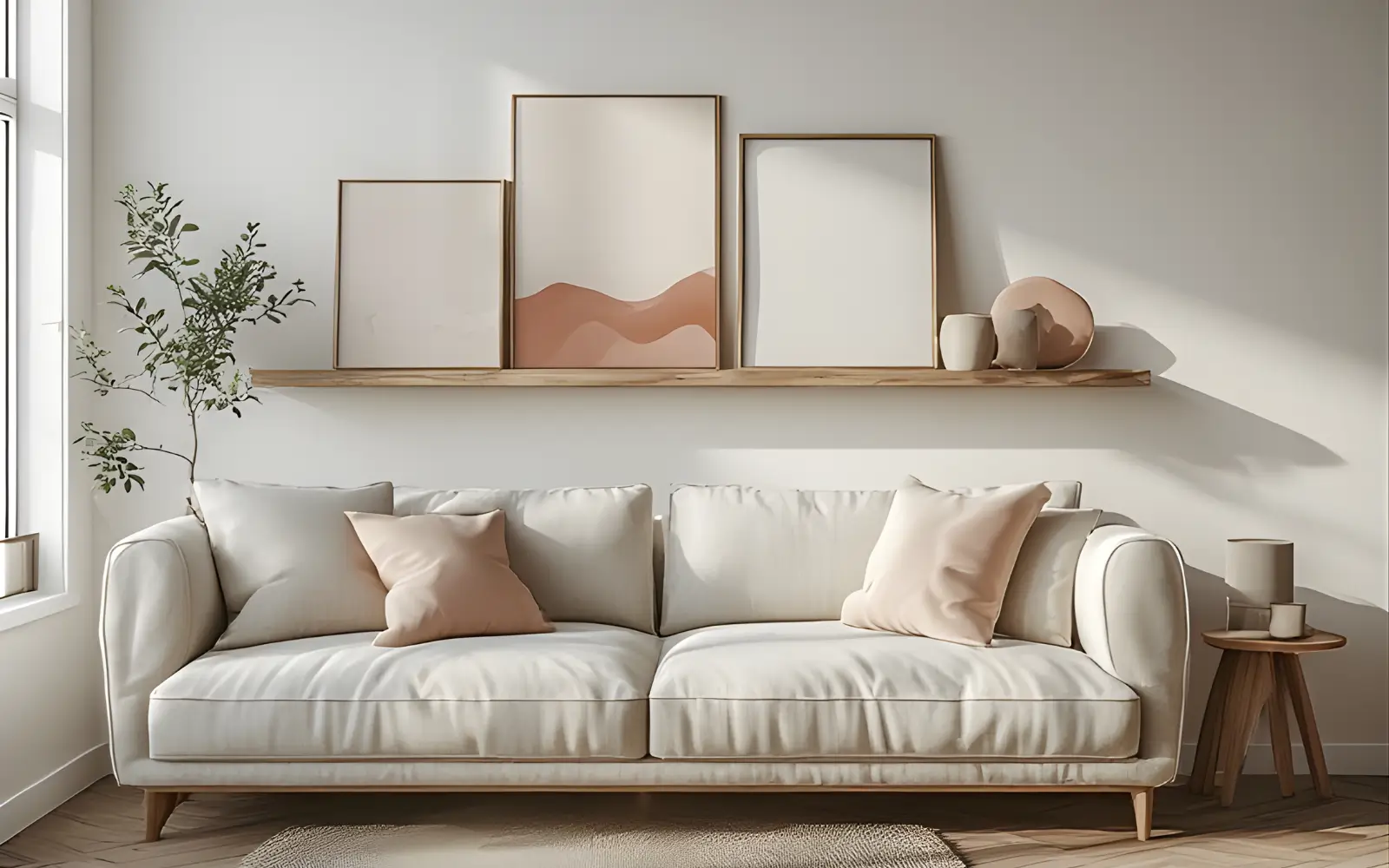
PICTURE LEDGE ABOVE THE SOFA
A single renter-friendly ledge replaces a scattered gallery of hooks and lets you restyle art without adding new holes.
Step 4: Removable colour and pattern — wallpaper, decals and painted panels
Surface-level changes that are genuinely reversible are the most powerful tools in a renter's toolkit — but only when they use the right products and a clear plan.
Removable wallpaper
Modern peel-and-stick wallpaper has improved significantly. On a smooth, well-painted wall, good-quality removable wallpaper will usually come away cleanly, especially if the surface beneath is in good condition.
It works best in alcoves, on a headboard wall, in a kitchen niche or inside a wardrobe. Covering an entire room is ambitious and material-heavy; a single feature wall or defined zone is far more manageable.
Before you commit, buy a small sample, apply it to an inconspicuous area, leave it for two weeks, then remove it carefully. If it comes away cleanly, you can proceed with confidence.
Red flags: very cheap “peel and stick” brands, reviews mentioning adhesive residue, or wallpaper that stretches during application — it will bubble and peel in warm weather.
Wall decals
Quality matters enormously. Cheap decals intended for children's rooms are the product most likely to rip paint on removal. Large, simple, adult-oriented shapes in quality materials — arches, colour blocks, botanical outlines, geometric forms — are a different category entirely.
Use the same test principle: try a sample in a low-visibility area, remove it slowly, and only then commit to a full composition.
Painted panels — even for renters
Painting an entire room is a big commitment, but painting one soft rectangular panel behind a bed or sofa is a much smaller one. One or two coats of a soft colour in a contained block can be covered with one or two coats of white on move-out.
The panel approach — a painted rectangle roughly the width of the headboard or sofa and slightly taller — reads as a designed detail rather than a half-finished paint job. It can deliver the feel of wallpaper for a fraction of the cost and with straightforward reversibility.
All colour choices here should come from the apartment's existing palette — the same base, secondary or accent colours used across walls, textiles and art. A sage panel on a headboard wall works when the rest of the apartment already contains sage as a secondary colour.
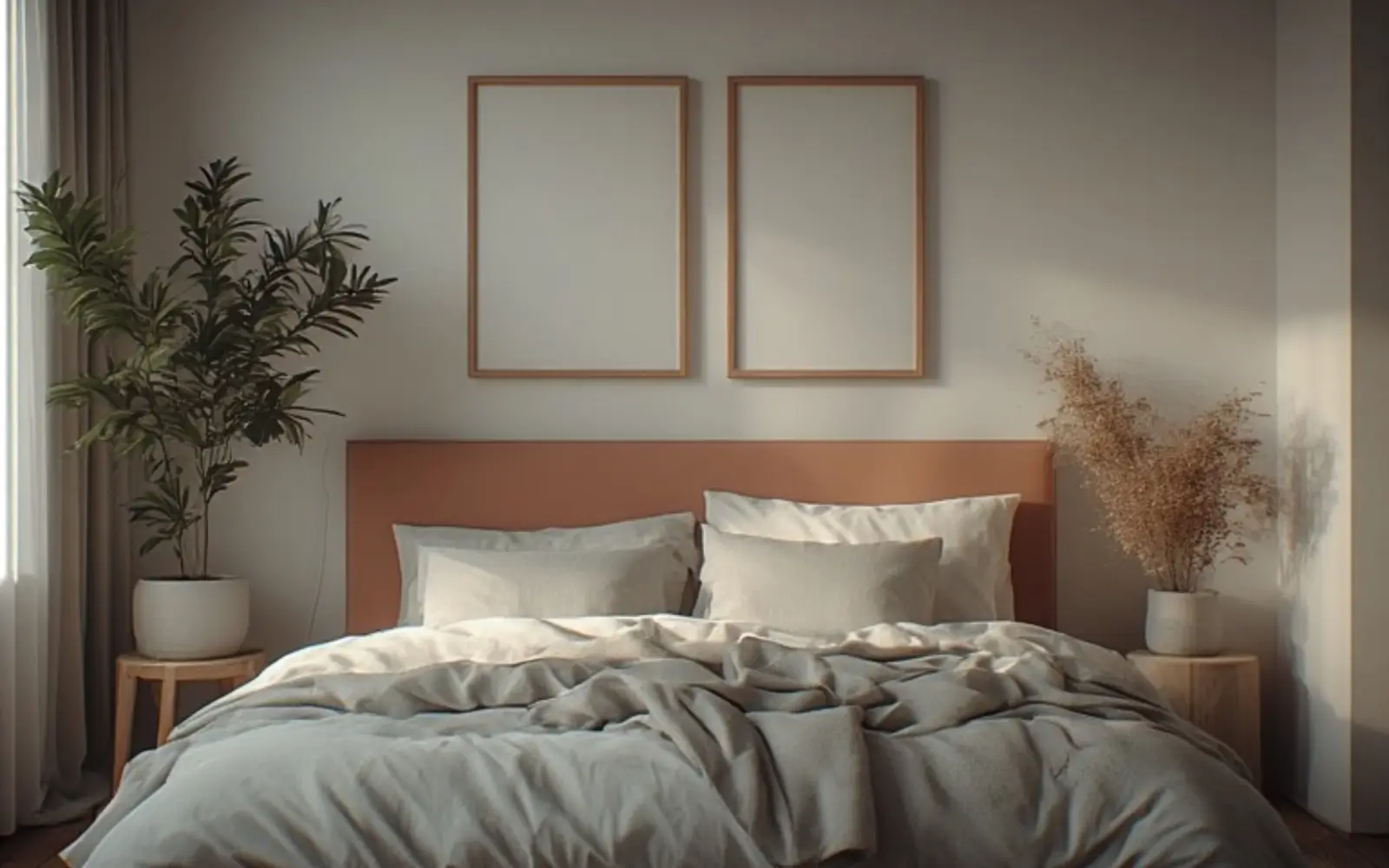
SOFT PAINTED PANEL
A simple painted block behind the bed gives you a designer headboard wall that is still easy to repaint on move-out.
Step 5: Fabric, curtains and soft panels for depth without commitment
Fabric is one of the most underused tools in rental decorating — and one of the most forgiving, because it almost never involves more than a tiny hole, and often none at all.
Wall-width curtains
Hanging curtains across an entire wall, not just a window, softens the surface, adds texture, hides ugly elements and makes the ceiling feel higher when hung close to the ceiling line.
In a bedroom, a floor-to-ceiling curtain behind the bed on a slim track or tension rod creates a soft headboard wall even without a headboard or paint. In a living room, curtains behind the sofa can define the seating zone in a studio while adding warmth to a bare wall.
Fabric panels and DIY headboards
A large piece of fabric — linen, cotton canvas, a woven textile — hung on a slim rod behind the bed or sofa creates a soft focal point without wallpaper or heavy hardware. The rod can sit on two small hooks or on a tension rod in an alcove with no holes at all.
A fabric panel 120–150 cm wide and 90–120 cm tall above a bed easily becomes the feature wall. You can style it with one or two small frames hung in front of the fabric, or leave it as a single textile statement.
Tension rods for studio zoning
In a studio apartment, a tension rod fitted between two walls with a sheer fabric panel creates a visual separation between sleeping and living zones without drilling into the ceiling or building a partition.
Concrete examples:
- Tiny studio: full-width curtains behind the bed on a ceiling track with just a couple of brackets. The fabric defines the sleeping zone and hides whatever is behind.
- Radiator wall: a sheer linen panel in front of the radiator on a tension rod — the radiator still works, but the wall now reads as a soft backdrop rather than a utilitarian problem.
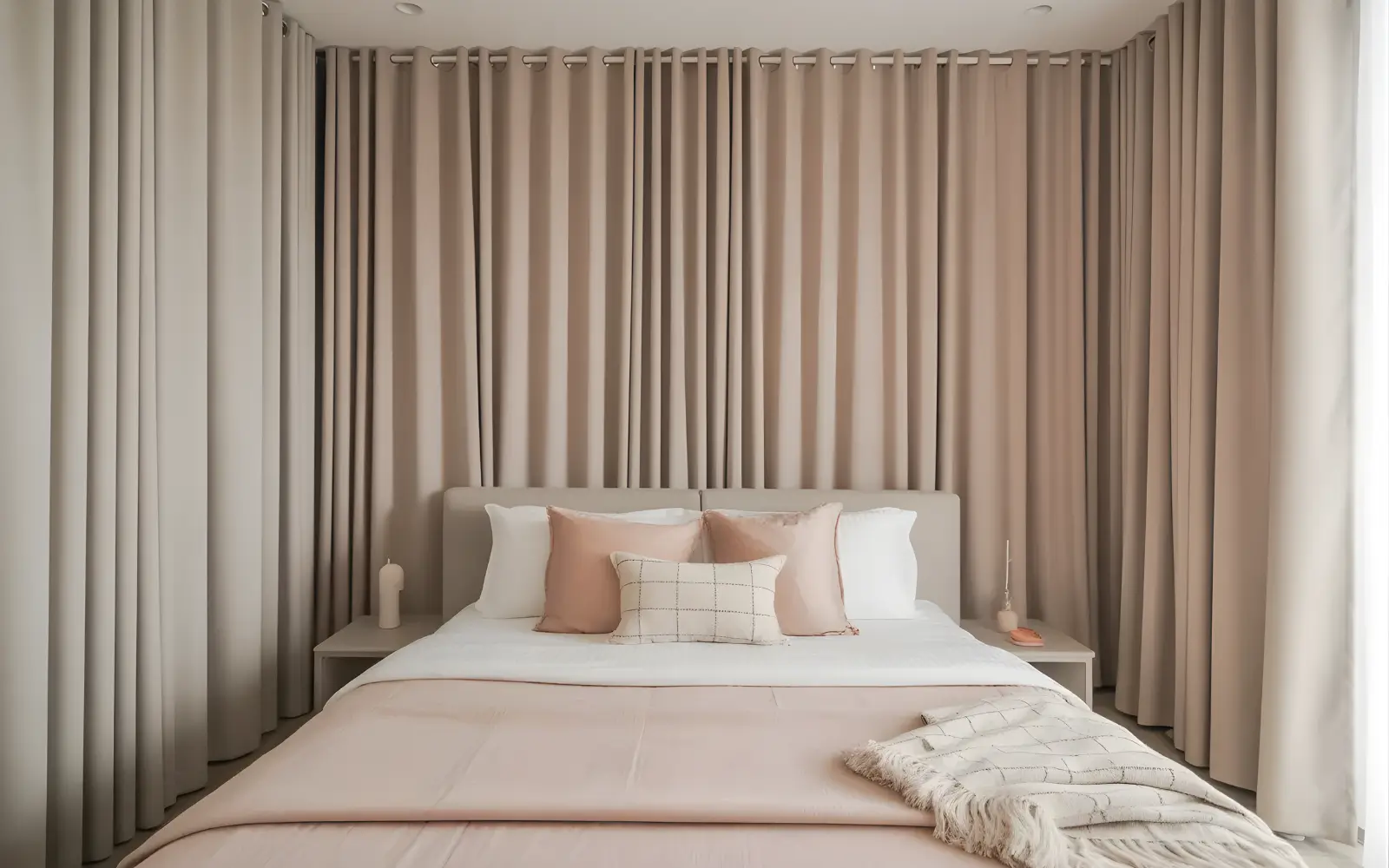
CURTAIN WALL ZONING
Wall-width curtains turn a plain rental wall into a soft backdrop and create a clear sleeping zone in a studio.
Step 6: Mirrors, sconces and vertical elements that feel built-in (but aren't)
Some of the most effective renter wall moves look architectural — as if they were planned into the apartment — but require minimal intervention.
Mirrors
A large wall mirror, 80 cm or taller, hung on two good-quality fixings does more for a small rental than almost any other single element. It bounces light, makes the space feel larger and reads as a deliberate design choice.
A full-length mirror leaned against a wall needs no fixings at all, or a single small safety bracket at the top to prevent tipping. It can move around the room as needed.
Plug-in wall sconces
Plug-in sconces simulate built-in lighting without electrical work. The cord can be managed with a slim cable tidy in a matching wall colour, routed along the baseboard or simply accepted as a visible design element.
Two plug-in sconces flanking a bed are one of the highest-impact lighting changes in a small bedroom. They free up bedside table space, add a layer of warm light and make the room feel considered — all from a couple of small fixings and a socket.
Vertical elements
A tall narrow bookcase standing against a wall with a slim anti-tip bracket into a stud is safe, stable and barely marks the wall. Two or three in a row create a built-in bookcase effect. A tall, narrow decorative column or plant stand adds height and structure with no fixing at all.
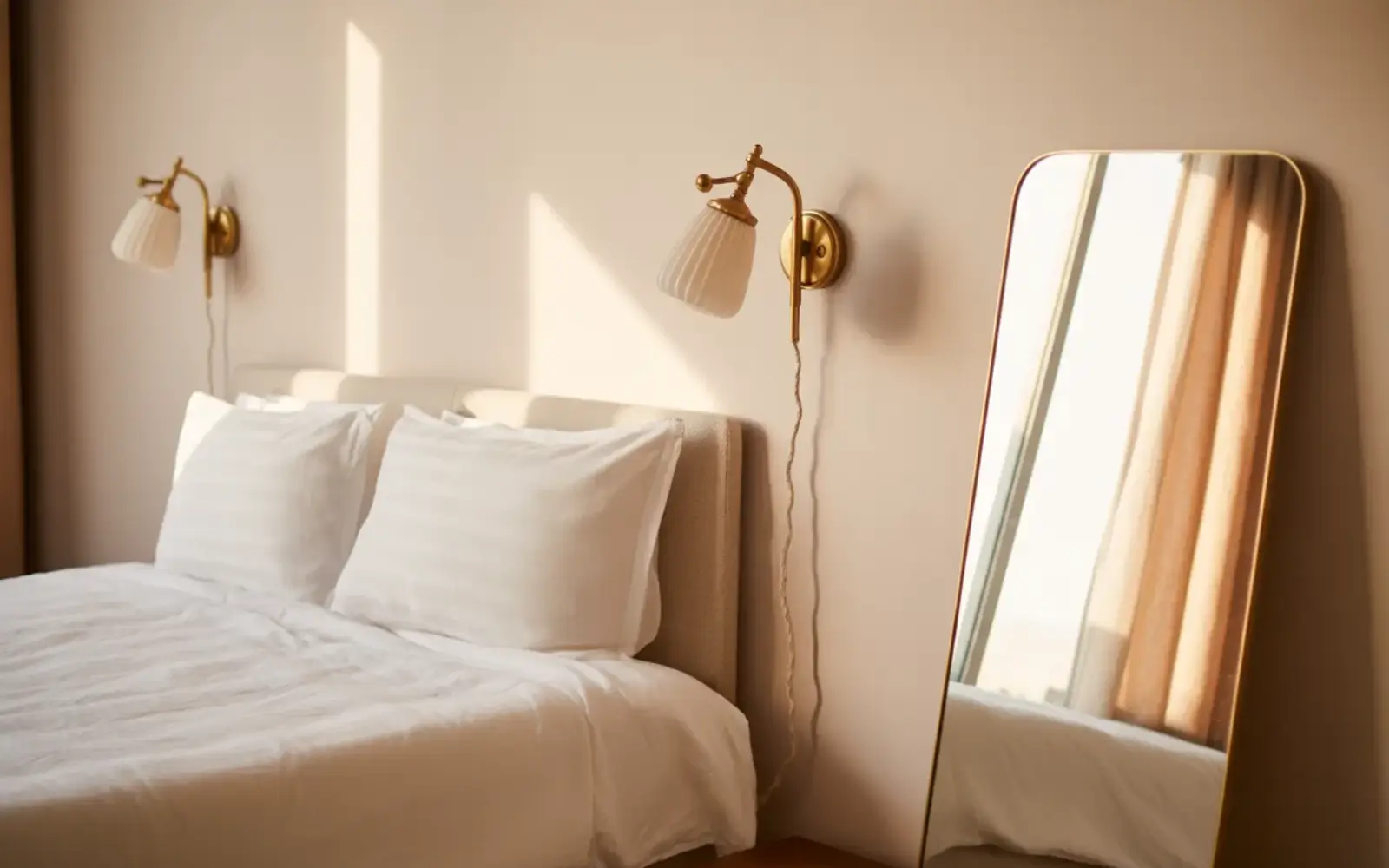
SCONCES AND LEANING MIRROR
Plug-in sconces and a simple leaning mirror add an architectural feel without any built-in wiring.
Step 7: Combine storage and decor without making walls heavy
This connects directly to the storage wall concept from the wall-planning framework: one organised storage wall is always calmer and more effective than shelves and hooks scattered across every surface.
In a rental, the temptation is to add storage wherever there is space. A hook here, a shelf there, a pegboard in the kitchen, a rail in the bathroom. Each individual item might be useful, but the collective effect is visual noise.
How to make a storage wall feel calm:
- Choose one wall per room to hold storage and keep the other walls mostly free.
- Use unified shelving systems with matching brackets, consistent depths and the same material.
- Add storage in closed or semi-closed form where possible — boxes, baskets, drawers, cupboard units — so the objects on the shelf are not the visual focus.
- Reserve one or two spots on the storage wall for decor so the wall reads as considered, not purely functional.
Renter-specific ideas:
- A slim closed cabinet or freestanding wardrobe along one wall with one or two art pieces hung above it so the whole wall reads as intentional.
- A pegboard in a kitchen or office corner, if the lease allows a few larger fixings — everything concentrated in one place instead of hooks scattered around three walls.
The rule for rental storage: concentrated, unified and calm — not distributed, mixed and busy.
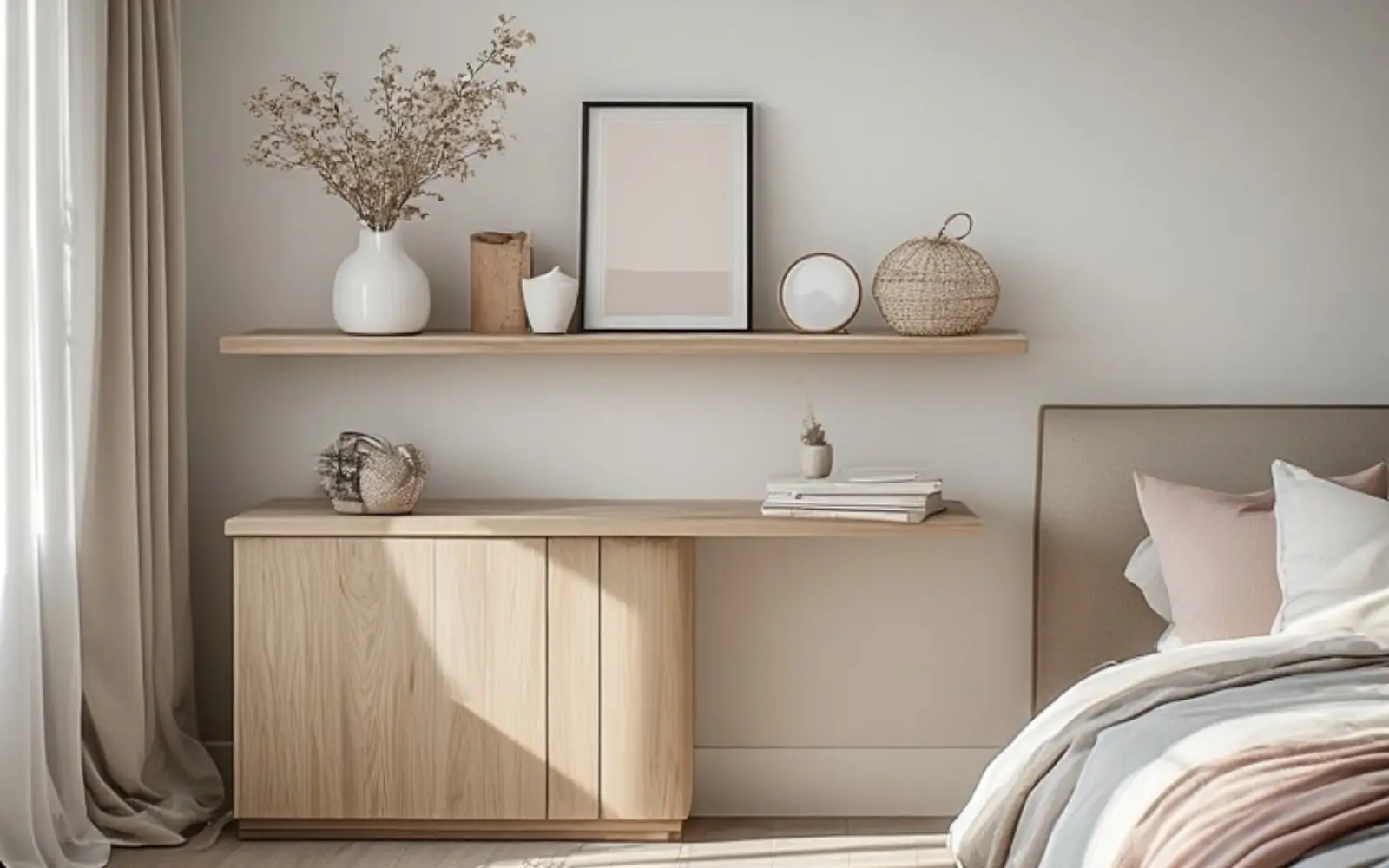
CALM STORAGE WALL
Concentrating storage and decor on one organised wall keeps a rental feeling calm instead of cluttered.
Step 8: Room-by-room renter-friendly wall ideas
Living room: renter-friendly feature wall around the sofa
The sofa wall is your hero wall. This is where you concentrate your effort and make the most intentional choices — and where the limited number of fixings you are willing to commit to should go.
Example combination: one long picture ledge (80–100 cm) above the sofa, installed with a few small screws and styled with art and objects. On the adjacent wall, a large round mirror on two fixings in a finish that belongs to the room's palette. Floor-to-ceiling curtains on the window wall make the room feel taller and softer.
Bedroom: soft headboard wall without permanent panels
The headboard wall is your bedroom hero wall and needs one clear moment, not three competing ones.
Example combination: a soft painted or wallpapered panel in the apartment's secondary palette colour, approximately the width of the bed frame and reaching from headboard height to about 30 cm above it, or a large fabric panel on a slim rod. Two small prints in matching frames hang on the panel itself with tiny nails.
On the side walls, add just one small art piece each at seated eye level. The headboard wall does the work; everything else supports it quietly.
Hallway and entry: no-drill first impression
The hallway's job is to make the apartment feel intentional from the first step inside.
Example combination: two or three quality adhesive hooks or one small nail for a mirror, plus a picture ledge with a small print and a key hook below. In a long, narrow hallway, a vertical column of three matching small frames with one nail each feels deliberate without being heavy.
Home office corner: reversible focus wall
A home office corner benefits from a defined wall behind or beside the desk — a visual anchor that separates the workspace from the rest of the room.
Example combination: a small removable wallpaper panel or painted rectangular block in a muted tone behind the desk chair, a picture ledge above the desk holding art and a few small objects, and one plug-in sconce to the side for warm task lighting.
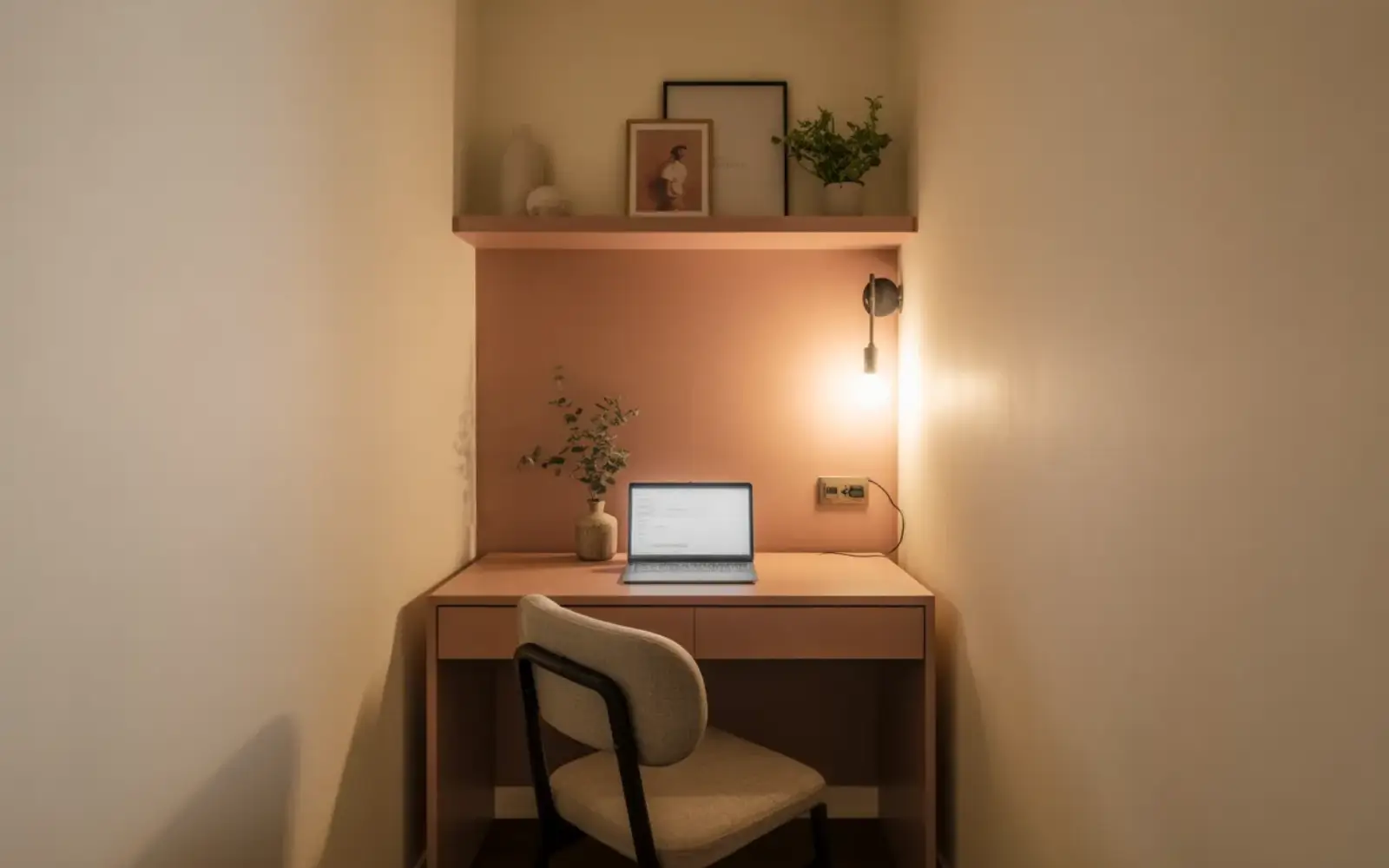
REVERSIBLE FOCUS WALL
A painted or wallpapered panel, ledge and plug-in sconce transform a small desk wall into a proper workspace without permanent changes.
Step 9: Renter wall mistakes that cost deposits (and what to do instead)
Mistake 1: Using cheap adhesive products that rip paint
The strip looks fine when you put it up. Six months later, when you remove it quickly at move-out, a section of paint comes away with it. This is one of the most common rental damage issues — and it is entirely avoidable.
Fix: only use quality adhesive products from reputable brands, follow the application and removal instructions exactly, and test in a low-visibility area first. Warm the adhesive gently with a hairdryer before peeling, and remove slowly.
Mistake 2: Random holes all over the place
One hook for a bag, one for a coat, one for the mirror, one for a small shelf, one for a print — scattered across multiple walls, none of them connected. The walls look disorganised during your tenancy and take time to repair on move-out.
Fix: plan your fixings in deliberate groups from the start. A ledge with four fixings does ten jobs. A defined art cluster replaces ten scattered hooks. Think in compositions, not individual objects.
Mistake 3: Over-decorating every wall to compensate for the rental
It is understandable: you want the apartment to feel like yours, so you add something to every wall. The result is the opposite of homely — busy, claustrophobic and visually exhausting.
Fix: remember the calm wall principle. Every room needs at least one wall with almost nothing on it. One or two hero moments per room — your feature wall, your storage wall — and everything else significantly quieter.
Mistake 4: No move-out plan
This is the mistake that actually costs deposits. Not the decision to hang pictures, but the lack of a plan for how the walls will look on the last day.
Fix: plan for move-out from move-in. Keep a small pot of filler, a fine sanding block and a small roller with white paint from the moment you hang anything. Take photos of the walls when you move in and when you move out, and leave a couple of hours on the last day specifically for wall repair.
Renter-friendly wall checklist for move-in and move-out
At move-in:
- Do I know exactly what my lease allows — holes, paint, wallpaper?
- Have I taken photos of every wall before touching anything?
- Have I chosen one hero wall per room and at least one calm wall?
- Do I already have filler, a fine sanding block and basic paint ready?
During your tenancy:
- Am I grouping fixings into ledges, mirrors and defined compositions?
- Do my wall choices support the overall palette and wall roles?
- Am I using quality removable products, not the absolute cheapest?
- Is every fixing decision one I could reverse cleanly?
At move-out:
- Are all holes filled and lightly sanded?
- Have all adhesive products been removed carefully and slowly?
- Have removable wallpaper and decals been taken down and the wall checked beneath?
- Do the walls look repaired and intentional, not damaged?
- Have I compared the current state to my move-in photos?
Dive deeper into each walls, color & art step
Choose the stage you are working on and explore more wall, colour and art articles for that step.
Step 1
Wall planning
How to give each wall a clear job so your small rooms feel intentional instead of noisy.
Step 2
Paint & palettes
Palette recipes and undertone tips so your wall colours feel cohesive with the rest of your home.
Step 3
Art & gallery
Gallery wall layouts, scale and hanging tricks that flatter compact rooms.
Step 4
Renter-friendly decor
Reversible wall ideas, fixings and checklists that protect your deposit.
Explore more small-space and style guides
Your walls will always look better when they are planned together with layouts, furniture and the overall vibe of your home. These guides help you connect everything:
- Aesthetic Room & Bedroom Ideas for Small Apartments – layouts, lighting, colour and storage recipes for cozy, feminine bedrooms.
- Small Apartments & Studio Decor – zoning and furniture ideas that your wall plan should support.
- Feminine Home Office Design – how to fit a workspace into your existing walls and colour palette.
- Aesthetic Styles & Vibes – choose the aesthetic that will drive your art and colour decisions.